
Emotions matter. They help change mindsets, are at the heart of relationships and are expertly targeted to fuel consumption – yet the rational mind can dismiss emotions as inferior to facts and figures. The pathways to nature connectedness and our interventions include emotions to help form a close bond with nature. Our latest research paper in Urban Ecosystems uses a simple twist to turn a more rationale nature experience into a more emotional experience. The research compared the benefits of counting birds to rating the joy they bring. Afterall, perhaps birds are what emotions look and sound like.
Alongside trees, birds are the envoys of the natural world, bringing nature into our everyday lives – an opportunity to rekindle forgotten connections. For many, watching and feeding birds is already a source of pleasure. Wouldn’t it be great to enhance that experience further? Especially if that was as simple noting the joy they bring. Previous research has already shown that consciously being aware of the wonders of nature on a walk brings greater benefits.

The joy of birds
The ‘joy watching’ twist builds on an idea I had of focussing on the emotions birds bring. Thanks to promotion by the Self Isolating Bird Club and assistance from the Alpkit Foundation, 156 people took part in the study and they were randomly allocated to one of two groups. The first group (the ‘Count’ group) were asked to watch the birds in their garden for thirty minutes, identifying each species and counting how many individual birds of each species visited (similar to the RSPBs Big Garden Birdwatch). The other group (the ‘Joy’ group) also watched and identified birds in their garden, but instead of counting them they were asked to rate their feelings of joy on seeing each species. All participants filled out a survey before and after the activity, which measured their feelings of wellbeing, anxiety and connection to nature.
Participants in both groups had improved wellbeing, decreased anxiety, and stronger connection to nature, but the decrease in anxiety was greatest for those in the ‘joy’ group whose anxiety levels dropped by over 20%. This suggests that paying attention to feelings of joy can enhance the psychological benefits gained from watching birds. These results show the positive impact of watching birds and suggest that activating a sense of joy heightens the benefits further. Promoting feelings of calm that reduce state anxiety – we know that nature helps manage our emotions. The findings also support our previous research that has found improved wellbeing from noticing nature and cultivating positive emotions.
Given the involvement of members of the Self-Isolating Bird Club, our sample was not representative of the general population, and we found they had levels of nature connectedness 28% higher than more typical populations. So, to detect and improvement suggests there’s even greater potential as we’ve found in other interventions that impacts are greater amongst those with lower levels of nature connectedness. As such, we could expect much greater increases if people who weren’t already connected to their local birds took part in the activity. And, that’s the majority of the population, as we know most people don’t notice the joy of birds.
Our most joyful bird?
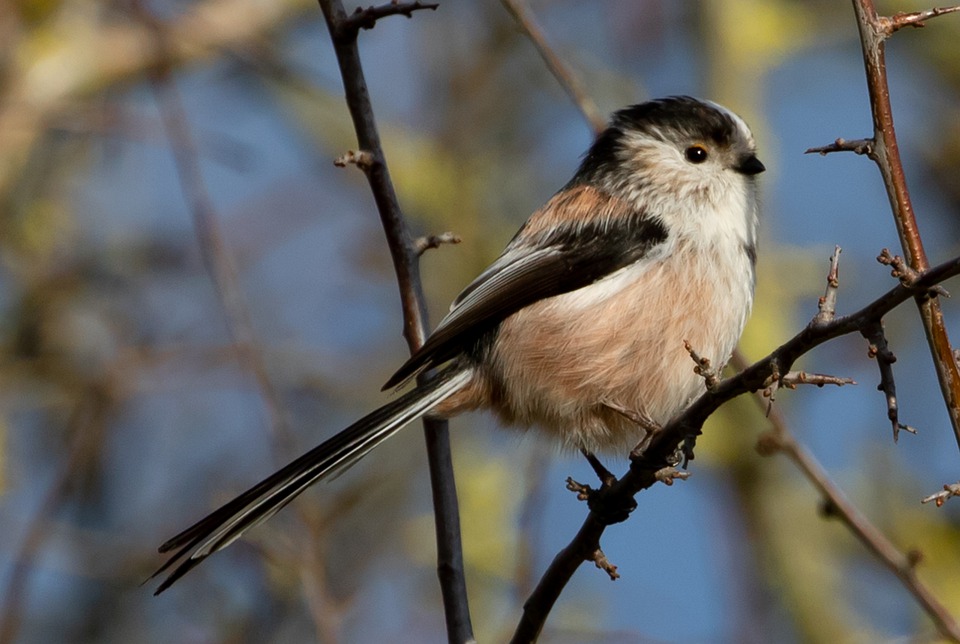
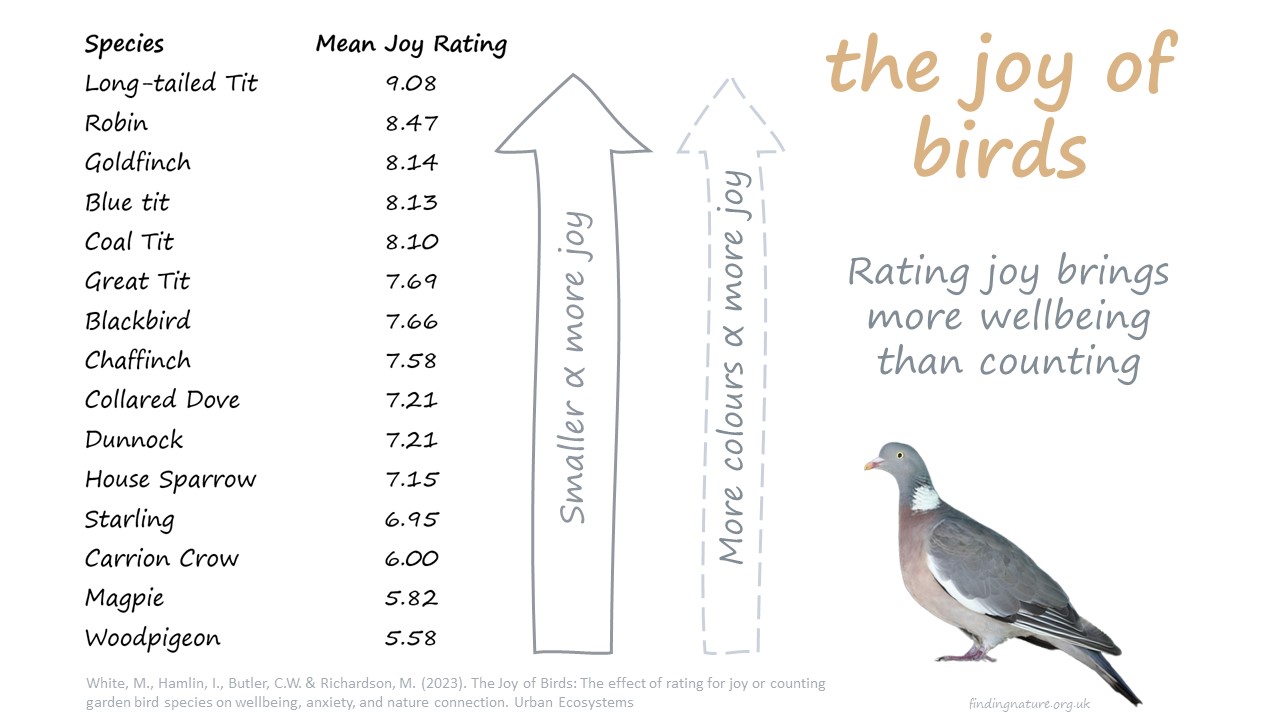
We also took the opportunity to explore which species brought the most joy. Long-tailed Tits came out on top, followed by Robins and Goldfinches. The lowest joy ratings were given to Woodpigeons, followed by Magpies and Carrion Crows. We expected woodpigeons and corvids to get the lowest ratings as they are disliked by many and there’s more on these cultural aspects in the full paper. There was a significant correlation between size and joy, with smaller birds bringing 50% more joy than the larger birds. There was a weaker, but still significant correlation between colourfulness and joy. Perhaps surprisingly there was no relationship between commonality and joy – although, as you’d expect, there was less data for uncommon visitors.
The Joy of Birds
Interestingly, while some birds brought more joy than others, that didn’t appear to impact on the benefits – it seems it is the act of noticing emotional responses itself which leads to the improvements in anxiety.
To sum up, the research offers evidence for the psychological benefits of watching birds, and suggests that taking part in citizen science projects like the Big Garden Birdwatch can bring about enhanced wellbeing and connection to nature. However, greater improvements in anxiety are gained by paying attention to the positive emotions experienced while watching birds.
In the context of Green Social Prescribing and Nature Prescriptions, ‘Joy Watching’ is a simple activity that anyone can do at home, or any outside space where birds are present. It could be adopted by school and community groups, or used alongside ‘bird therapy’ stations in workplaces. However, as recent research has suggested bird feeding could have a negative impact on some bird species, care would be needed in designing such schemes. However, as bird feeding increases the nature connection that brings pro-nature behaviours, there’s a need to consider the wider picture.
Our research has shown consistently that noticing nature is a critical first step towards connecting to nature for improved wellbeing. Noticing our emotional responses to nature takes us further towards building a new relationship with it. We know that those who feel close to nature are more likely to take action to help it, so appreciating the joy of birds could lead to more planting for birds and insects, better feeder hygiene, and more eco-aware behaviour. So, next time you fill up your feeders, pause, watch, and – most importantly – enjoy the birds who come to feed.
White, M., Hamlin, I., Butler, C.W. & Richardson, M. (2023). The Joy of Birds: The effect of rating for joy or counting garden bird species on wellbeing, anxiety, and nature connection. Urban Ecosystems. https://doi.org/10.1007/s11252-023-01334-y

Based on an earlier blog with Dr Carly Butler

 Finding Nature