A Solstice Farewell

An alternative seasonal tale

Each winter, as the low sun casts its pale light across the sodden landscape, a remarkable phenomenon occurs on the side of our house. The gate latch and picket fencing cast a shadow that transforms into Gatezilla—an 8-bit silhouette reminiscent of the legendary Godzilla.

Like its namesake, Gatezilla is a creature of nature’s rhythms. Its appearance is dictated by the Earth’s tilt, the orbit around the Sun, and the geometry of my garden gate. It is a fleeting spectacle, just a few minutes long—an alignment so special I liken it to an eclipse.

The wonder of this annual event inspired me to attempt to predict the exact times when Gatezilla will stride across the wall each winter’s day. I measured the exact orientation of the fence (216° from North) and the latch geometry: 1 meter high and 1.35 meters from the wall. Combining these figures with the latitude and longitude I was tempted to use the 8-bit technology of my 1984 Oric Atmos—still desperate for a purpose—to calculate Gatezilla’s full seasonal window from just a single day’s observations. But I just asked Grok.

It turns out that the shadowy creature first stirs for All Hallows’ Eve in late October (13:26–13:41 GMT), peaks through November (between 13:15–13:30), shifts earlier in December (early: 13:10–13:25), and finally succumbs to the inexorable march of the season around the Winter solstice. A secret in the sunlight decoded.

Opportunities to capture a photo of Gatezilla were running out. As the sun reaches its solstice low, the defining rays are scattered and obscured by twigs and holly leaves of taller trees. A situation that reminded me of James Reason’s Swiss Cheese Model of systems failure as I crouched camera ready in hand. The clouds on the breeze and ever-shifting holes between the twigs illustrated how momentary alignments create pathways to failure, or in my case success.

Now that the solstice has ended the spectacle I can spend the Winter thinking of next steps for 2026. A makeshift henge, perhaps? Constructed from an old garden trampoline frame to celebrate Gatezilla’s arrival next October by carefully aligning its uprights with the sun’s paths. Or an app, a local alert system, #GatezillaRises, notifying enthusiasts when conditions are optimal: low winter sun, clear skies, and the right hour of the day. Much like chasing the Northern Lights, I feel sure that witnessing Gatezilla will become a seasonal ritual, a celebration of geometry, astronomy, and the magic of nature.

Above all, Gatezilla reminds us to seek magic in the mundane, proof that even in the quiet geometry of winter shadows, nature finds ways to surprise.


Postscript

A tradition of the Dull Men’s Club Facebook group is for the photograph to include a banana for scale. So, there was another race against time. After many gloomy days, the sun appeared, but clouds hurried across the sky. Gatezilla’s fleeting glory versus my blunt scissors and a roll of gaffa tape. I hacked at the tape but had been woefully ill-prepared. The banana was placed in position alongside a watery shadow of Gatezilla which soon dissolved. The picture did not do Gatezilla justice.

The Swiss Cheese theory came to life the next day when I was sat at my desk and glimpsed the discarded banana climbing my leg. It had somehow become gaffa-taped to my calf while I was rummaging in the office. It gave me a real fright—and then a bout of laughter at the absurdity of the situation. A textbook example circumstances aligning to create unexpected events.

Posted in Uncategorized | Leave a comment

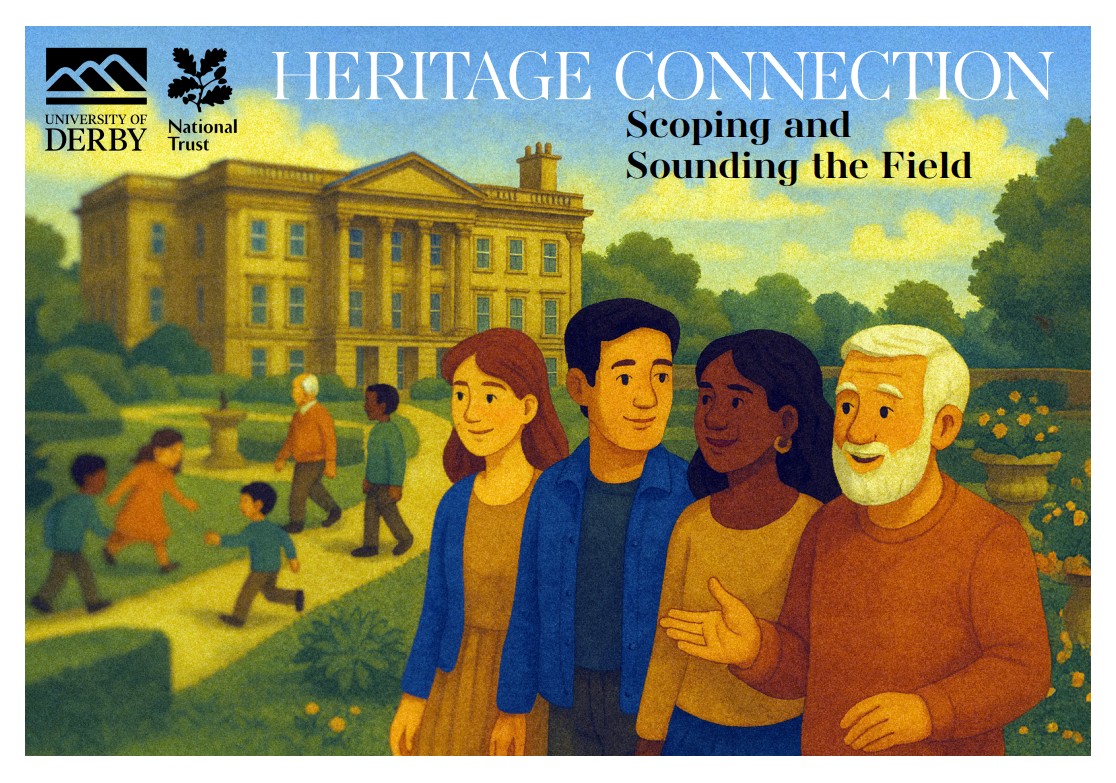
Heritage Connection: Scoping and Sounding the Field

Dr Carly Butler & Professor Miles Richardson  

Earlier this year, we introduced the idea of ‘heritage connection’ – an individual’s subjective sense of relationship with people, nature and place over time. With the support of University of Derby’s Vice-Chancellor’s Partnership Award, we’ve teamed up with the National Trust to dig deeper, asking: what is heritage connection is, why does it matter, and how can we help more people experience it?

Over the past year, we have been scoping the literature, listening to heritage professionals, and pilot-testing the first heritage connection intervention. We’re now excited to share a summary of this work in our latest report, Heritage Connection: Scoping and Sounding the Field. The report brings together key insights from published research, discussions with heritage professionals, and the results of our first heritage connection intervention. It also sets out an ambitious research agenda for advancing knowledge and supporting practice and policy.

Previous research has identified a link between heritage and wellbeing – living near or visiting heritage sites or taking part in heritage activities have been found to boost mood and bring meaning and purpose to people’s lives. As well as supporting individual wellbeing, heritage can bring people together, offering community cohesion and a sense of place.

But the power of heritage to make us feel good doesn’t come from historic buildings or ancient artefacts or landscapes themselves. Simply being in or near something historic isn’t what boosts our sense of wellbeing. Much like nature connection, it’s people’s psychological experience of a place that matters – how we think and feel about heritage is more important than physical contact with it. This is where heritage connection comes in. It’s a way to understand and measure our subjective relationship with the places, people, and things of the past.

Through roundtables and workshops with heritage professionals, we explored what heritage connection looks and feels like. It’s about personal, meaningful and emotional engagement with heritage that helps people situate themselves in relation to time, place and other people. It offers a deep sense of belonging and a feeling of being a part of something bigger.

While work in this area is just beginning, we already know that heritage connectedness (as measured by a simple scale) can predict wellbeing and is associated with a sense of pride in place. Heritage connection offers exciting possibilities for understanding why heritage matters and how it can benefit both people and places.

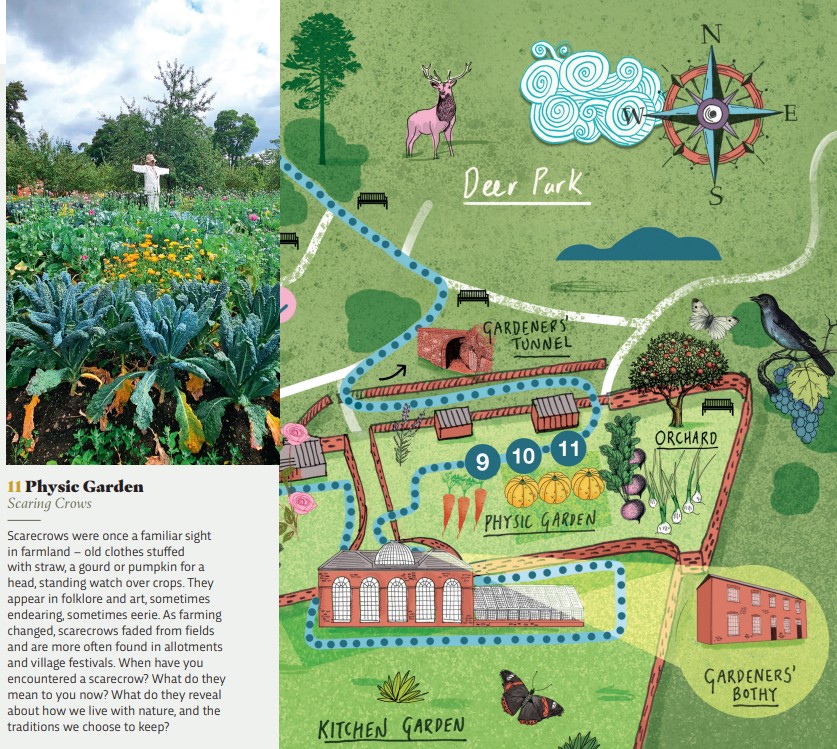
We wanted to find out if some simple activities could help people feel more connected to heritage. So, we designed a heritage connection trail in the grounds and walled gardens of the National Trust’s Calke Abbey. Visitors were given an illustrated booklet with map and prompts at 15 ‘pause points’. Each prompt invited them to notice, imagine and reflect on the heritage around them, and encouraged sensory, emotional, imaginary, and personally meaningful engagement. Participants completed a survey before and after the trail. We found a significant boost to heritage connectedness, as well as enhanced nature connectedness and happiness.

A heritage connection trail

In a focus group discussion, participants shared how personal and cultural backgrounds, like ancestry, class, ethnicity, nationality, and individual interests shaped opportunities to find connection with the heritage on the site. Important points were made about the hidden or unacknowledged heritage in many historic sites – which stories get told, and which ones don’t?

We are excited for the possibilities of this work. Our research agenda sets out ambitious next steps, developing understanding, frameworks and tools to strengthen heritage connection, embed it in policy and practice, and tackle barriers to inclusive engagement.

Relational approaches are essential for wellbeing and sustainability. We know about the importance of relationships with nature and other people – this work highlights the temporal dimension of connectedness. Heritage connection helps us see ourselves in relation to past people, places and events, creating a sense of continuity between past, present and future. That sense of connectedness offers meaning and purpose – linking us to bigger stories that shape who we are today and who we might become.

If you want to dive deeper, check out the report and share your reflections by commenting on this blog. We’d love to hear from you. What places or stories make you feel part of a bigger story?


Posted in Uncategorized | Leave a comment

Reconnecting People and Nature: Research Invitation

Nature connectedness is increasingly recognised globally as a strategy for transformative change. At the University of Derby’s Nature Connectedness Research Group, we’re exploring how professionals across sectors—from health and education to urban design and the arts—are helping people build deeper relationships with nature. Your insights can help shape policy and practice aligned with these global priorities.

Whether you’re designing green cities, creating nature-inspired art, improving wellbeing through outdoor experiences, or shaping policy for sustainable farming—your work is part of a growing ecosystem of change.

To take part click here by 30th January 2026 – full details below.

Our research aims to understand and highlight work that connects people with the rest of nature: current practices, barriers and opportunities, collaborations, and visions for a more deeply nature-connected society. We want to learn what’s already happening—and what’s possible—when we reconnect with the rest of nature.

Help us map the nature connection ecosystem. Share this invitation with colleagues and networks—the more voices we hear, the stronger the movement for transformative change.

Who can take part?
If you’re working on initiatives that help people build a closer relationship with the natural world, we’d love to hear from you. Whether you’re in policy, practice, research, or community action – your insights matter.

We would like to hear from anybody whose professional work involves connecting people with the rest of Nature, particularly where the emphasis is on enhancing people’s relationship with nature (i.e. more than just spending more time in Nature). You may work in policy, professional practice, or in applied research and impact. We are interested in hearing from those working in any sector (education, health, policy, conservation, urban design, farming, the arts, academia, community support and more), and at any scale, from individual to international.

What will participation involve?
If you choose to take part, you will be asked to complete an online survey. The survey includes a mix of ‘tick box’ and open-ended questions and should take approximately 15–20 minutes to complete. If you choose to write a lot in the open-ended questions, it may take longer but we do not expect it would take longer than 30 minutes. You will be asked about your organisation’s purpose and scale, current activities and impact, barriers and opportunities, sectoral collaboration, personal and cultural Nature connection, vision and inspiration

To take part click here by 30th January 2026.

We’d like as many responses as possible from far and wide, so please share this invitation widely with colleagues, networks, and partners. The more perspectives we gather, the better we can understand the full nature connection ecosystem and the amazing work happening across sectors.

Nature connectedness is not just a local challenge—it’s a global priority. By contributing your insights, you’ll help build a clearer picture of how we can reconnect people and nature for a healthier, fairer, and more sustainable world. Together, we can turn transformative change from a report into reality.


Posted in Uncategorized | Leave a comment

Tune Into Nature Music Prize 2026

The Tune into Nature Music Prize is back for 2026. With a first prize of £500, the prize aims to encourage submissions of original music from young musicians aged 18 to 30 that celebrate the human-nature relationship and showcase the inclusion of sounds of the natural world.

You can find out all you need to know about the prize, new partners, opportunities for winners and judges on the new website: https://www.tuneintonaturemusicprize.info/

Last year’s joint winners were 23-year-old Josephine Illingworth, whose track titled ‘Dawn’ was made from sounds collected from mountain huts across the Dolomites, while the lyrics were taken from entries in the guestbooks from visitors.

The second winning track, Nightingale by Wildforms, aka Dan Cippico, turned bird song into a drum and bass track. The winners were featured on BBC Radio and in The Guardian.

Nine other artists were shortlisted for the Prize, including a range of genres from Hip Hop, Rock and Pop to Jazz, Folk and Classical, showing the universal appeal and relevance of nature as a source of inspiration and connection. Here’s a playlist of their and the winners’ tracks.

The 2026 winner will have the option of their track being released on NATURE’s profile across major streaming platforms as part of the Sounds Right initiative, benefiting from significant promotion and marketing, and featured on a special playlist to raise funds for nature restoration and protection.

From Louis Armstrong to Louis VI, a Tune into Nature play list on Spotify provides inspiration, with lyrics and sounds that celebrate the natural world. The playlist also include previous winners Ceitidh Mac, Girl Next Door  and Caslean.

Alongside the University of Derby’s Nature Connectedness Research Group, the competition is backed by a collaboration of recognised environmental-loving organisations including Yorkshire Sculpture Park, Voice for Nature, EarthPercent and Sounds Right.


Posted in Uncategorized | Leave a comment

The Four Forces in the Western Nature Disconnect

In the face of climate change and biodiversity loss, IPBES has called for transformative change—a deep shift in how societies relate to nature. One of the most powerful levers for that change is nature connectedness: the extent to which people feel emotionally and cognitively part of the natural world. But what are the societal factors that shape our relationship with nature?

Our latest research, published in Ambio and reported in The Guardian, takes a unique global perspective to help answer that question. Based on an analysis of data from over 60 countries and nearly 57,000 people (an impressive feat by the BINS survey team) it reveals that many nations are falling short. Nature connectedness isn’t just low in a few places; it’s systematically lower in wealthier, more urbanised, and business-oriented societies. And that matters, because nature connectedness is linked to our wellbeing, pro-environmental behaviour, and ultimately, the health of our planet.

To understand why this disconnect exists, we examined a wide range of macro-level factors—both tangible objective indicators (like urbanisation, biodiversity, and ease of doing business) and cultural subjective values (like spirituality, attitudes toward science, and views on societal change). The analysis combined statistical modelling, network analysis, and theoretical interpretation to identify which societal conditions and shared values are most strongly associated with nature connectedness. The results offer a compelling picture of how modern life shapes our relationship with nature—and where we might intervene to restore it.

What Shapes Our Relationship with Nature?

The findings show that urbanisation and ease of doing business are the strongest negative predictors of nature connectedness. These factors reflect a societal orientation toward efficiency, growth, and infrastructure—often at the expense of nature contact and biodiversity.

On the other hand, spirituality and a belief that society relies too heavily on science over faith emerged as the strongest positive predictors. These values suggest that nature connectedness flourishes where people seek deeper meaning and maintain a sense of reverence or emotional resonance with the natural world.

Interestingly, environmental organisation membership had little impact. This points to a deeper issue: nature connectedness is not just about what we do, but how we feel, think, and value our place in the living world.

A Global Pattern: The Disconnect of the Developed World

The rankings below tell a clear story. Countries like Nepal, Iran, and South Africa top the list for nature connectedness. Meanwhile, many affluent nations—including Germany, Canada, Japan, and the UK—sit near the bottom. The UK ranks 55th out of 61.

 The UK in Context: A Case Study in Disconnection

Within this global picture, the UK offers a stark example. Despite a rich tradition of nature writing and a strong conservation sector, the UK ranks near the bottom for nature connectedness. Why?

  • High urbanisation means many people live with limited access to wild spaces.
  • Ease of doing business reflects a system geared toward economic efficiency, not ecological balance.
  • Cultural values tend to favour science and rationality over spirituality and meaning.

This doesn’t mean the UK lacks environmental concern. But it suggests that concern alone isn’t enough. To foster a deeper relationship with nature, we need to shift the cultural narrative—from control and consumption to connection and care.

Nature Connection Rankings

1 Nepal 21 Egypt 41 UAE
2 Iran 22 Slovenia 42 Italy
3 South Africa 23 Estonia 43 Poland
4 Bangladesh 24 Ecuador 44 Australia
5 Nigeria 25 Greece 45 USA
6 Chile 26 Lithuania 46 Lebanon
7 Croatia 27 Bahrain 47 Iceland (English)
8 Ghana 28 India 48 Ukraine
9 Bulgaria 29 Slovakia 49 Norway
10 Tunisia 30 Indonesia 50 Switzerland
11 Brazil 31 Cyprus 51 South Korea
12 Argentina 32 Hungary 52 Russia
13 Latvia 33 Kazakhstan 53 Ireland
14 Serbia 34 China 54 Saudi Arabia
15 Philippines 35 Thailand 55 United Kingdom
16 Colombia 36 Czechia 56 Netherlands
17 France 37 Portugal 57 Canada (English)
18 Malaysia 38 Romania 58 Germany
19 Malta 39 Austria 59 Israel
20 Turkey 40 Pakistan 60 Japan
61 Spain

This isn’t just about geography or climate. It’s about culture, values, and systems. The global north tends to prioritise economic growth, technological advancement, and urban living—factors that, while hugely beneficial in many ways, appear to erode our relationship with nature.

So, what can we do about it?

Introducing the ‘X’ Model: Four Forces to Target for Change

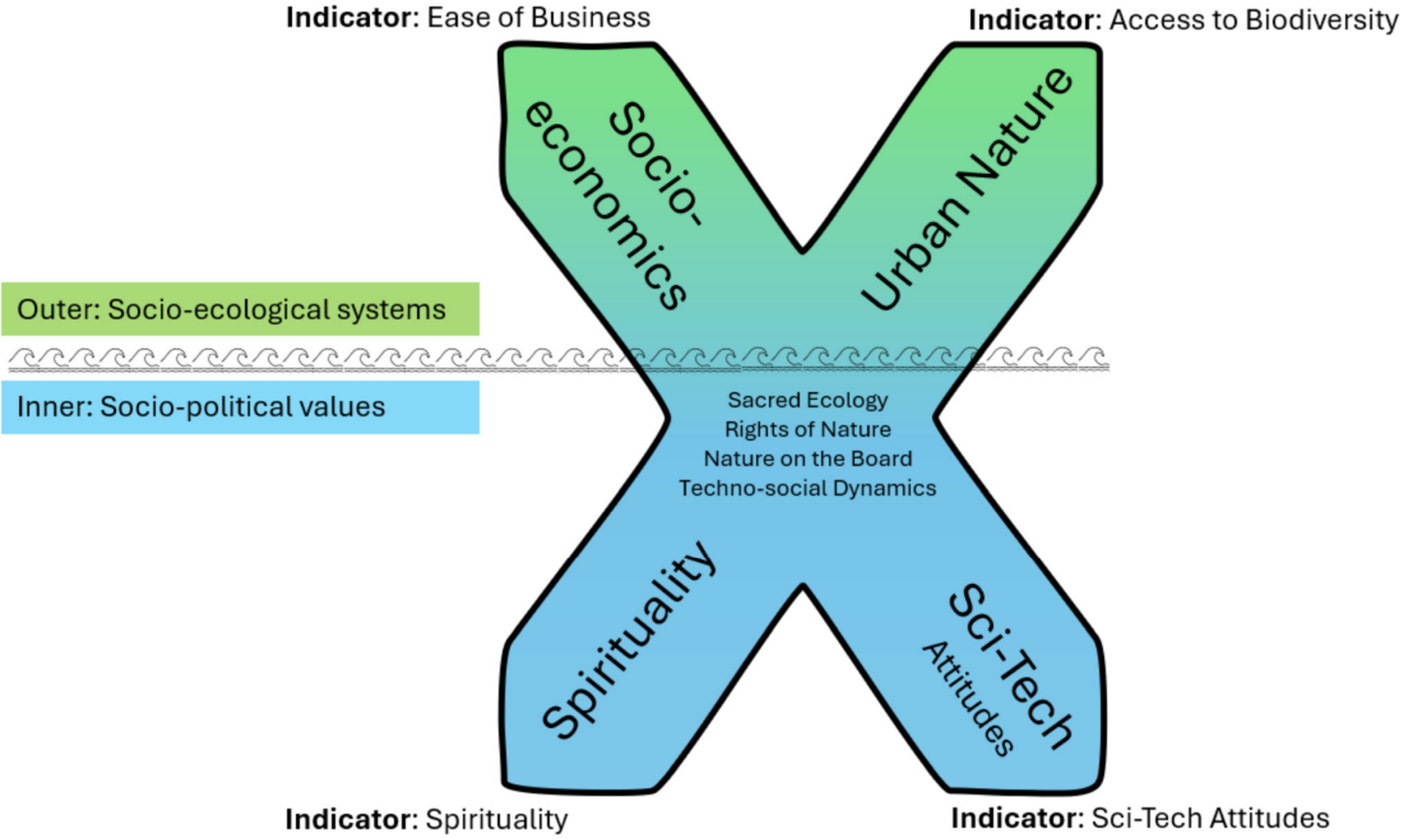
To help make sense of these findings, I developed a new conceptual framework—shaped like an ‘X’—to represent the key macro-level influences on nature connectedness. Each point of the X reflects a distinct force:

  1. Urban Nature: The impact of urbanisation and access to biodiversity. Cities often reduce direct contact with nature, but thoughtful design can restore it.
  2. Socio-economics: The influence of business systems, economic structures, and societal priorities. Ease of doing business was the strongest negative correlate—suggesting that pro-business regulations may come at the cost of ecological balance.
  3. Spirituality: The human search for meaning and connection beyond the material world. Countries with higher spiritual values tend to have stronger nature connectedness.
  4. Sci-tech Attitudes: The cultural balance between science and faith. A society that leans too heavily on technical solutions may overlook the emotional and existential dimensions of our relationship with nature.
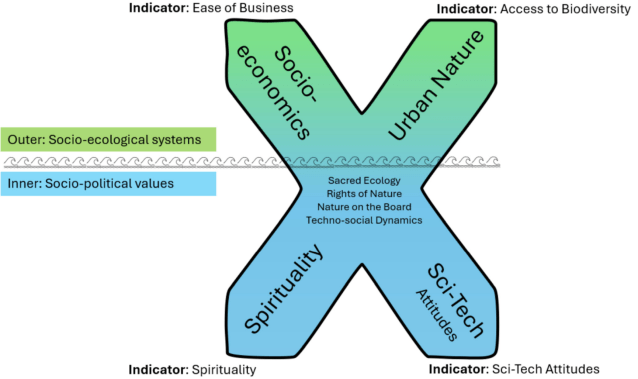
The ‘X’ Model: Four Dimensions of Nature Connection

These forces interact in complex ways. The top half of the X—Urban Nature and Socio-economics—represents the outer world of infrastructure and policy. The bottom half—Spirituality and Sci-tech Attitudes—represents the inner world of values and beliefs.

Beyond the X: Towards Integration and Meaning

 Tangible Systems, Intangible Needs

The ‘X’ Model highlights four macro forces shaping our relationship with nature—but the real challenge lies in how we integrate them. Urban Nature and Socio-economics reflect the tangible systems we build. Yet these systems often lack space for the intangible: spirituality, reverence, and meaning.

Sacred Urban Nature

Urban design must move beyond access to nature and toward nature-based neighbourhoods that bring engagement and meaning. This raises a deeper question: can urban nature be sacred? We respect cemeteries as places of rest, yet rarely extend that reverence to the places where nature lives. Initiatives like the Rights of Nature, which grant legal personhood to ecosystems, offer one way to bridge this divide—embedding spiritual and ethical value into the very fabric of urban planning.

Nature in Economic Systems

This also invites a rethinking of business and economics. If ease of doing business is a key factor in disconnection, then models that integrate nature into decision-making—such as biodiversity net gain or nature representation on company boards—can help shift the system. These approaches begin to treat nature not as a resource, but as a stakeholder.

Techno-Spiritual Futures

Sci-tech Attitudes and Spirituality pose a different challenge. As science and technology become ever more embedded in our socio-economic and urban systems, they increasingly shape how we live, think, and relate. But will they become a powerful source of meaning far removed from the natural world? How might spirituality evolve in a world of artificial intelligence and synthetic biology?

Reimagining Science and Spirit

This is not about choosing between science and spirit, but about reimagining their relationship. A techno-spiritual synthesis could help societies reconnect with nature—not by retreating from progress, but by infusing it with purpose. Concepts like sacred ecology, embodied design, and relational technologies may offer pathways forward—where innovation is guided not just by efficiency, but by empathy and reverence.

Rethinking Metrics and Meaning

The study also found that Sustainable Development Goal (SDG) scores are negatively correlated with nature connectedness. That’s a problem. If our sustainability metrics are anthropocentric and don’t reflect a relationship with nature, they are missing a crucial point.

A Framework for Thinking Differently

The ‘X’ Model offers a starting point. It’s not a final answer, but a framework for thinking differently.


Richardson, M., Lengieza, M., White, M. P., Tran, U. S., Voracek, M., Stieger, S., & Swami, V. (2025). Macro-level determinants of Nature Connectedness: An exploratory analysis of 61 countries. Ambio.


Posted in Uncategorized | Leave a comment