
To tackle the environmental crises we need a new relationship with the rest of nature. To do science, and for simple messaging, we often isolate the factors that are important for a new relationship with nature. Yet, in reality these factors form a network and do not work in isolation. Life and relationships are complex. In our latest research, published in the Journal of Environmental Psychology, we aimed to capture there interrelations by treating nature connectedness experiences as a network using principles adapted from social network analysis. The results showed the approach works well, confirming previous research using other approaches, but suggesting novel insights too.

The details of network analysis and how it was done are in the full paper, but very briefly it involved asking a couple of hundred people to complete a card sorting task about their nature connection experiences, moving network factor cards to show which were present or not. One study looked at the emotions that may or may not be part of nature connection experiences, such as joy, fear or love. The second study considered the activities that may or may not be part of nature connection experiences, such as watching nature or learning about nature.
The Emotion Network
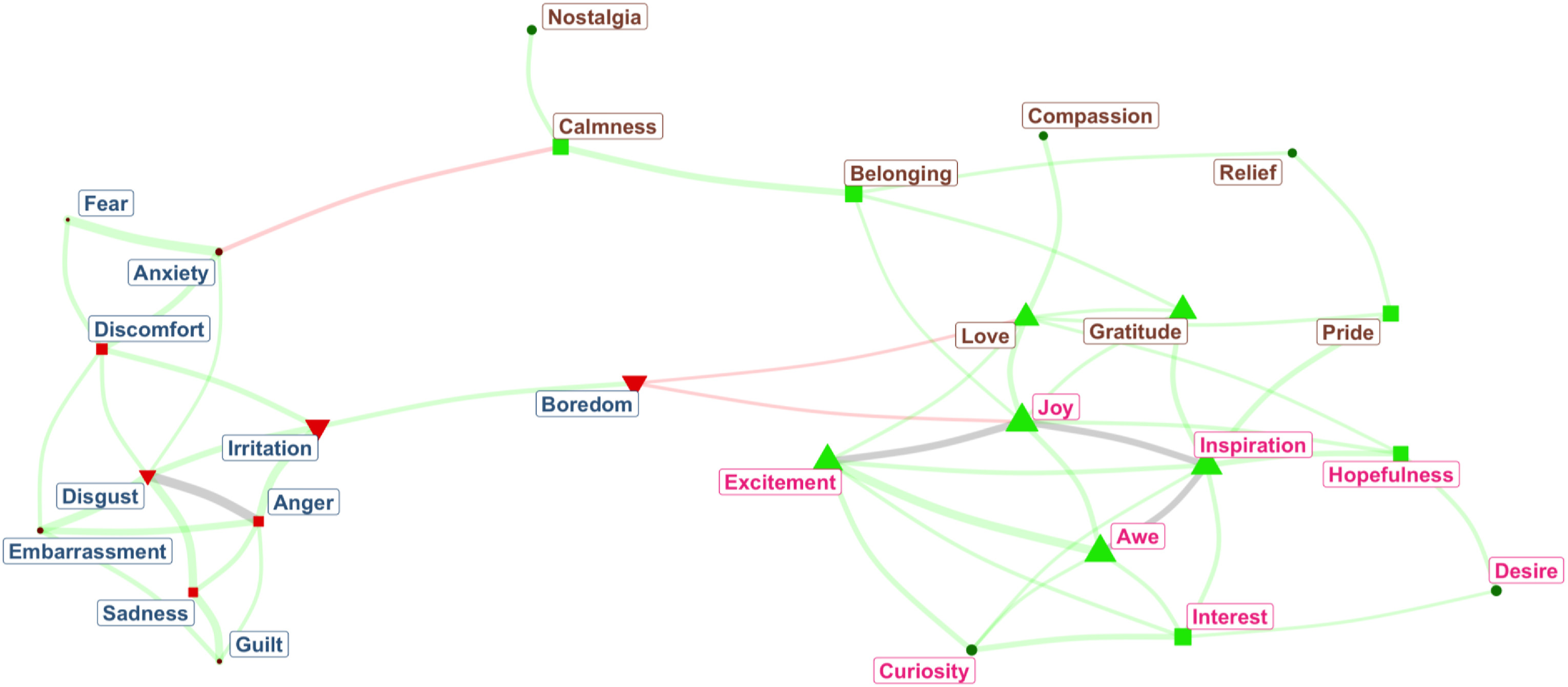 All emotions, especially the positive ones, seemed to have at least some degree of influence on nature connectedness. Let’s look at negative influence first. The most noteworthy (i.e., the biggest and reddest nodes) were boredom, irritation, and disgust. These negative emotions were highly and distinctly absent from peoples’ nature-connection experiences.
The most noteworthy positively influential emotions (i.e., the biggest and greenest nodes) were awe, joy, inspiration, excitement, love, and gratitude. These positive emotions were highly and distinctly present in peoples’ nature-connection experiences. Some of this is known or suggested from previous research using other methods, thereby showing the network approach works well.
The network analysis did though produce some more novel insights. First, eco-anxiety may not be an obstacle to nature connection, see this recent blog for more on this relationship. Second, boredom, which may serve as a barrier to positive experiences, but has surprisingly received little attention. Third, the role of nostalgia and curiosity. Curiosity is a desire to know more, it turns knowledge, which does little on its own to increase nature connection, into an emotion.
Nostalgia is an emotion found across cultures that makes life more meaningful and provides a bridge between the past and present. Like nature connection, nostalgia is a positive emotion and helps us feel part of something beyond the here and now. Many nature connectedness interventions focus on mindfulness and being ‘in the moment’. There is far less work that considers time and looking back. Such ‘beyond the moment’ narratives and traditions—such as those more that feature more prominently in the more harmonious Indigenous relationships with nature—are likely to have a role in negating emotions such as disgust and boredom and generating positive emotions, together with interest, curiosity, and hope from reflecting on the bigger picture. At the very least, the evident role of nostalgia here may give reason to broaden our scope beyond in-the-moment and mindfulness-based interventions to consider narrative and remembering-the-past based interventions (see this recent blog for more).
Further, the network also shows ‘centrality’. The three most positively central emotions were inspiration, love, and excitement. So, when inspiration, love, and excitement are present, many other positively influential emotions are likely to be present, and few negatively influential emotions are likely to be present (see this recent blog for more on love).
Finally, three distinct clusters emerged in the network; drive, contentment and threat. These clusters mapped strongly onto my accounts of how nature helps play a role in affect regulation and well-being. The fact the emotions in nature connectedness experiences clustered in a way that mirrors this model of emotion regulation, suggests a novel point of convergence between nature-connectedness, emotion regulation in nature, and physiological responses to nature, helping, for example, to explain how nature connectedness brings wellbeing.
The Activity Network
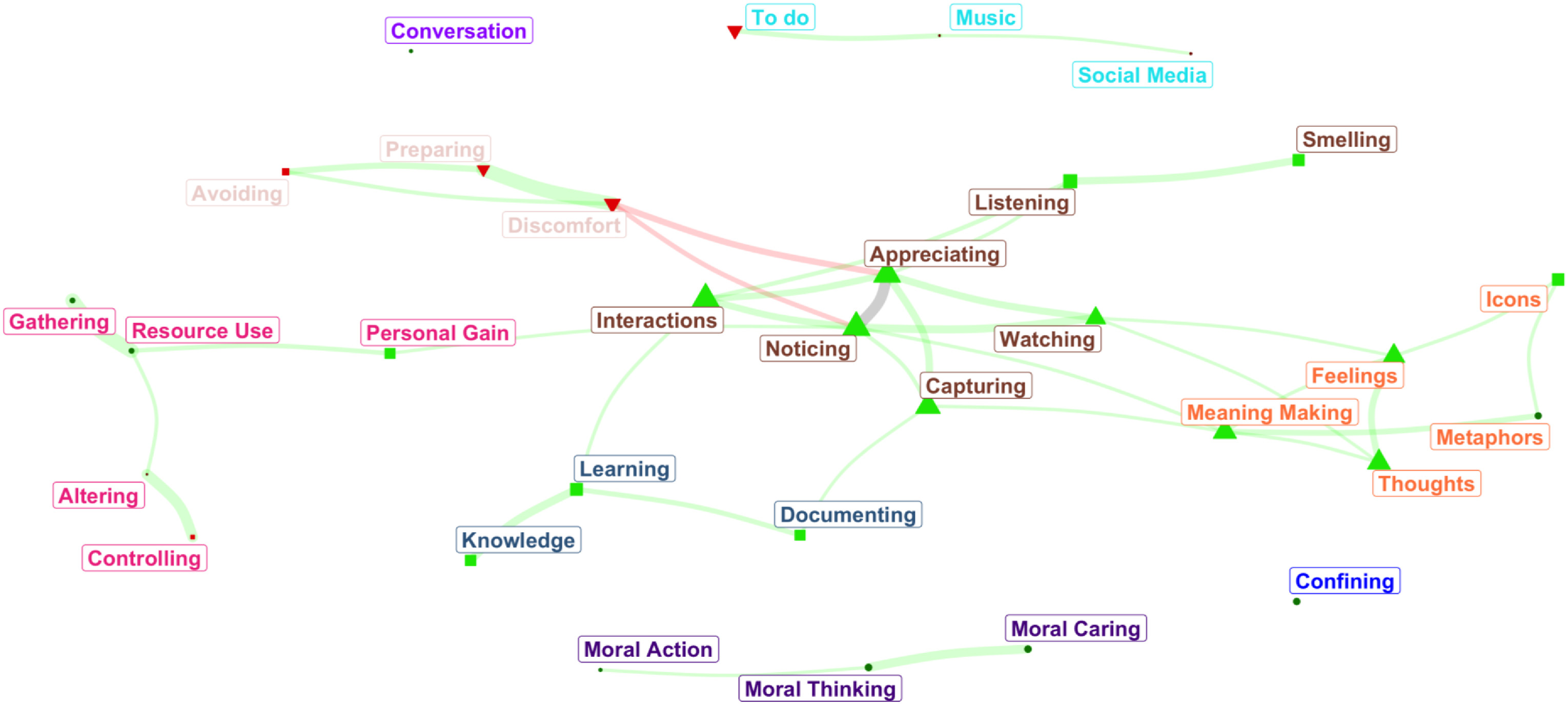
The good news here was that the pathways to nature connection came through strongly as being highly and uniquely present in people’s nature connection experiences. So they were confirmed by a completely different method, but the network analysis showed how they may work together. It also confirmed that scientific engagement is not an important pathway, but can be a stepping stone. Our pathways suggestion has always been to make the science emotional or meaningful.
Interestingly, basic engagement with nature was necessary, but not sufficient, it needs to be meaningful. This returns us to a common theme, there’s a need to move beyond access as nature connection is about moments not minutes.
In terms of barriers, discomfort and distraction (e.g. thinking about things to do or listening to music) came through as barriers to nature connection, which tie into irritation and boredom from the first study. The separate roles of stewardship and social engagement were further novel insights that need to be explored further.
So, some key take aways:
- The key role of emotions in the human–nature relationship, but they feature little in policy.
- The need to move beyond access to meaningful and deliberate engagement.
- The importance of inspiration and love.
- The role of nostalgia and ‘beyond the moment’ narratives and traditions.
- Disgust, boredom, and irritation seem to get in the way of nature connectedness.
- The pathways to nature connection were confirmed.
To summarise, the research demonstrated the utility of the situation network approach. Its validity was supported by its ability to corroborate existing research findings, such as the importance of key positive emotions (e.g., awe and joy) and key pathways to nature connectedness (e.g., meaning and beauty). Further, the generativity of the approach, even within a well-established body of literature, was supported by its ability to identify novel findings. That’s useful for further research, but for application, this approach has highlighted the need for policy to recognise interrelationships and move beyond limited notions of access to include active and meaningful engagement with nature, through targeting key emotions such as inspiration from or love for nature and combating irritation and boredom.
Lengieza, M.L., Richardson, M. & Aviste, M (2024). Situation Networks: The emotions and activities that are central to nature-connectedness experiences, Journal of Environmental Psychology.

 Finding Nature