
Understanding how our relationship with nature has changed over time helps identify the forces that have shaped the long‑term decline, and where recovery might come from. Using nature‑related word use in books as a proxy for the human–nature relationship over the past two centuries, my latest research paper, published in Sustainability Science, explores that long-term decline using a simple machine learning approach.
This new study explores whether wider socio‑economic and cultural factors, represented through their own word‑use trends, can predict the long‑term changes in the human–nature relationship. In short: can non‑nature words explain the fall in nature words?
Tracing the human–nature relationship through language
The human–nature relationship proxy comes from the frequency of use of 28 experiential nature words such as river, blossom, mosses and meadow. The set spans sensory modalities (e.g., bark, stream), experiential places (e.g. mountain, meadow, coast), living elements (e.g. birds) and archetypal aspects (e.g. river). The words evoke lived and sensory experiences in nature and tap into deep symbolic or cultural meanings of the type related to closer relationships with nature.
These words reflect what people noticed, valued, and wrote about. And when their use is plotted over time, a clear decline of around 60% is revealed. Particularly from 1850, a time when industrialisation and urbanisation grew rapidly.
The new model pairs this nature‑word trend with seven macro‑factors, each represented by their own cluster of words:
- Natural disasters
- Science and technology
- Religiosity
- Industrialisation
- Humanism
- Urbanisation
- Economic development
These wider clusters capture structural and cultural shifts known to influence people’s relationship with nature.
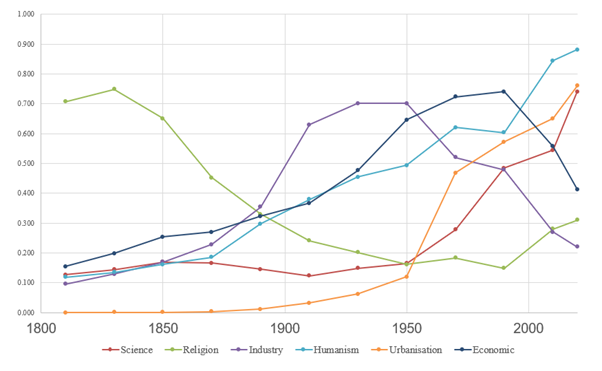
Word use trends since 1800
Testing whether macro‑factors predict nature‑related word use
So through varying the weight attached to each macro-factor trend, can the seven trends shown in the chart above be combined to form the nature words trend?
The study tested over 48 million combinations of factor weights using a machine learning approach before refining the best solution using an approach called gradient descent. The resulting model fits the observed HNR trend closely, see chart below, explaining around 98.6% of the variance. Trends in non‑nature words can explain the fall in nature words!
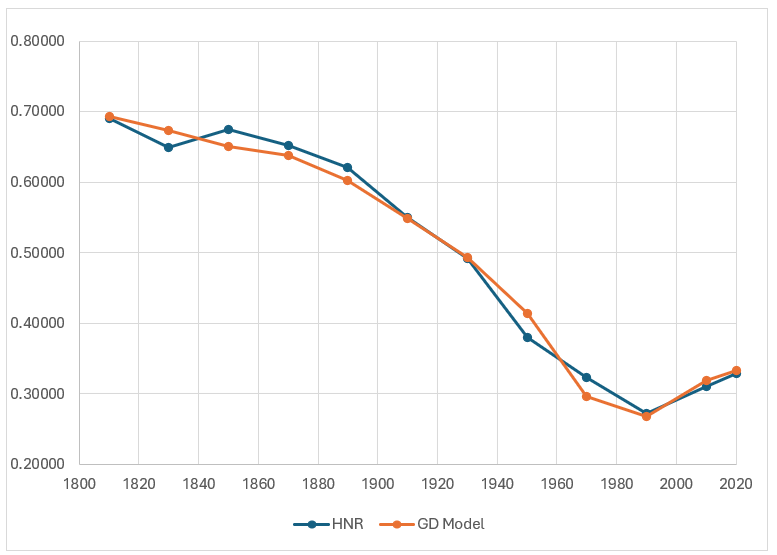
Nature word trend versus trend constructed from non-nature words
Looking at the weights attached to the non-nature words that are needed to explain the use of nature words, three points stand out:
1. Urbanisation and economic development are the dominant influences.
This aligns with the shift to urban living and increased consumerism.
2. Industrialisation mattered earlier but less so now.
Its influence peaked in the early 20th century, reflecting its key role in the initial decline.
3. Humanism shows a steady and growing influence.
Although assigned a lower weight, its consistent rise, particularly since 1990, suggests an increasing cultural focus on human‑centred values, potentially at the expense of meaning derived from the wider natural world.
Science, natural disasters and religiosity show comparatively modest contributions in the model, despite large changes in their own trajectories.
Overall, the weightings align well with historical intuition: large‑scale structural shifts, especially urbanisation and the economy, map closely onto the long-term decline in the cultural presence of nature.
Looking forward: on‑trend futures and possible recovery
The model’s fit over time allowed two simple scenarios to 2050 to be tested.
On‑trend scenario showed that if current patterns continue, the recent uptick in nature‑word use is unlikely to continue. Increasing urbanisation and continued rise in human‑centred values may push the HNR downwards again.
The recovery scenario suggested that if urbanisation is softened through approaches such as biophilic city design, and if humanistic values broaden towards an “all beings” viewpoint, as seen in the rights of nature and One Health movements, the model suggests a recovery to levels last seen around the mid‑20th century.
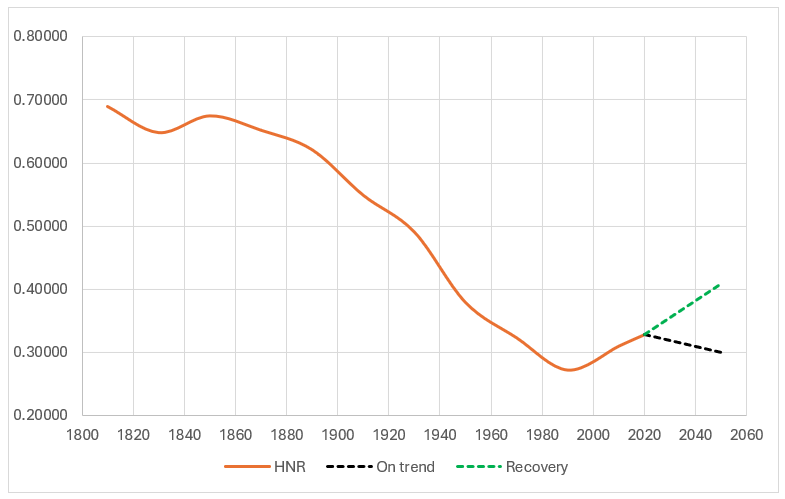
Where is the human-nature relationship heading?
These are not forecasts, but illustrations of how socio‑cultural shifts could influence the future HNR.
Three independent approaches, one pattern
This work now sits alongside earlier approaches:
- the agent‑based model simulating the decline in HNR from 1800 to 2020, and
- the raw nature‑word trend itself.
All three show a remarkably similar pattern: a strong decline beginning around 1850, a long trough, and a modest recent rise. Convergence across methods increases confidence in the underlying trend.
Conclusions
The results show that the frequency of use of non‑nature words can indeed explain nature‑related word use. Language about industry, cities, economics and human‑centred values explains the long‑term weakening of the human–nature relationship. Of these, urbanisation and economic development have the strongest influence. The findings reinforce the importance of structural and cultural drivers, not just individual behaviour, in shaping connection with nature. They also highlight pathways for recovery: greener urban living, and worldviews that place humans within, rather than apart from, the wider community of life.
Richardson, M. (2026). The human–nature relationship across two centuries: Macro factor insights from a machine learning model. Sustainability Science. https://doi.org/10.1007/s11625-026-01807-x

 Finding Nature