
Nature Connection has kept me really busy over recent months, the growing interest is great, but I’m understanding the restorative effects of nature more and more! So far in 2016 i’ve written, and had accepted, five research papers and the Nature Connections 2016 conference took place last month – see the story here. Next up is one project that’s going to keep me (and several others) busy for the next 3 years. IWUN: Improving Wellbeing through Urban Nature has been awarded £1.3 million from the Natural Environment Research Council – part of the human health and wellbeing goal of the Valuing Nature programme. Although we know that spending time in with nature is good for people, the project will investigate the dose and which particular features of green space boost people’s health and personal enjoyment.
The Nature of Smartphones Users
Technology is often cited as a reason for our disconnection from the natural world, but there’s not a great deal of research in this area. Recently smartphone technology has become common and a colleague (Dr Zaheer Hussain) and I have just completed a study looking at phone use and connection with nature.

Posted in Uncategorized
3 Comments
30 Days Wild: How Connection to Nature Brings Happiness and Health
Last year we evaluated the impact of 30 Days Wild for The Wildlife Trusts. The results were excellent and the resulting journal paper has just been published – so you can read the full 5000 words here. This blog is a short summary, but focussing on an exciting aspect of the results which is only a small part of the article.
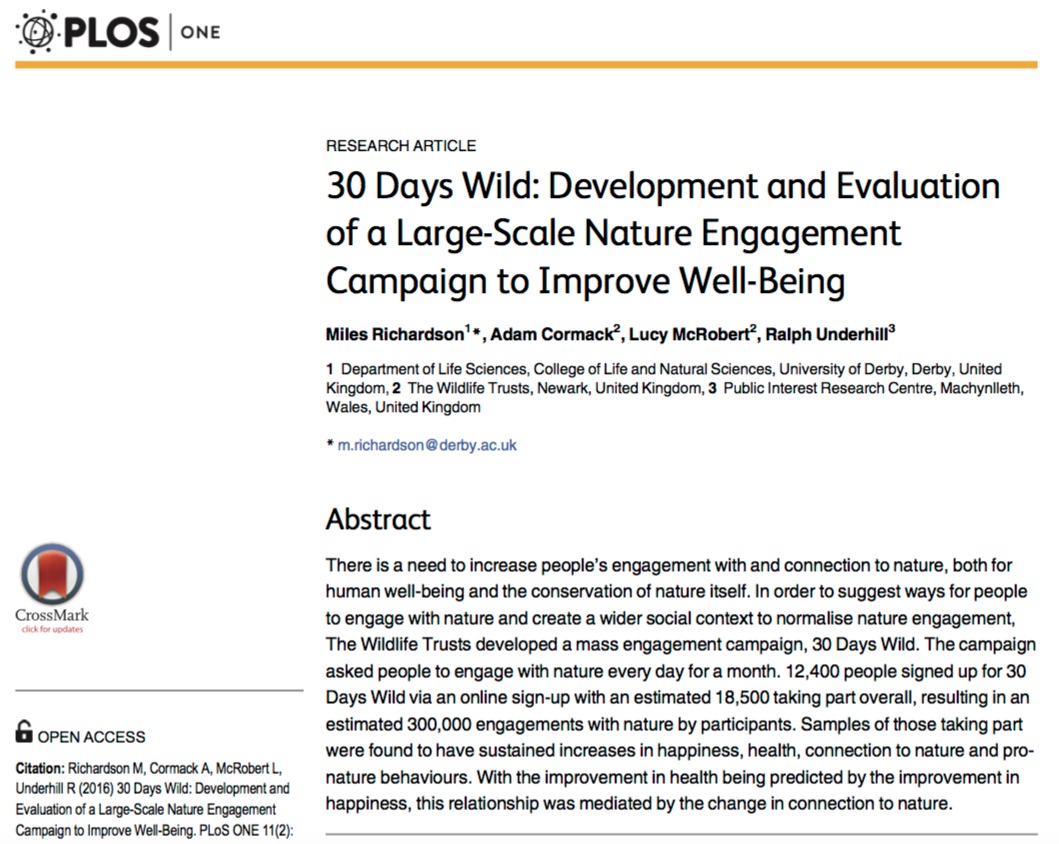
Evaluation of 30 Days Wild Published in PLOS: ONE
Posted in Uncategorized
8 Comments
Nature: A New Paradigm for Workplace Wellbeing
This blog introduces key points from our 6500+ word review paper. The paper summarises the benefits of nature for health, wellbeing and restoration and argues that there should be action to bring nature into the workplace to address major challenges such as work related stress and ill-health. At present, workplace health programmes don’t tend to consider nature as a solution despite the health benefits of nature being known for many years. This mirrors, and is perhaps driven by, the wider societal dissociation from nature. In addition to simple exposure to nature, there is also evidence that a connection to nature is good for well-being and has a positive impact on valuable workplace factors such as vitality, creativity, happiness, pro-social behaviour and pro-environmental behaviour. The paper also reviews and summarises those benefits. I tried to capture it all in the figure below.
Posted in Uncategorized
5 Comments
Better Well-being and Education Results when Connected to Nature
Connecting with nature should be part of every child’s life as it has the potential to aid nature’s revival while benefiting the child. However, to embed nature connection within our social norms, there is a need to understand the benefits a connection with nature can bring. In order to supply evidence to support greater integration of nature into children’s lives, we were commissioned by the RSPB, through funding from Calouste Gulbenkian Foundation, to look at the links between connection with nature, education, well-being and pro-nature behaviours.

The Impact of Children’s Connection to Nature
Posted in Uncategorized
3 Comments
 Finding Nature