Tune Into Nature Music Prize Winners

The Tune into Nature Music Prize aims to celebrate nature and we’ve been listening to entries since early January. The winners have now been announced and they and shortlist the have been featured on BBC Radio and in The Guardian. You can listen to the show on catch-up or try the playlist.

We regularly hear about the climate and biodiversity crises, but fostering hope and forging a new bond with nature is part of the solution. The entrants of the Tune into Nature Music Prize exemplify this, offering music that not only celebrates but also inspires hope through our connection with the natural world.

The competition welcomed entries from musicians and singer/songwriters aged 18-30 whose original work demonstrates a true collaboration with nature including sounds of the natural world. Two entrants, of very different styles, wowed the judges so much that they awarded the prize jointly.

Two entrants, of very different styles, wowed the judges so much that they awarded the prize jointly.

The first winning track, Dawn by Josephine Illingworth, 23, offered total engagement in the sound world of the mountain.

Josephine said “Dawn, Aurora is a piece made from sounds I collected over several weeks of sleeping alone in mountain huts across the Dolomites. Its lyrics are taken from entries left in the guestbooks of these huts by past visitors. It is a tapestry of the memories and experiences taking place across the mountains, and a call for us to see life and movement in things we may think are silent. I am so honoured to be chosen for the Tune Into Nature prize, and I hope that you can listen to the song, and that perhaps it touches you in some way”

The second winning track, Nightingale by Wildforms, aka Dan Cippico, turned mesmeric bird song into a brilliant drum n bass track.

Dan said “I’m excited that the interplay of nature and music is being celebrated by a prize such as this, and I’m so grateful for the opportunity it’s provided for my music – especially to be heard by such an established panel. My track is based upon a Nightingale that I recorded singing in the UK last Spring. It was my first time hearing the bird, and I was instantly inspired by its song, which to me, evoked the Jungle and Drum & Bass music genres that were a major influence on my musical upbringing.”

 Nine other artists were shortlisted for the Prize, including a range of genres from Hip Hop, Rock and Pop to Jazz, Folk and Classical, showing the universal appeal and relevance of nature as a source of inspiration and connection. Here’s a playlist of their and the winners’ tracks.

The BBC has supported the shortlisting and judging process with expertise from their music teams and presenters.  The final tracks were previewed across BBC Radio networks, including Radio 1, 6 Music and Radio 3, which has devoted a special edition of Unclassified to featuring the winners and shortlisted artists, with further airplay planned on Radio 2 and BBC Introducing shows.

Elizabeth Alker, presenter of Radio 3’s new music show Unclassified, said: “Unclassified is a show for artists who work across genres so I’ve really enjoyed being a judge for this prize which welcomes acts from a range of different disciplines. The future of the planet affects us all and it’s been a privilege to hear talented young composers make work which celebrates and advocates for the natural world. Our special ‘Tune Into Nature’ episode of Unclassified is a showcase of all the shortlisted acts and each one deserves to be heard on BBC Radio 3”.

Alongside backing from the University of Derby’s Nature Connectedness Research Group, the competition is backed by a collaboration of recognised environmental-loving organisations including Yorkshire Sculpture Park, The Conservation Foundation, EarthPercent and Sounds Right.


Posted in Uncategorized | Leave a comment

From Access to Celebration: Building Our Bond with Nature

As part of the ‘Connected Treescapes‘ project we’ve been exploring the benefits of trees, their governance and how people value them. All to inform the design of future treescapes. The detailed research papers that focus on how trees support wellbeing and pro-environmental behaviour are a little way off, but meanwhile we’ve summarised some of the essential findings in the graphic below.

You can see there’s a circle of connection…

  • Access
  • Engage
  • Celebrate

…with each informing the next. Access brings opportunity to engage and build the deeper connection needed to get the maximum benefits for wellbeing and pro-nature behaviours. Sharing the stories leads to Celebration for yet deeper connection, but also to inspire others to Access and Engage.

There are some tips at each stage for getting the most benefits, on governance and for fostering the values and beliefs that bring a sense of place and community.

Design for inclusive access

Create accessible habitats for connection through creative design of trails and sit spots, spaces to get away, and spaces to be with others. Grow trees in and near where people live. Partner with community organisations to create opportunities for everyone to visit, notice, and enjoy nature.

Offer opportunities for engagement that nurture care and connection

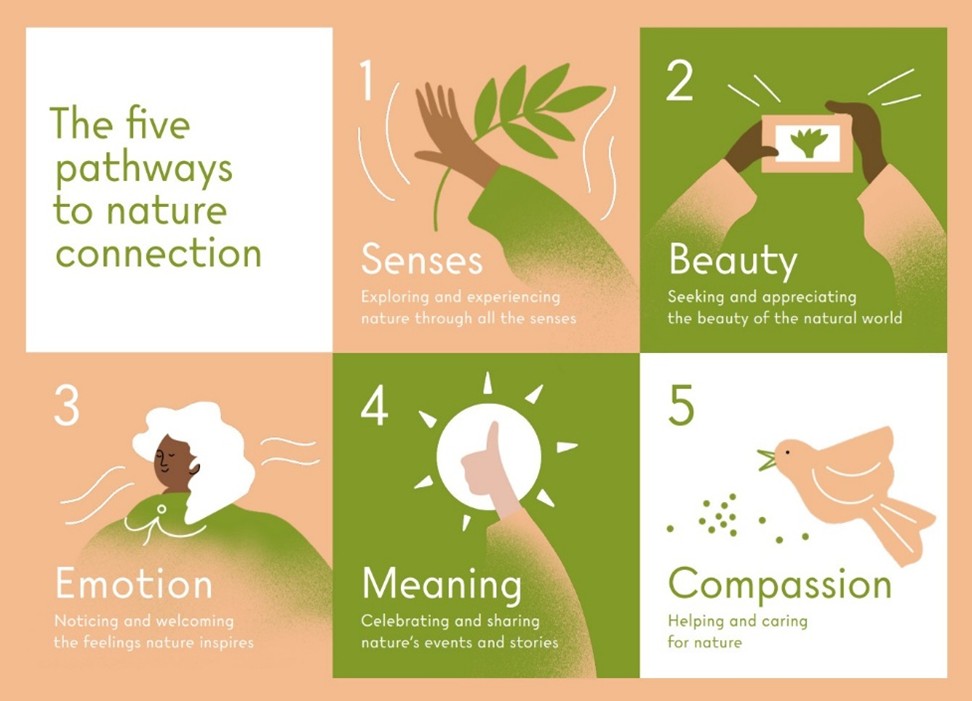
Creative use of the pathways to nature connection to prompt rich sensory and emotional engagement with the beauty and wonder of nature. Explore personal, and cultural meanings of nature in past, present and future. Foster compassion through conservation and citizen science activities.

Celebrate stories, cycles, and connections

Share stories of community access and engagement and celebrate the growth and change of people’s relationships with nature. Events, communications, art and conservation successes can inspire others to access and engage.

In conclusion, the ‘Connected Treescapes’ project underscores the vital role trees play in our lives, not just as environmental assets but as integral components of our wellbeing and community identity. By focusing on access, engagement, and celebration, we create a virtuous cycle that not only enhances personal connections to nature but also fosters a collective commitment to environmental stewardship. Together, through thoughtful governance and community involvement, we can nurture a deeper appreciation and active participation in the life cycles and stories of our trees, building a greener, more connected future.


Thank you to Katapult for doing an excellent job of turning my concept sketch into reality.

Posted in Uncategorized | 1 Comment

Growing community nature connectedness: A new handbook for growing human-nature community relationships.

By Dr Carly Butler

Following our previous handbooks, which offer an introduction to connecting people with nature, and helping organisations connect with nature, we are delighted to launch our newest handbook – the Nature Connected Communities Handbook, a guide for inviting communities to notice, engage and relate with the more-than-human world, for closer community-nature relationships.

There is growing activity and interest in nature-based community initiatives around the United Kingdom, which help people connect with each other, their local areas, and with the natural world. Such initiatives take many forms, and can include community events, rewilding a patch of grass in a suburban street, or developing a community garden, through to creating a greener city, and everything in between. As well as benefitting individual and community wellbeing and resilience, such initiatives can improve nature’s wellbeing and resilience by boosting biodiversity and creating more space for more nature. Crucially, these initiatives can also help strengthen people’s relationships with the rest of nature, improving nature connectedness which is associated with even greater benefits for personal, social and environmental wellbeing.

The handbook includes some practical guidance and inspiration with tips and case studies from those who are designing and delivering excellent green community initiatives and generously shared their expertise and experiences with us. We also link to some brilliant online resources and networks that offer support for help nature-based community projects. With improving human-nature relationships being at the heart of what we do in the Nature Connectedness Research Group at University of Derby, our particular focus for the handbook was on how such projects can spread and deepen community nature connectedness, by helping communities grow emotional and meaningful relationships with the rest of nature.

Research demonstrates how important an individual’s sense of nature connectedness is for their own wellbeing and pro-environmental behaviour. A focus on growing nature connectedness at a community level has benefits that go beyond the individual, supporting community wellbeing and larger scale pro-nature values and actions. When communities share a sense of feeling a part of the rest of nature, we edge closer to the social tipping points for transformational change in human-nature relationships.

As Aldo Leopold noted over 75 years ago, humans are part of a wider community of life, including non-human beings. A deeply nature connected community is one that recognises humans and more-than-humans are all citizens of shared common spaces, in which people and nature flourish together. Such communities are based on relationships and a sense of kinship between people and the rest of nature, with practices of love, care and respect between all lives at its core. The human members of nature connected communities:

* Understand that we are part of nature, not separate from it.

* Grow deeper emotional connections with animals, plants, and other living things.

* Engage with the natural world in ways that help all forms of life.

* See animals, plants, and the environment as members of our shared community.

* Work to improve the wellbeing of both people and nature together.

The Nature Connected Communities Handbook explores how green community initiatives can nurture relationships between humans and the rest of nature that support the recognition and celebration of the interconnectedness of humans and the rest of nature within communities. We were guided by the number one message from those organisations involved in initiatives on the ground: listen to communities. A successful community project has to reflect the needs and interests of communities themselves. As such, we offer the guidance as a basis for exploration and inspiration, for those communities interested in supporting emotionally meaningful relationships between humans and the rest of nature. The offerings will hopefully inspire reflection, discussions and playful questioning into the spaces between human and non-human community members.

Community as River

We draw on a metaphor of a community as river, that flows together as one. Springs are the source of nature-connected communities, the principles from which an initiative begins. Currents are how they move, the things that enable easy flow around obstacles and blockages within an initiative. Streams carry human and more-than-human community members together into closer relationship – these represent the modes of human-nature interaction that a community initiative can nurture. The three streams are Notice, Engage and Relate which flow progressively towards a recognition of communities as made up of both human and more-than-human citizens.

Springs: Principles of nature-connected communities that recognise the commonality of humans and the rest of nature.

Currents: Practical tips for connecting communities with nature and supporting movement and flow within projects and hubs, based on the experience and knowledge of those on-the-ground, delivering successful green community initiatives.

Streams: Design for a nature connected community by creating opportunities for people to notice nature, engage with nature using the pathways to nature connectedness, and relate with non-human community members.

Resources

The handbook comes with a collection of resources:

  1. A workshop guide with some suggestions for exploring the ideas in the handbook with community groups
  2. Urban Safari – a printable nature-noticing activity that can be used in any environment at any time of year focused on sensory, emotional and meaningful engagement with nature
  3. Nature Connection Seeds – a printable deck of cards that can be used flexibly to design and develop nature connection projects and activities, with some suggestions for use
  4. External resource hubs and networks – signposts to support and practical guidance for delivering green community projects.

Case Studies

As well as inviting those leading inspirational green community projects to share their top tips for creating nature-connected communities (the Currents), we gathered some case studies to showcase their innovative and successful initiatives. The case studies illustrate the power of gardens, woodlands, art, nature connection activities and green hubs to connect communities with nature, and emphasise the importance of listening to communities, co-design, inclusion, systems-based approaches, and bringing life into nature-depleted spaces.

Share your examples!

With nature-based community initiatives continuing to spread and grow, we want to collect examples of projects and community-based events and activities that help support nature connectedness so they can be shared to inspire others. Let us know of creative, fun, and powerful ways of encouraging communities to notice and celebrate the nature around them, to engage with the pathways to nature connectedness for sensory, emotional, aesthetic, meaningful and compassionate moments with nature, and to consider the perspectives and rights of the more-than-human. Whether it is an example you’ve seen elsewhere or something you’ve delivered yourself, please visit our webpage and add to the public database: https://www.natureconnectedness.net/nature-connected-communities

Thanks

Our thanks go out to the fabulous Open and Honest for design and Catherine Chialton for illustration, who have – once again – made the handbook look beautiful. Thanks also to those who attended our Nature Connected Communities workshop in May 2024 and contributed to the tips collated here, particularly those who shared their projects and initiatives. Thanks to Lara Pike for help with the workshop, and a huge thank you to Wates Family Enterprise Trust who funded and supported this work.


Posted in Uncategorized | 1 Comment

The Unseen Crises of Human-Nature Connection

Too often, we are oblivious to interconnectedness and our relationship with nature. Over the last three years, me and over 100 leading experts from over 40 countries have been working on changes needed to halt biodiversity collapse. It was a massive undertaking, and the week before Christmas, 147 governments approved this report, and a second, by the UN founded Intergovernmental Platform on Biodiversity and Ecosystem Services (IPBES). The report covered the Transformational Change needed to tackle the root causes of the biodiversity crisis. The second report focussed on the ‘nexus’ between the multiple global crises we face.

The IPBES Nexus Report, was widely covered by major news outlets such as the New York Times and the BBC, but the Transformative Change Report received little similar attention. Looking at major news outlets I only found coverage in Le Monde and a little later, a column by William Hague for The Times (more on that in the box below). Broadly, the Nexus report shows that the global crises are interconnected. Secondly, the Transformative Change Report shows that the root cause, our unsustainable focus on the domination and consumption of nature, requires a fundamental shift in how people view and connect with the natural world. It is an essential story of our time.

The Unseen Crises of Human-Nature Connection

The current mainstream narratives for saving the planet include recycling and reducing emissions, for example by not flying, or stories of expensive schemes to capture carbon. But these IPBES reports tell us we mostly need to change how we think and feel.

When looking for solutions we tend to let more tangible single issues dominate. Climate change, with its increasingly dramatic impact and technical solutions receives over eight times more press than biodiversity loss. Yet, the Nexus report highlights the need to tackle the five interlinked global crises in biodiversity, water, food, health and climate change in unison. The key messages of the report captured how biodiversity is essential for food and water supplies, our health, and stability of the climate – yet the rapid loss of biodiversity continues, with wildlife populations plummeting by 73% since 1970. The Nexus report highlights how society’s fragmented approach exacerbates the problem. Continuing with compartmentalized, “siloed” responses and focussing on one element above another, will lead to greater negative outcomes and financial costs.

The Transformative Change Report offers a different, yet equally critical perspective. To deal with the biodiversity crisis, it calls for fundamental shifts in how people view and interact with the natural world. Challenging the pervasive, unsustainable relationship of domination and consumption of nature ingrained in society and institutions. This aligns with the views often held by Indigenous Peoples, advocating for practices that respect and are in harmony with nature. Relational worldviews that lie submerged beneath centuries of modernity. A situation that will persist if it goes unreported.

Thankfully, William Hague thought differently, featuring the report in his column Destruction of nature is harming us all. Given the 73% decline in wildlife populations since 1970, he noted the significance of the 3-year global assessment by a UN panel of scientists, approved by almost 150 countries.

Recognising how a narrow focus on climate can lead to policies that inadvertently damage nature, the column included evidence of nature’s benefit to wellbeing, such as how woodland can manage moods and the benefits of microbes – as I’ve detailed at length in Reconnection: Fixing our broken relationship with nature.

William Hague argues that destroying nature, which is vital for our health, has huge implications for government policies. He recognises that progress will depend on a key recommendation of the IPBES report, that we have to change views and values to recognise that humans and nature are interconnected. He hopes that in 2025 we realise that poor mental health is connected to laying waste to the ecosystem of which we are part as the “the evidence shows that all need the connection with nature that we have so nearly lost”.

The column recognises that humans and nature are interconnected, although the focus of the column, perhaps necessarily just now, is on nature as a benefit for humans. Shifting away from human centric values to that interconnection is the key message of the second IPBES report. Policies noted in the column, such as access to green spaces don’t change such values on their own. After all, we had access to 73% more nature around us in 1970, but didn’t protect it.

Both reports share a common theme: interconnectedness. The lack of coverage of the Transformative Change Report underscores the key messages of both reports, the need to appreciate interconnectedness and shift dominant societal views to recognise and prioritise human-nature connection because it can unite both human and nature’s wellbeing. The current unsustainable relationship with nature is so deeply embedded it is unseen by many and unchangeable by a few.

Even if the timing of the reports was not ideal, the oversight of this report reflects a lack of consciousness of our failing relationship with the rest of the natural world. It is also a missed opportunity to inform, to play a role in creating a positive vision of a flourishing future with nature. The report found that visions are fundamentally important to inspire transformative change and that there is a role for every person and organisation to create change.

However, rather than interconnectedness, our collective focus, both in policy and public discourse, has been predominantly on managing symptoms — restoring habitats, mitigating pollution and, overwhelmingly, reducing carbon emissions. The latter often a negative story of a life without things we are accustomed too. Yet, such actions are merely bandages on the deeper wound of our relationship with nature. This relationship, rooted in viewing nature as a resource for human use rather than a partner in our existence, perpetuates the very problems we seek to solve.

Even when there are calls to reconnect with nature, they often frame nature as a resource for human well-being, perpetuating a human-first mindset. True relational thinking doesn’t focus on a dose of nature being a ‘pill to pop’ for our wellbeing. It sees nature as interconnected with human life and fostering this interconnectedness unites the wellbeing of people and planet – and can even improve relationships between people.

Policy tends to focus on tangible features, reducing nature to terms like “green infrastructure,” taking the subjective decisions to focus on ‘objective’ physical and measurable aspects and thereby failing to inspire visions of human-nature connectedness. Even when included, the less tangible concept of nature connectedness is often overlooked. For instance, the UK Government’s Dasgupta Review on the Economics of Biodiversity, considered and noted the importance of nature connectedness, but this was lost in policy summaries. Yet policy recognises that relationships do exist – marriage makes them tangible in law.

Understandably, the news focuses on reporting the (increasing) symptoms also. The lack of coverage of the Transformative Change Report is a stark reminder of the widely neglected crises of our disconnection from the rest of nature. A sustainable future is not just about saving habitats or reducing carbon footprints; it’s about rethinking our relationship with the natural world at a fundamental level. The second IPBES report shows that we must delve deeper into these narratives and make them more visible, presenting visions of integrating nature connection across the public realm and encourage more people to play a role in making them a reality.


Thanks to Dr Carly Butler for comments on a draft of this blog.


Posted in Uncategorized | 1 Comment

Human-nature connectedness: A powerful strategy for transformative change.

Deep, fundamental shifts in how people view and interact with the natural world are urgently needed to halt and reverse biodiversity loss and safeguard life on Earth, warns a landmark new report by the Intergovernmental Platform on Biodiversity and Ecosystem Services (IPBES). The Transformative Change Report has been approved by representatives of 147 Governments at an IBPES meeting in Windhoek, Namibia. The new report will inform policy and action on the underlying causes of biodiversity loss and the kind of system-wide changes needed for a more just and sustainable world. The three underlying causes identified by the report include the ‘disconnection of people from nature’. Human-nature connectedness is recognised as a powerful strategy for transformative change.

Prepared over three years by more than 100 leading experts from 42 countries from all regions of the world, the report explains what transformative change is, how it occurs, and how to accelerate it. I was one of Government nominated lead authors, so it is fantastic that the Summary for Policy Makers has been approved and published.

The report defines transformative change as fundamental system-wide shifts in views – ways of thinking, knowing and seeing; structures – ways of organising, regulating and governing; and practices – ways of doing, behaving and relating. Promoting and accelerating transformative change is essential to meeting the targets of the Kunming-Montreal Global Biodiversity Framework. This vision of living in harmony with nature describes a world that is just and sustainable, where all life can thrive. The new assessment focuses on transformative change that deliberately contributes to achieving the 2050 Vision for Biodiversity and global sustainability

The Transformative Change assessment took three years, so clearly there’s a lot of content. This blog simply selects content from the Summary for Policy Makers most relevant to nature connection, which is straightforward as it is identified as one of three main causes of biodiversity loss and one of the five areas for action.

Key Messages

The summary for policymakers recognises that transformative change is urgent, necessary and challenging – but possible. It contains six Key Messages, one of which (KM3) is the identification of four principles to guide deliberate transformative change: equity and justice; pluralism and inclusion; respectful and reciprocal human-nature relationships; and adaptive learning and action.

The principle of respectful and reciprocal human-nature relationships acknowledges relational values and responsibilities based on human-nature connectedness and represents a move from instrumental relationships of extraction, exploitation, domination and control towards fostering values of care, respect, solidarity, responsibility and stewardship.

5 Strategies

Embracing insights and evidence from diverse knowledge systems, disciplines and approaches, the report also identifies five strategies and actions to overcome the human domination over nature. These are:

  1. Conserve, restore and regenerate places of value to people and nature that exemplify biocultural diversity
  2. Drive systematic change and mainstreaming biodiversity in the sectors most responsible for nature’s decline
  3. Transform economic systems for nature and equity
  4. Transform governance systems to be inclusive, accountable and adaptive
  5. (KM12) shifting dominant societal views and values to recognise and prioritise human-nature interconnectedness.

 Human-nature interconnectedness is recognised as a powerful strategy for transformative change. Cultivating feelings of nature-connectedness is seen as important. For example, targeted policy measures that support and enhance the visibility of nature connection can catalyse and sustain new social norms and behaviours. This should include experiential nature appreciation and knowledge co-creation by combining different knowledge systems including Indigenous and local knowledge. Also recommended is ‘integrating nature connectedness into education, health, spatial planning, communication and art, and by fostering the understanding that human well-being and quality of life are dependent on nature’. Additionally, practices like, systems thinking and transdisciplinary approaches can help embed nature’s values into decision-making.

Visions of Transformative Change Visions

Shared positive visions and their development are fundamentally important to inspire transformative change (KM13). It is especially important to recognise socio-ecological interdependencies and the agency of non-human life. Visions, which include narratives and stories, are desirable future states of people and nature, including Mother Earth, shaped by values and worldviews. Transformative visions value nature in multiple ways and no single vision is appropriate to all contexts, but visions that promote Indigenous and local knowledge and recognize and combine intrinsic, relational and instrumental values are the most promising. However, one of the knowledge gaps identified by the report is the imagination gap in envisioning positive futures where humans are seen as an integrated part of nature and living in harmony with nature.

Five core themes emerged from an assessment of over 800 visions with transformative aspirations for desirable futures for humans and nature. These are: 1) regenerative and circular economies, 2) community rights and empowerment, 3) biodiversity and ecosystem health, 4) spiritual reconnection (between humans and nature) and behavioural change, and 5) innovative business and technology.

Roles for All

A key message from the report is that there is a role for every person and organisation to create transformative change at multiple levels. Transformative change is system-wide, therefore, to achieve it requires a whole-of-society and whole-of-government approach that engages all actors and sectors in visioning and contributing collaboratively to transformative change.

Closing thoughts

After forming the Nature Connectedness Research Group in 2013 and seeing the rapid increase in research over recent years, it’s great that, having considered the evidence, such a range of experts are emphasising the importance of nature connectedness and advocate integrating this concept into various sectors alongside fostering positive visions of a harmonious future with nature.

I’ve always believed nature connectedness is an essential and powerful strategy for the transformative change needed to address the environmental crises. We’ve suggested policy measures to mainstream nature connection, such as integrating nature connectedness into education, health, urban planning. We’ve also considered visions, narratives and stories that provide people with a positive future with nature, rather than a life without things like, cars, gas boilers and air travel.

Shifting dominant societal views and values to recognise and prioritise human-nature connectedness is a massive undertaking. The pull of the status-quo akin to escaping the Earth’s gravity.

With the disconnection of people from nature identified as a central issue and nature connectedness as a solution, there might be more awareness and willingness to engage. Environmental policy tends to focus on addressing the symptoms of the environmental crises, for example restoring habitat and cutting carbon. Although important, this can miss the root cause, so it is great to have our relationship with the rest of nature clearly identified as an underlying cause and solution.

Policy tends to focus on physical connections, on tangible features and often reduces nature to terms like ‘green infrastructure’. This does little, if anything, to inspire visions and recognise human-nature connectedness. The less tangible concept of nature connectedness is often not considered. Take, for example, the Dasgupta Review. The consideration of nature connectedness in the full report, was lost in the policy summaries. Yet, the IPBES Transformative Change Report highlights the urgent need for that focus. I hope this report, approved by 147 Governments, will be a major boost to tackling the root cause of the environmental crises, our failing relationship with the rest of nature.

Posted in Uncategorized | Leave a comment