
Last year we published a paper comparing the human nature relationship to inter-personal relationships, put simply love between people, or love for nature. Love is a profound human experience, it influences relationships, motivates behaviour and the love of nature is among the most frequently felt types of love. Our experience of love is shaped by both biological and cultural factors, rooted in fundamental neurobiological mechanisms of attachment.
Sometimes, people refer to the UK as a nation of nature lovers, although it’s not. A nation of pet lovers maybe? Love doesn’t have to be between people, but are these types of love different neurologically? Is a love of nature the same as love of a child?
To explore this, a recent research paper examines brain areas involved in love for six different objects: romantic partners, one’s own children, friends, strangers (varieties of interpersonal love), nonhuman pets (interspecies love), and nature (non-social love). The researchers used functional magnetic resonance imaging (fMRI) to measure brain activity while inducing feelings of love through short stories.
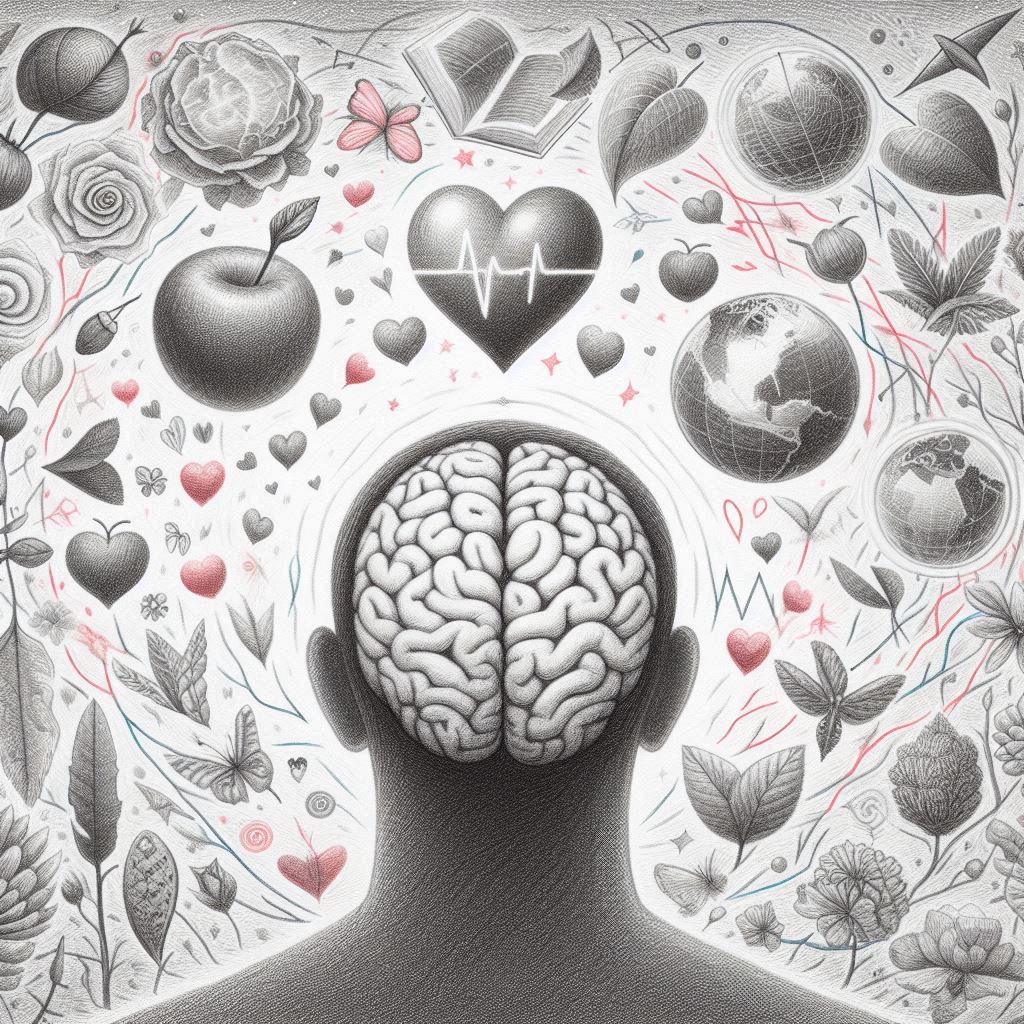
The stories about love for nature depicted beautiful natural surroundings, immersing the subject in nature, for example: You are in the archipelago at the seaside. The blue waves ripple over the coastal stones, a crooked pine rises next to you, and there are white fluffy clouds here and there in the sky. You love nature.
Researchers systematically evaluated the differences between categories of love, using contrasts of the six types of love with each other in a pairwise manner. These contrasts highlighted clear differences between close interpersonal relationships, particularly romantic and parental love, and love towards nature.
Romantic and parental love activated social cognition, long-term personal memories and self-processing activations significantly more than love for nature. Those associated with sensory perception, were absent for interpersonal love.
Love for nature activated some brain regions more strongly than love for humans or pets, such as sensory integration, emotional memories, emotion related behaviours, modulation of visceral reactions, temporal memory, imagery, viewing of landscapes autonomic nervous system regulation and joy! While, as one might expect, self-processing activations were missing.
The activation of sensory, emotional and meaningful memories have parallels with the pathways to nature connectedness. Which also include beauty, of landscapes, for example and compassion – which returns us to care and behaviours driven by love. It is fair to talk of nature connection as a relationship.
So, while love for nature and interpersonal love share some neural mechanisms, they also involve distinct brain regions. That said, human and nature love both produced significant activation in the region associated with neurobiological frameworks of human affiliation. This commonality together with the differences, suggest a ‘fuzzy continuum’ where love between people is the original ‘prototype’ case, and compassionate love for categories, such as pets and nature love resemble the prototypes in varying degrees dependent on biological, cultural, and subjective psychological factors.
Of course there’s another prototype, the brain architecture of human love can also be seen as emerging from and building on fundamental biological attachment systems shared with other mammals, showing our innate connection with the rest of the natural world.
Pärttyli Rinne, Juha M Lahnakoski, Heini Saarimäki, Mikke Tavast, Mikko Sams, Linda Henriksson, Six types of loves differentially recruit reward and social cognition brain areas, Cerebral Cortex, Volume 34, Issue 8, August 2024, bhae331, https://doi.org/10.1093/cercor/bhae331
Rinne, P., Tavast, M., Glerean, E., & Sams, M. (2023). Body maps of loves. Philosophical Psychology, 1–23. https://doi.org/10.1080/09515089.2023.2252464

 Finding Nature
[like] Liz Shearer reacted to your message: