The latest Living Planet Report paints a stark picture of our planet’s health, revealing that wildlife populations have plummeted by 73% since 1970. This alarming statistic is now visually represented by two darker grey stripes added to the biodiversity stripes, a tool designed to raise awareness and engagement about biodiversity loss. While climate change often dominates headlines, the decline in biodiversity is equally critical, underscoring a failing relationship between humans and nature. This blog delves into the complexities of biodiversity data, the significance of the Living Planet Index, and the urgent need to address both climate change and biodiversity loss to ensure a stable future for generations to come.
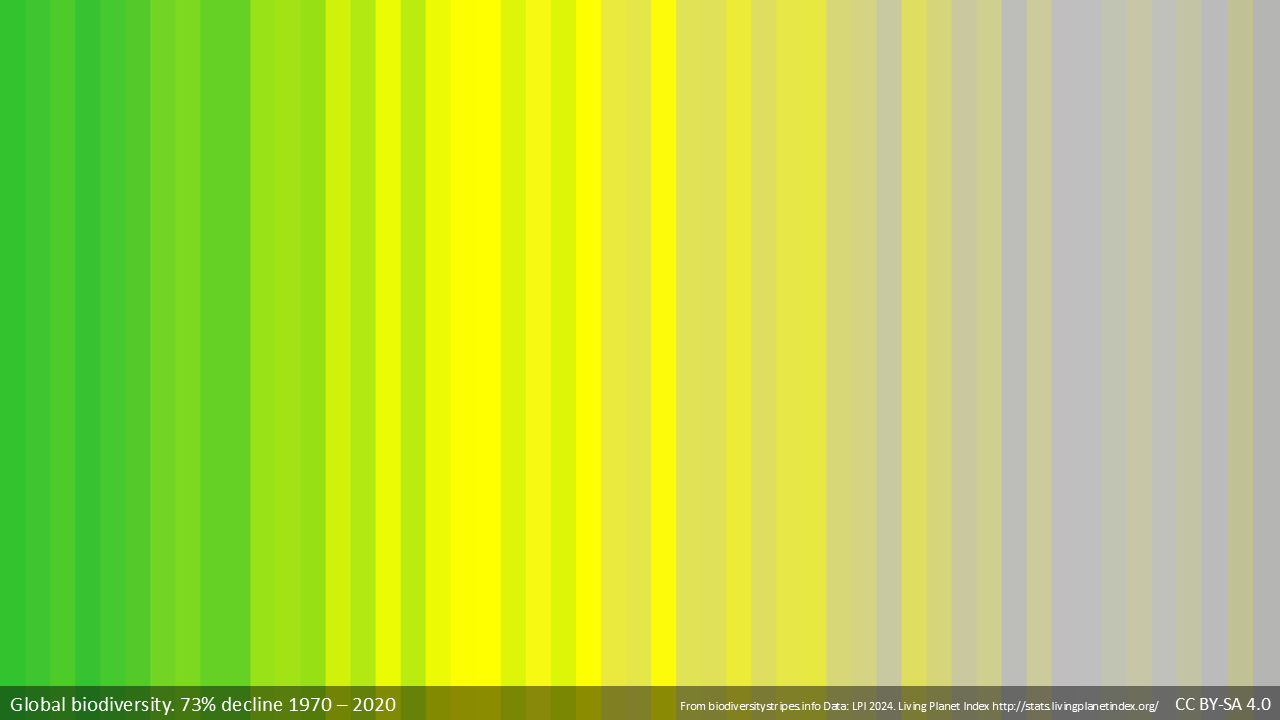
The biodiversity stripes have been used widely, from a football kit to adoption by the global Nature Positive campaign that put nature and the stripes at the heart of the world’s biggest environmental conventions, including COP27, COP28, and COP15. This biodiversity stripes themed campaign won the Best Environmental Cause Campaign at the Purpose Awards in June 2023. Such exposure should now be easier with the new stripes released as Creative Commons CC BY-SA 4.0, thereby allowing others to share and adapt the stripes, with appropriate credit and sharing.
Biodiversity data is massively difficult and complex, and the Living Planet Index is just one approach that focusses on wildlife populations. The global data includes over 30,000 populations of over 5000 species and tells us that the population of mammals, birds, fish, amphibians and reptiles has seen an average drop of 73% globally since 1970.
The biodiversity stripes though are an awareness and engagement tool to highlight the issue. Climate change has been found to get up to eight times more coverage than biodiversity loss. Yet only by addressing both the warming climate and loss of wildlife do we stand a chance of passing on a stable planet for future generations. This imbalance is odd as many of us claim to love nature and wildlife. And while we may talk about the weather, few of us love the climate. The decline of nature provides a sure sign that our relationship with nature is failing.
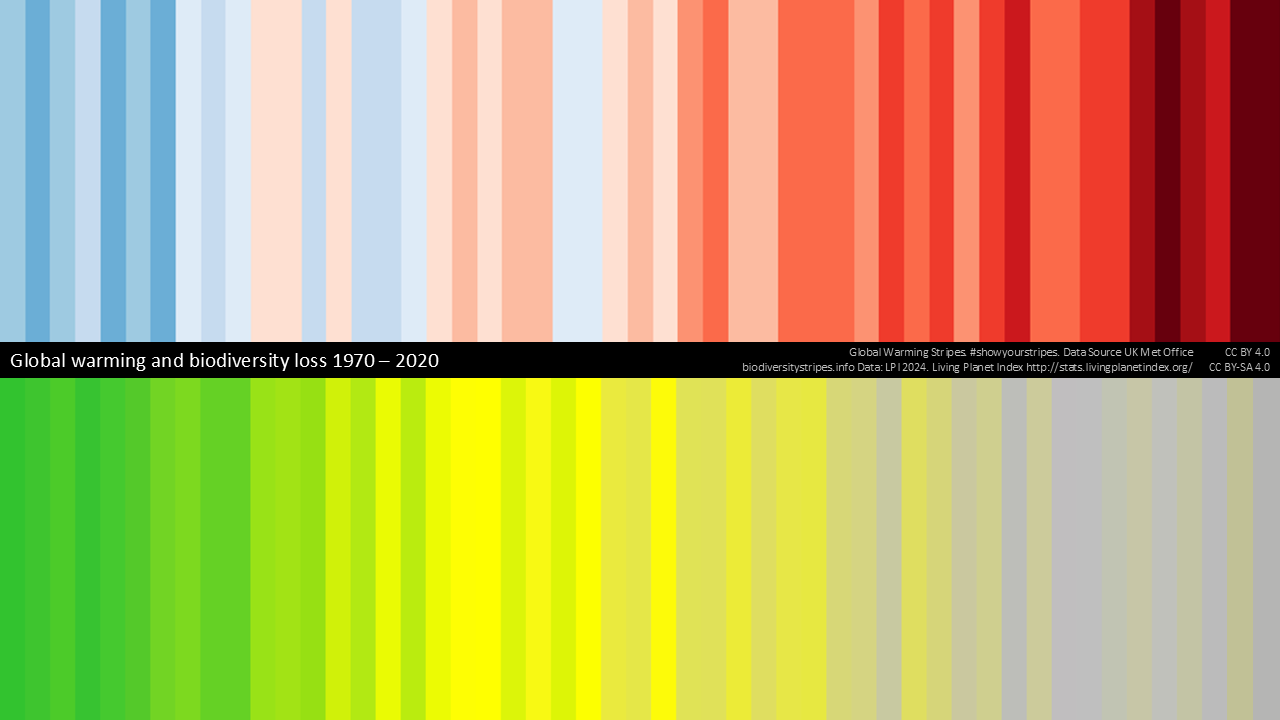
It is biodiversity, the variety of life on Earth, that supports life. It is fundamental in providing the air we breathe and food we eat. Humans evolved within a vibrant, biodiverse, natural world. It is inherently good and vital for our wellbeing. Yet through a disconnected relationship dominated by use and control of nature we have done great damage to the natural world. A spiralling breakdown as when biodiversity decreases so does our relationship with nature. A failing relationship that the UN recognise as the root cause of the environmental crises.
In addition to the global stripes, there are stripes for several continental areas, such as Latin America, a region where the creative use of the stripes is illustrated with the toucan, showing the 95% decline in Latin American wildlife populations since 1970.

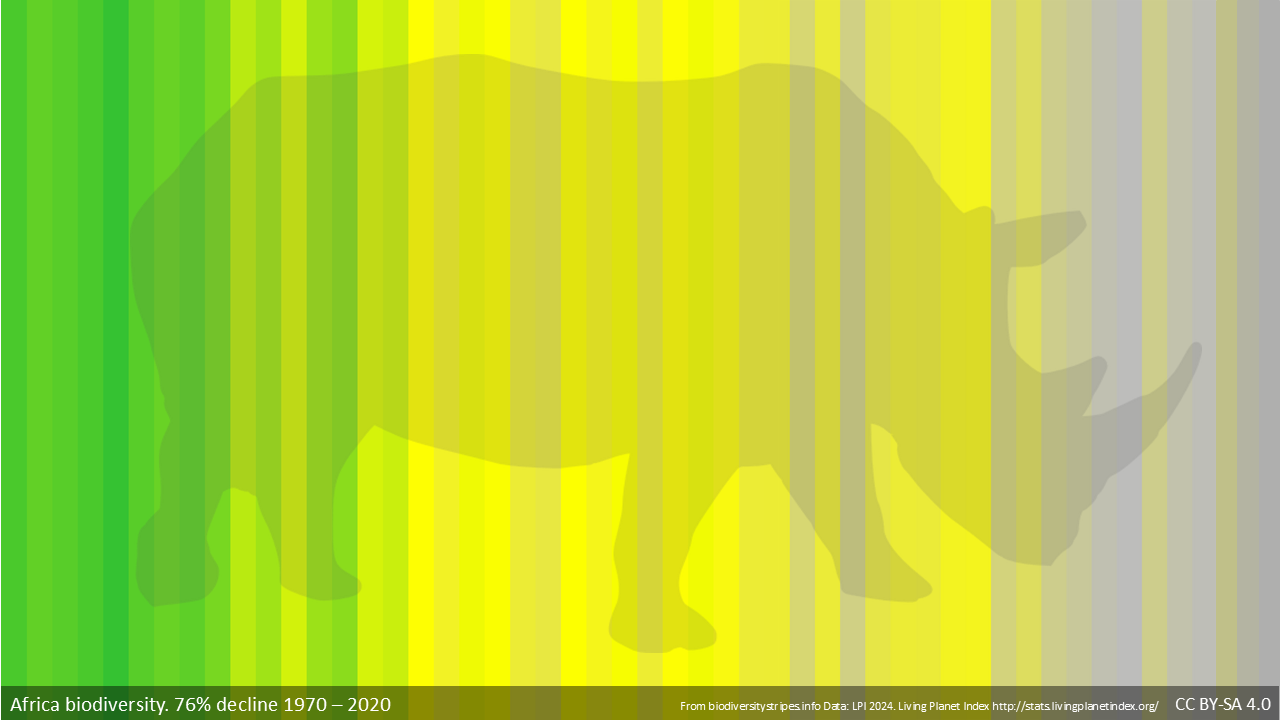
And Africa with 76% decline.
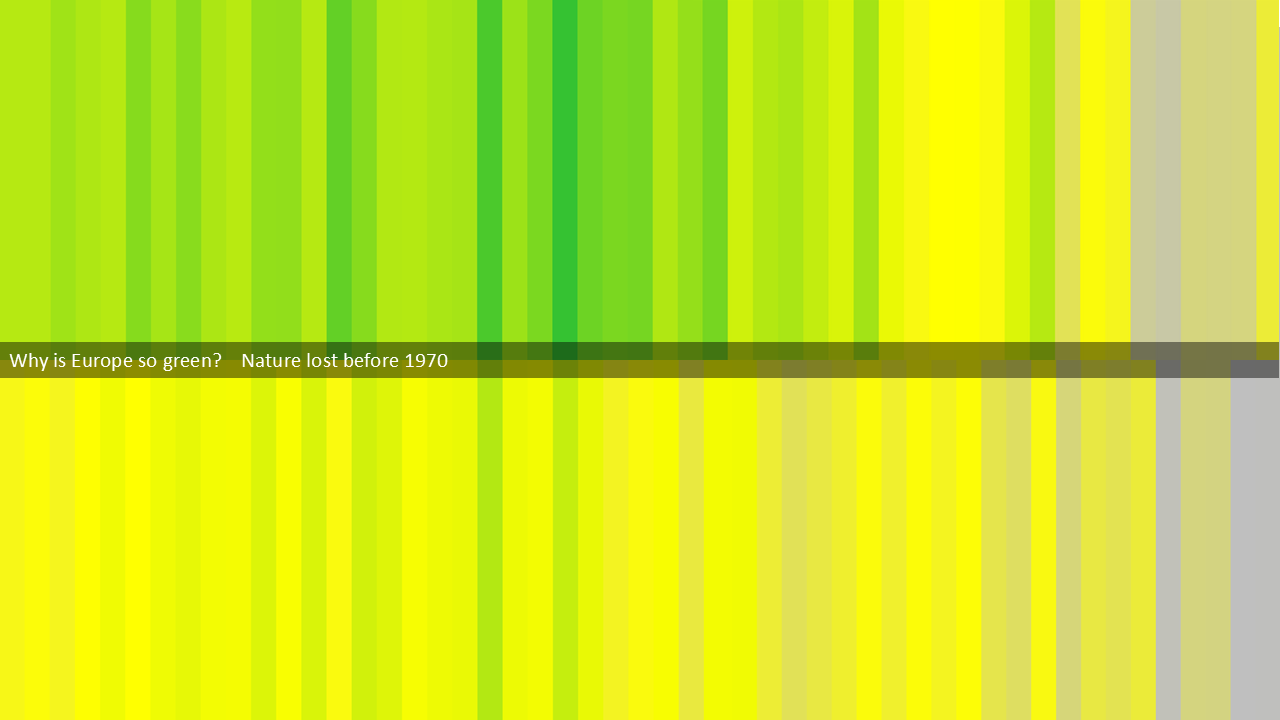
The larger the decline, the darker the grey, so you may wonder why the Europe and Central Asia stripes below are comparatively green? The living planet index starts at 1970 and the decline calculated from a standard maximum level of ‘1’. Therefore, any loss of wildlife before 1970 doesn’t feature, every region starts as a vibrant green, even though some have less nature to lose.
The biomass of wild mammals has declined by 85% since the rise of humans. Tens of thousands of years ago several million humans hundreds of mammals were wiped out in a megafauna extinction. Then, the Industrial Revolution centred in Europe saw the industrial exploitation of nature, together with changing agriculture, this saw the UK becoming one of most nature depleted countries on the planet.
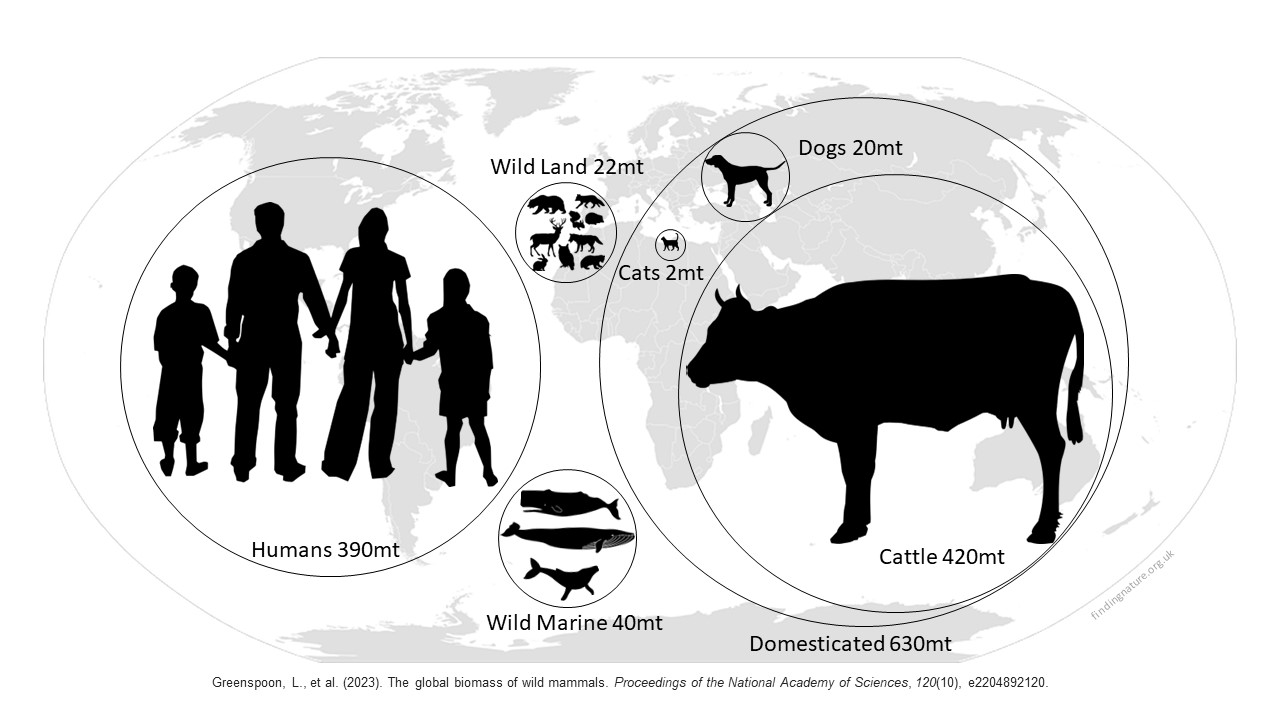
Biomass of mammals
So, to illustrate, using another biodiversity index, the NBI, the mean level of biodiversity across the European nations of UK, Poland, France, Germany and Spain is 0.39, compared to mean in selected Latin American nations of Brazil, Columbia, Ecuador, Uruguay and Venezuela of 0.80. Latin America is around twice as biodiverse as Europe, yet has the greyest stripes based on the decline since 1970. Whereas Europe and Central Asia has stayed relatively green. The pair of stripes below provide a rough visualisation of this. The biodiversity stripes represent decline, rather than levels.
There is an urgent need to protect and restore what remains. But, like climate change, biodiversity loss is a symptom of a failing relationship between people and the rest of nature. Addressing biodiversity loss requires more than just conservation efforts; it demands a fundamental shift in our relationship with nature. ‘Nature connectedness’ captures this relationship and research shows it can be targeted to inspire pro-environmental behaviours and enhance human well-being. The biodiversity stripes serve as a powerful reminder of the urgent need to protect and restore our planet’s wildlife. By fostering a deeper connection with the natural world, we can. As we confront the intertwined crises of climate change and biodiversity loss, we must strive to rebuild our bond with nature, ensuring a vibrant and biodiverse world where both people and nature thrive.
Find out more about the human relationship with the rest of nature and how to improve it take a look at Reconnection: Fixing our broken relationship with nature and The Blackbird’s Song & Other Wonders of Nature.