
Nature connectedness, our love of nature, shapes our identity and values and is a decisive construct in influencing people’s values and behaviours and an important ‘leverage point’ for a sustainable future. Similarly, connectedness to Humanity, our sense of connection with others, is associated with behaviours focused on achieving harmony between the individuals within society. An interesting new research study explores how they interact to bring responsible eco and social behaviours.
Although we divide nature into fragments to inspect and understand, it is relationships that make the world go around. Relational worldviews are perhaps the original worldviews, split apart by revolutions of science and consumption, to the point reality is forgotten. Cognitive science shows us that mind, body and the wider environment are one. Connectedness matters.
This recent study measured both nature and social connectedness, plus eco and social values and responsible consumption, of close to 500 adults from the UK and USA. Some complex statistical modelling tested how nature and social connectedness effected values and responsible consumption.
As you might expect, nature connectedness contributed to eco-responsible consumption, and socio-responsible consumption lesser extent. And social connectedness contributed to socio-responsible consumption, and eco-responsible consumption to a lesser extent – but independently of the common factor of connectedness. Again, as you might expect, biospheric values were involved in the link between nature connectedness and eco-responsible consumption, while altruistic values were involved in the link between CH and socio-responsible consumption.
Now for two really interesting findings! First, nature connectedness was a better predictor than connection to humanity of altruistic values that go on to promote socio-responsible behaviours. This suggests that nature connectedness is a more encompassing and profound form of connection that extends to both the natural and social environments. Second, connection to humanity had a negative contribution to biospheric values and thereby eco-responsible consumption.

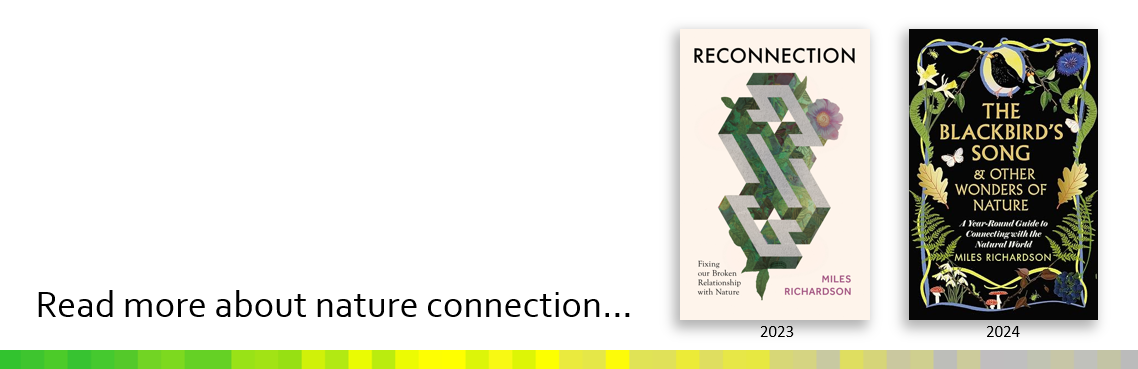
These results are discussed with reference to in-group and out-group dynamics or us and them. The suggestion being that nature connection involves aligning with an out-group. Whereas, being solely connected to humanity, the in-group, could lead to the othering and rejection of nature. Alternatively, it could be that nature connection is a broad concept that includes humans, as we are of nature. Whereas connection to humans is a narrower concept that does not include nature. Further, there’s also a theory that people emotionally absorbed in human concerns can neglect the more than human world. And more and more people are becoming absorbed in human concerns. I discuss research into the rise of individualism in Reconnection. Cultivation of identities, the increase in personal pronoun use and individualistic phrases leading to whole in-groups of people believing that they deserve special treatment, thereby generating hostility towards those outside the group, leading to yet more preoccupation with human concerns.
In-group, out-group is a foundational component of psychology, so is our need for affiliation with others. Yet, contemporary society seems to foster disconnection, from family structures to technology and high-rise living, within economic and business systems that disconnect consumers and producers. Counterintuitively, the study of social and nature connectedness above suggests a solution lies on focussing on affiliation with nature.
In sum, an exclusive focus on human connections can lead to nature being viewed as an out-group, thereby undermining eco-responsible behaviours. Whereas focussing on nature connectedness can enhance both nature’s and human wellbeing.
Stinus, C., Shankland, R. & Berjot, S. Connectedness to humanity and connectedness to nature as a leverage point for eco and socio-responsible consumption. Curr Psychol 43, 30429–30445 (2024). https://doi.org/10.1007/s12144-024-06621-1

 Finding Nature
Very interesring and thanks for sharing!