
Part 2 of 2: How to unite fragmented academic disciplines and reshape policy to rebuild our connection with nature.
In Part 1, we explored how our new Ambio paper synthesises a first wave of research showing that nature connectedness is a societal property shaped by urbanisation, economics, culture, and the values passed between generations—not just an individual trait. Here in Part 2, we look at what that shift means for uniting fragmented academic fields and designing policies that can reverse the decline.
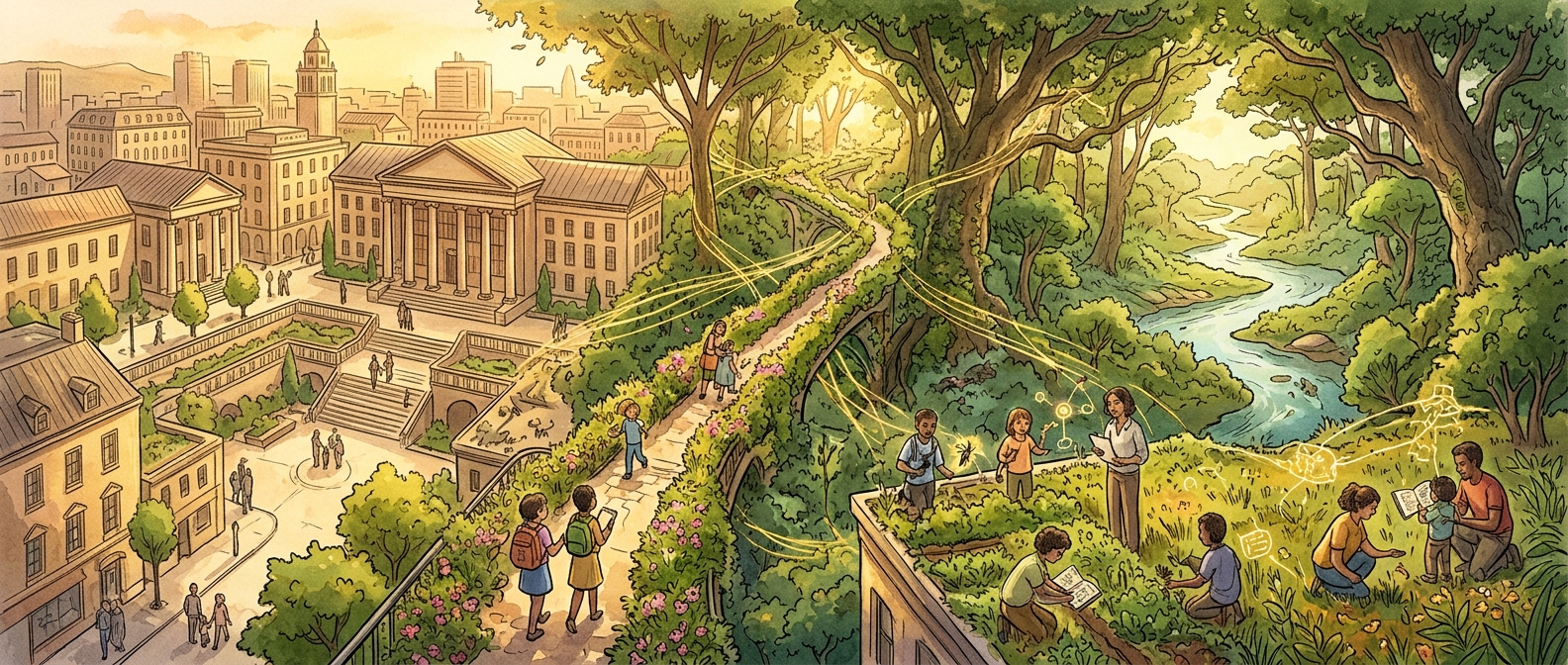
The emergence of a first wave of quantitative macro-level studies marks a significant moment in the evolution of nature connectedness research because it begins to examine the human-nature relationship at the scales at which cultures, societies and historical trajectories operate. Traditionally anchored in environmental psychology and focused on individual traits and experiences, the field is now expanding to integrate macro-sociology, cultural psychology, historical and longitudinal analysis, socio-ecological and economic indicators, and complex systems modelling.
Importantly, this is not a rejection of the psychological foundations of nature connectedness, but an expansion of them. While the psychological roots of nature connectedness remain vital, this wave extends the field toward identifying population-level drivers of nature connectedness, modelling long-term trajectories, and testing large-scale intervention scenarios.
Nor does this shift emerge in isolation. For decades, scholars across environmental sociology, sustainability science, social-ecological systems research, and related fields have highlighted, theorised, and often empirically examined the roles of societal change, cultural worldviews, urbanisation, intergenerational processes, secularisation, and other macro-level influences on human-nature relationships. The contribution of this first wave is not to introduce these influences, but to bring them together within a common nature connectedness framework, translating them into measurable indicators and dynamic models that can be compared, integrated, and used to explain population-level patterns of human-nature relationships.
What makes this first wave particularly important, therefore, is that it begins to explain nature connectedness as an emergent outcome of interacting societal, cultural, structural, and psychological processes. Nature connectedness is no longer viewed solely as an individual attribute but as a phenomenon that emerges from dynamic interactions across multiple levels of society.
These approaches begin to unify cultural evolution, structural change, intergenerational processes, psychological mechanisms, and regional variation within a single explanatory framework. Although other frameworks have acknowledged macro influences on human–nature relationships, few, if any, have brought these elements together in a coherent empirical system. This first wave, particularly the most recent agent based modelling work, offers an integrated account of long-term decline and cross-sectional differences by unifying time, culture, and structure. In doing so, it transforms conceptual insights concerning embeddedness, cultural influence, intergenerational transmission, and social-ecological relationships into actionable, data-driven tools, linking objective indicators such as urbanicity or economic context with subjective dimensions such as values and orientations within predictive models. This provides a foundation for designing multi-level interventions, from cultural and educational initiatives to planning and policy reforms aimed at restoring societal nature connectedness.
| ‘a single, underlying fault upon which the entire edifice of Western thought and science has been built – namely that which separates the “two worlds” of humanity and nature’, Tim Ingold |
Bridging the fault line identified by Tim Ingold requires moving past the academic silos that divide disciplines within the human sciences, as well as between the human and natural sciences, and that too often overlook a relational viewpoint. Together, these studies lay the empirical foundations and conceptual scaffolding for an integrated science of the human–nature relationship. By uniting cultural evolution, structural change, intergenerational processes, and psychological mechanisms in a single framework, they give us the tools to explain, predict, and ultimately reshape long-term trajectories of societal nature connectedness.
Implications for policy and transformative change
The first wave of macro‑level nature‑connectedness research makes clear that policy responses must move beyond approaches centred solely on individual experience or the provision of local greenspace. Because declines in nature connectedness stem from slow‑moving structural forces, such as urbanisation, economic development, secularisation, cultural worldviews, and intergenerational transmission, policy must address the cultural “software” of society as well as its physical “hardware.” This means education systems, planning frameworks, cultural institutions, and media environments all have a role in shaping societal orientations toward nature.
Interventions that embed nature across childhood experience, community identity, and shared cultural meaning are essential, since intergenerational processes strongly condition long‑term trajectories. Urban design, too, needs to shift from nature as amenity to nature as identity, ensuring nature rich neighbourhoods, everyday contact, and equitable access that counteract the disconnecting pressures of modernity.
At the same time, the findings point toward a need for transformative, system‑scale strategies that operate across cultural, spatial, and temporal levels. Policies must recognise that values linked to spirituality, faith, science, and humanism influence how societies conceptualise nature; therefore, relational and meaning‑based worldviews should sit alongside economic and scientific priorities in sustainability planning.
Future scenarios in the first wave suggest that single interventions will not be sufficient. Reversal of decline requires coordinated, multilevel action: cultural initiatives that normalise nature as part of the good life, planning that embeds biodiverse everyday environments, and long‑term investment in childhood nature engagement. This integrated approach mirrors how other socio‑ecological transformations are now tackled: through systems thinking, cross‑sector collaboration, and sustained commitment over decades. By adopting these principles, policy can begin to reshape the human–nature relationship as a societal asset rather than an individual preference, enabling the kind of cultural and structural change required for genuine sustainability transformation.
Final Thoughts
The work emerging in this new “first wave” of macro‑level nature connectedness studies, which take a systematic, empirically integrated, or temporally modelled approach, represents an opportunity to integrate and unify the fragmented study of the human–nature relationship. This first wave of macro‑level studies demonstrates—empirically and quantitatively—that the human–nature relationship is shaped by deep structural, cultural, and intergenerational forces, not merely by individual experiences or short‑term interventions. These slow‑moving forces help explain both historical decline and contemporary global variation. Yet the research also shows that these patterns are not fixed. Transformative change depends on policies that integrate cultural, educational, and spatial interventions, embedding nature meaningfully across children’s lives, community identities, and the built environment. By aligning structural planning with relational and value‑based approaches, societies can begin to restore a deeper, more enduring connection with nature that supports wellbeing and long‑term sustainability, especially within an integrated science of nature connectedness that encompasses several disciplines.
Richardson, M., Lengieza, M.L. The first wave of macro-level nature connectedness research: Convergent insights and emerging directions. Ambio (2026). https://doi.org/10.1007/s13280-026-02507-7


