A collaboration between Ochre Dawn, Ben Bowen (Indigenous Literacy Foundation), Araceli Camargo (Centric Lab), Professor Miles Richardson (University of Derby) and Dr Jake M. Robinson (Flinders University).
Languages can be a powerful tool to relate to and interconnect with the natural world1. Indigenous languages––those developed by First Nations Peoples––embody a deep ecological knowledge that is critical to protecting nature2. Biodiversity and Indigenous languages are undeniably intertwined3.
“Indigenous languages are the heart of the Earth… they embody the processes and teachings of the planet”1.
However, half of the world’s population speaks just 24 of the 7,000 or so languages, such that Indigenous Peoples, making up around 6% of the global population, speak more than 4,000 of the world’s languages1. The importance is such that the period between 2022 and 2032 has been proclaimed as the International Decade of Indigenous Languages by the United Nations General Assembly.
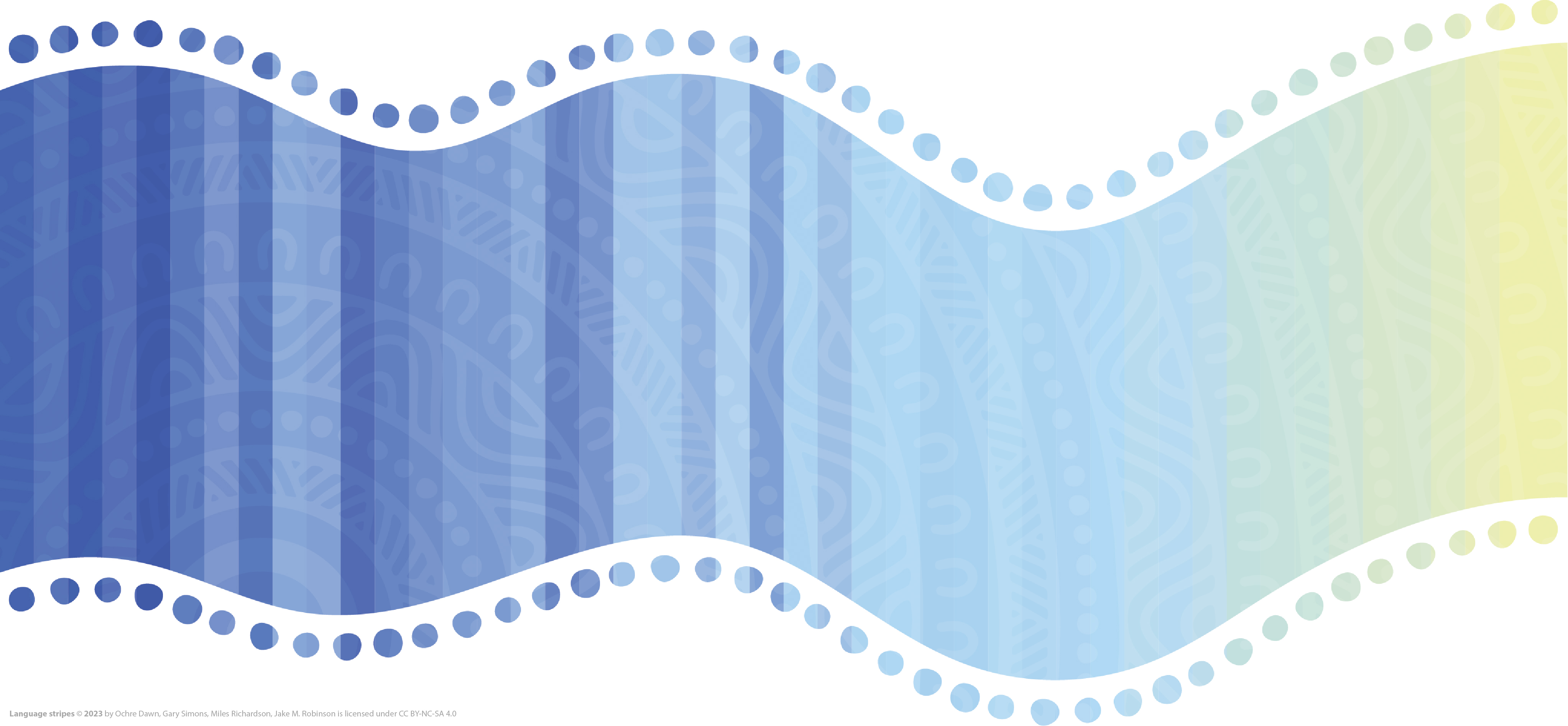
Languages developed over many millennia embody the values, symbols, meanings, and norms of the diverse cultures on Earth. Yet we’ve lost over 700 languages since 1700 largely due to colonialism and political repression, and the current rate of language extinction is 9 per year4. This is a shocking and under-reported phenomenon. But as startling as it is, by 2080, the loss of languages is expected to rise to 16 per year, further rising to 26 per year by 2150, at which point 50-90% of the 7,000 global languages will be extinct4–gone, and many with no means of recovery. Countless diverse cultural experiences poured into the development of human communication and knowledge over thousands of years, lost to history. To highlight this, we’ve created the Language Stripes.
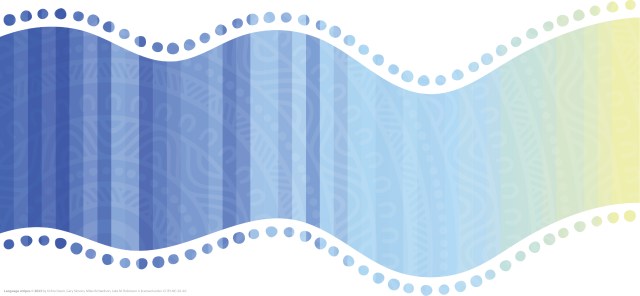
The Language Stripes
“Language is the expression of our culture and our land. We cannot have one without the others. We cannot describe our culture and our land if we do not have language” – The Queensland Indigenous Languages Advisory Committee.
Cultural diversity is decreasing alongside biodiversity loss, and Indigenous languages are deeply tied to biodiversity, so this dual loss is often interrelated. Indigenous Peoples protect most of the global biodiversity, their ways of living are often in harmony with nature (even when they “manage” the land), and losing languages threatens cultures, which threatens biodiversity, which threatens languages. It’s a vicious cycle.
Therefore, protecting nature is vital to curb the loss of Indigenous languages and to protect Indigenous cultural identity and knowledge. Moreover, protecting Indigenous Peoples’ rights and sovereignty has the fundamental benefit of protecting nature’s voice.
“When Indigenous Communities lose their languages, kinship with nature is interrupted.”
Wiradjuri man and CEO of Indigenous Literacy Foundation Ben Bowen says,
“First Nations languages indeed operate at a deeper level of knowledge compared to Western languages in certain aspects. These languages often carry millennia of cultural, ecological, and spiritual wisdom embedded in their vocabulary, grammar, and syntax. They are intimately connected to the land, environment, and traditions of Indigenous Peoples, reflecting profound insights about relationships with nature, social structures, and spirituality.
Unlike many Western languages, First Nations languages often prioritise relationships when used. There are numerous words for kangaroo which gives an understanding of how one would interact with the animal due to the season, the land, behaviour and gender of the animal, to name a few. This has been shared and learned for millennia through scientific observation, learning of cultural practice and environmental stewardship.
In essence, First Nations languages are repositories of Indigenous knowledge, offering unique perspectives that challenge Western worldviews and provide valuable insights into sustainable living, ecological stewardship, and cultural continuity. Efforts to preserve and revitalise these languages play a crucial role in safeguarding this deeper level of knowledge for future generations. These languages are truly irreplaceable treasures of human heritage.”
A coding tool.
Language is a coding tool that allows humans to absorb information about environmental phenomena for future use (memory)5. In time, we use these memories to create more advanced cognitive outputs such as stories, culture, and knowledge6,7,8. In this way, we can understand that language is embodied and rooted in the environments we inhabit9. Indigenous Peoples developed languages that are intrinsically entwined with the Land10. This allows them to be in deep and constant dialogue with all beings around them, which in turn provides them with knowledges that guide their ecological practices. However, it goes beyond developing a lexicon or vocabulary; the culture developed through Indigenous languages influences ecological relationships. For example, in the Raramuri language, Iwigara “expresses the belief that all life shares the same breath. We are all related to, and play a role in, the complexity of life11.” This type of thinking influences how some Indigenous Peoples relate to other-than-human beings, seeing them as Kin. It is this kinship that births a curiosity and responsibility to care for and contribute to the abundance of biodiversity.
The data and stripes
Here, we present the Language Stripes. We developed the stripes to bring awareness to the phenomenon of language extinction. You’ve probably heard of the IUCN Red List of Threatened Species, where animals and plants are given a category based on how ‘at risk’ they are of becoming extinct. Some species thrive and are considered ‘Least Concern’, others are ‘Endangered’, and others still are on the verge of becoming ‘Extinct’. You can think of languages in a similar way. Some languages, like English and Spanish, are ubiquitous, whereas others are doomed to extinction. Indeed, 46 languages have just one native speaker, while 357 languages have fewer than 50 speakers.
The Language Stripes follow the same logic as the Biodiversity and Climate Stripes. The data were acquired from a peer-reviewed study, showing historical average language loss from 1700 to the current day and future projections to 2080 and 21504. The tool developed by Simons (2019) was based on the Graded Intergenerational Disruption Scale (GIDS)12.
To create the 46 vertical stripes, conditional formatting of the language data allowed a data point each decade from 1700 to be assigned a colour. The highest number in 1700 was represented by blue, the lowest was represented by cream. A mid-point value in the data was represented by light blue. The declining trend in languages was therefore captured by a transition from blue to light blue and then from light blue to cream.
However, given the fact that the data is smooth, the colour changes would be too subtle for clear stripes to emerge. To capture the trend and produce stripes, each data point varies randomly between +/-3%. The creation of artificial variability is openly acknowledged as the stripes are intended to be a communication and public engagement tool on an underreported issue. The stripes engage people with the overall declining trend in languages over time.
We worked closely with the Australian Indigenous creative organisation Ochre Dawn to create the stripes (below). You’ll notice the stripes have a faint ‘yarning circle’ layer, designed by Indigenous artist Jordan Lovegrove. Yarning circles are prevalent in First Nations art. They represent a tradition of storytelling, knowledge sharing, and community bonding that is deeply rooted in Indigenous cultures––hence being highly relevant to this topic.
What the stripes represent
The impact of globalisation is a world dominated by a more Western mindset13. This impact on Indigenous Communities is one driver of language loss and represents human populations becoming less diverse as nature becomes less diverse. This matters intrinsically to Indigenous Peoples, but also to nature, as languages are critical in the protection of biodiversity and key to a deep relationship with nature. Indigenous Peoples also tend to have a different relationship with the natural world founded on a relational worldview––something we can all benefit from embracing.
Indigenous languages reflect this relational worldview, describing, for example, animals of the forest as co-dwellers, sentient beings able to feel and think, and perceiving nature to be integrated within their own self.11 Indigenous languages express concepts related to nature differently than, for instance, the English language does, with languages regulating the human-nature relationship14. Our language is limited and constrains solutions; for example, unlike some languages, we, who speak English as our primary language, don’t have a word for ‘living in harmony with the natural world’.15
Even within our English language, Indigenous Communities talk about nature differently. For example, when speaking of outdoor practices, Western families talk of sports, cycling and canoeing – activities that move through nature as a background. Whereas indigenous Communities talk of reciprocity, foraging, forest walks and medicinal plants.
Our preoccupations and tastes are reflected by our language. Even when we have words for nature, they are being used less and less. Our disconnection with nature is so profound that its separation seeps into our everyday language. Importantly, language not only reflects culture, but it also shapes it. The language of separation starts to frame our thinking, forming concepts of truth and reality. It has a profound influence on how we think and act, creating real boundaries to a close relationship with nature. Our perceived separation from nature is now so deep within our conceptual system, it is difficult to overcome.
The dualistic language of Western thinking promotes abstract reasoning about the natural world. For example, when people’s concepts of nature are studied, they can be placed into three themes: descriptive, normative and experiential.16 Descriptive language, such as describing plants and wildlife, dominates with 73% of responses. Normative language, often used by those with nature expertise, and Experiential language, which includes positive emotions, feelings and activities in nature, accounted for less than 6% of responses. People who describe nature in simple descriptive terms tend to have lower nature connectedness. Whereas more experiential terms are used by people with higher nature connectedness scores.
So, language drives the human-nature relationship. In the Anishinaabe culture of Central/Southern Canada, a strong positive relationship with nature grew from songs and stories.17 These oral traditions put nature in the foreground and together with close observations of nature, school children notice interrelationships. When oral traditions and languages are lost, the natural landscape falls mute.17 Essential knowledge, once passed from elders to children in the landscape through spoken language, is replaced by facts and figures delivered in the classroom. Further, when a language is lost, another must be adopted, and the conventions of that other language may separate the speaker from the rest of the natural world.
When Indigenous Communities lose their language, nature loses a voice, and when we lose nature, Indigenous peoples lose their cultural identity, rights and sovereignty. Therefore, we must prioritise language revitalisation efforts as a fundamental step towards preserving both the rich tapestry of Indigenous cultures and the ecological harmony they have maintained with the land for countless generations. These efforts require support and collaboration from broader society, including educational institutions, governments, and individuals. By actively working together to protect and revitalise languages, we can ensure that the voices of these Communities are heard, that their cultural identities are celebrated and respected and that the delicate balance between humanity and the natural world is maintained for the benefit of all.
Please support organisations such as the Indigenous Literacy Foundation, Language Conservancy, Living Tongues, and the Endangered Languages Project, which work tirelessly to protect Indigenous languages.
References
- Redvers, N., Menzel, K., Ricker, A., & Lopez-Carmen, V. A. (2023). Expanding the scope of planetary health education: the International Decade of Indigenous Languages. The Lancet Planetary health, 7(1), e4-e5.
- UNESCO, C. (2017). Biodiversity and linguistic diversity. UNESCO.
- Gorenflo, L. J., Romaine, S., Mittermeier, R. A., & Walker-Painemilla, K. (2012). Co-occurrence of linguistic and biological diversity in biodiversity hotspots and high biodiversity wilderness areas. Proceedings of the National Academy of Sciences, 109(21), 8032-8037.
- G. (2019). Two centuries of spreading language loss. Proc. Ling Soc Amer. 4. 27:1-12.
- Gabrieli, J.D. (1998). Cognitive neuroscience of human memory. Annual review of psychology, 49(1), pp.87-115.
- DiMaggio, P. (1997). Culture and cognition. Annual review of sociology, 23(1), pp.263-287.
- Lupyan, G., Rahman, R.A., Boroditsky, L. and Clark, A. (2020). Effects of language on visual perception. Trends in cognitive sciences, 24(11), pp.930-944.
- Gabrieli, J.D. (1998). Cognitive neuroscience of human memory. Annual review of psychology, 49(1), pp.87-115.
- Perlovsky, L. (2009). Language and cognition. Neural Networks, 22(3), pp.247-257.
- Martinez, D. (1994). Traditional environmental knowledge connects land and culture: American Indians serve as the link. Winds of Change 9:(4)89–94.
- Salmón, E. (2000). Kincentric ecology: Indigenous perceptions of the human–nature relationship. Ecological applications, 10(5), pp.1327-1332.
- Fishman, J.A. (1991). Reversing language shift. Clevedon, UK: Multilingual Matters Ltd.
- Sabloff, A., & Lemon, J. (2001). Reordering the natural world: humans & animals in the city. Urban History Review, 30(1), 71.
- Angle, S. C. (2009). Sagehood: The Contemporary Significance of Neo-Confucian Philosophy. New York: Oxford University Press.
- Bang, M., Marin, A., Medin, D., & Washinawatok, K. (2015). Learning by observing, pitching in, and being in relations in the natural world. In Advances in Child Development and Behavior, 49, 303–13.
- Lakoff, G., & Johnson, M. (2008). Metaphors We Live By. Chicago: University of Chicago Press.
- Hatty, M. A., Goodwin, D., Smith, L. D. G., & Mavondo, F. (2022). Speaking of nature: relationships between how people think about, connect with, and act to protect nature. Ecology and Society.