Stockholm+50: Unlocking a Better Future

The Stockholm+50 international meeting convened by the United Nations General Assembly took place earlier in June. It was attended by heads of state and government ministers from over one hundred nations, as well as many other representatives. The meeting saw the launch of Stockholm+50: Unlocking a Better Future – An independent scientific report by the  Stockholm Environment Institute (SEI) and the Council on Energy, Environment and Water (CEEW) produced to provide a scientific basis for the meeting.

Stockholm+50: Unlocking a Better Future

Guided by an advisory panel of experts in sustainable development science and policy, researchers at SEI, CEEW and collaborating institutions have synthesised the scientific evidence and prepared recommendations for action. The report notes how scientific research provides evidence and guidance on how to make progress on critical challenges and lays out many of the ideas that can help transform our world.

It was great to see that a key message highlighted in the report was on the human-nature relationship:

  • “Our relationship with nature needs redefining, from one of extraction to one of care. Human-nature connectedness should be strengthened in our social norms and value systems, and in how we live our everyday lives.”

The wider report noted the science of nature connectedness with the summary for policymakers noting the need to repair and redefine our relationship with nature. This also included calls to action around that:

  • “Integrate nature in cities and urban areas – Local governments can promote human-nature connectedness through green architecture, infrastructure and access to nature in the towns and cities where most people live and work, as a way of both seeding transformative change through shaping values and providing immediate climate, biodiversity and health benefits. “
  • “Expand and invest in nature-based education – Through education policy and school curricula that connect children with nature, education authorities and teachers could contribute to a long-term, catalytic effect on repairing our relationship with nature. Inspiration can be taken from Indigenous communities’ nature-based education.”

The summary for policymakers is based on a more detailed consideration of redefining the relationship between humans and nature. It recognises that society’s disconnection from nature is a root cause of ecological decline. This section of the report covers the need to address the core imbalance in how societies value nature, including the need for more relational values.

This would require profound changes across economies, societies and communities and the report notes that measuring human-nature connectedness is a pathway to repairing our failing relationship with nature. Coincidentally, our paper on nature connectedness being a key metric for a sustainable future was published a few days before the report.

The report includes our pathways research which suggests that nature connectedness can be increased through carefully designed interventions and that there is an opportunity to combine with leverage points for transformative change.  The report notes how this approach can be adopted in areas such as education and urban design “to encourage a cultural reset on how we see nature – and how we then ‘use’ or interact with nature”.

The areas for action to redefine the human-nature relationship include drawing on the pathways to nature connectedness to repair the broken relationship between humans and nature. This leads to specific areas for action to help reconnect people, communities and societies to the nature around them. The actions address how we live, produce food and learn and include integrating nature within cities and urban areas and expansion of nature-based education. Recommending, for example, education policy and curricula that are explicitly informed by pathways to nature connectedness thinking. The breadth of opportunities and change needed is reflected in the action on housing policy which suggests that all new developments include opportunities for an active relationship with nature. For example, urban planning providing everyday opportunities to care for and connect with nature.

The report is a significant step in the growing global recognition that the human-nature relationship is a core issue and that the science of nature connectedness can be applied to make a difference. We don’t have all the answers, but there is sufficient evidence to progress another key message in the report – that “bold and science-based decision-making is needed to accelerate the pace of change”. The message is clear, the human-nature relationship itself, not just the symptoms of that failing relationship, is a tangible target for change – and bold, creative, evidence based thinking can help fix that failing relationship.


SEI & CEEW (2022). Stockholm+50: Unlocking a Better Future. Stockholm Environment Institute. DOI: 10.51414/sei2022.011

M. Richardson, J. Dobson, D. J. Abson, R. Lumber, A. Hunt, R. Young & B. Moorhouse (2020). Applying the pathways to nature connectedness at a societal scale: a leverage points perspective, Ecosystems and People, 16:1, 387-401, DOI: 10.1080/26395916.2020.1844296


Posted in Uncategorized | 1 Comment

Nature has to be more than our labels

Some people are more connected to nature than others. We know that most people don’t notice nature, but what do they think about nature? A couple of recent research studies give some insight into this question. And their findings help confirm what we know about how to improve the human-nature relationship. As we know, a closer relationship with nature is essential for both human and nature’s wellbeing.

The first paper by Melissa Hatty and colleagues examined people’s concepts of nature through looking at the language they used. They found the responses fell into three themes. The first was the use of descriptive language such as descriptions of animals, plants and landscapes. 73% of responses were of this type. The second theme was the ‘normative language’ often used by experts, terms to do with conservation and biodiversity for example. Less than 2% of people used these types of terms. The third theme was experiential language, language to do with activities in nature, positive emotions and feelings. These accounted for just 3.5% of responses. Around 19% of people used language from two or more categories.

So how did this relate to nature connectedness? Those people with higher levels of nature connectedness used more experiential terms, or terms from more than one group. People who described nature in simple descriptive terms had lower nature connectedness scores.

So, it’s rather concerning that most people think of nature in simple descriptive terms. There is little sign that people think about nature in the emotional terms that create a closer relationship and bring mental wellbeing. This reflects how we’re schooled to think about the world. In typologies, processes, and the labels of the various parts of nature.

Teaching facts, figures and information is also a popular approach to engaging people with nature, but research has shown this tends not to be the best way to improve nature connectedness. It is thought that the usual approach of transmitting knowledge suppresses emotional content. When people understand through facts and figures they become primary. Emotions become secondary. More positively, getting people to write about nature using emotional language leads to increases in nature connectedness – and mental health.

This knowledge-based approach together with the extinction of nature experience could well explain the second recent paper about how people think about nature. This research explored urban dwellers ‘mental models’. Mental models are the conceptualisation people have about the real world. This research found that people living in an urban environment had a more simplistic understanding of nature – the complex interrelationships between nature and humans. This limited their ability to live in harmony with nature.

In sum, the two studies show that being disconnected from nature is linked to simplistic thinking about nature. With simplistic thinking about nature leading to fewer pro-nature behaviours. Sadly, the simplistic descriptive thinking was found in the majority of people.


Hatty, M. A., Goodwin, D., Smith, L. D. G., & Mavondo, F. (2022, May 12). Speaking of nature: Relationships between how people think about, connect with, and act to protect nature. https://doi.org/10.31219/osf.io/wtgy3

Aminpour, P., Gray, S. A., Beck, M. W., Furman, K. L., Tsakiri, I., Gittman, R. K., … & Scyphers, S. B. (2022). Urbanized knowledge syndrome—erosion of diversity and systems thinking in urbanites’ mental models. npj Urban Sustainability, 2(1), 1-10.


Posted in Uncategorized | Leave a comment

Nature connectedness: A key metric for a sustainable future

As noted in the first part of this blog, there is global recognition from organisations such as the UN and IPBES that the failing human relationship with nature is an underlying cause of the environmental crises. Nature connectedness captures that relationship with nature which allows researchers to identify the factors in the failing relationship, develop solutions and monitor progress towards a sustainable future. Our latest paper published recently in the Springer Nature journal Ambio illustrates why nature connectedness is a key metric for a sustainable future. The paper is available here and the blog summary is split into two parts, this blog on nature connectedness as a key metric being the second part – the first part covers country level factors in a failing relationship with nature.

Nature connectedness – one measure for one health

Part one showed the relationship between country level factors and individual levels of nature connectedness, with the strong relationship between individual levels of nature connectedness and various country level factors. There is also wider research which shows the strong and causal relationships between nature connectedness and both wellbeing and pro-environmental behaviours. This suggests nature connectedness could be a useful indicator to monitor progress towards a more sustainable future. So in the Ambio paper we compared nature connectedness to existing indices of prosperity, human development, sustainability and social progress. Again, the full paper gives more detail.

The table below provides a summary of the correlations between a selection of composite indices for each country and outcomes related to human and nature’s wellbeing. 14,745 adults across 14 European countries responded to questions on nature connectedness (INS) and well-being (WHO’s 5-item index of positive well-being) with the National Biodiversity Index NBI used for biodiversity and the Emissions Database for Global Atmospheric Research (EDGAR) for carbon emissions.

Nature Connectedness Carbon Emissions Well-being Biodiversity
Legatum Prosperity Index -0.61 0.13 -0.52 -0.83
Human Development Index -0.65 0.06 -0.51 -0.76
Social Progress Index -0.44 0.01 -0.33 -0.67
Sustainable Development Ranking -0.38 0.20 -0.42 -0.72
Nature Connectedness 1.00 0.02 0.64 0.81

Interestingly, whereas nature connectedness is linked to higher levels of well-being and biodiversity, the four composite metrics all had a negative relationship to well-being and, most notably for the Sustainable Development Ranking, biodiversity. Further, the selected composite indexes all have a negative relationship to nature connectedness, even the Sustainable Development Ranking.

Higher scores on these indexes are intended to reflect positive outcomes related to meeting basic human needs, human development, prosperity and sustainability – yet they have a negative relationship to wellbeing and biodiversity. They fail to capture the bond between people and nature that is recognised as by organisations such as the UN and IPBES as essential for a healthy and sustainable life. While nature connectedness emerges as a useful, yet simple indicator of both human and nature’s well-being that should inform the transition to a sustainable future. It provides one measure for one health.

These relationships could be limited to this sample of countries, although when extended to data from 150 nations, the relationship between biodiversity and the Sustainable Development Ranking is weaker, but still negative. More work is needed to extend this analysis to all the countries around the globe.

Meanwhile it’s interesting to consider what might be happening. The sustainable development ranking measures a country’s overall progress towards achieving the 17 Sustainable Development Goals (SDG). To me the SDGs are essentially dualistic, they are a product of the dominant worldview where people and nature are sperate. Some of the goals focus on humans, such as ensuring health and education, ending poverty and hunger. And other goals focus on nature, such as conserving marine and terrestrial ecosystems. Despite the UN statements on the “urgent need to transform our relationship with nature“ the SDGs do not specifically mention the human-nature relationship or consider nature connectedness (or related measures) as an indicator.

The only relevant reference to the human-nature relationship I can see is a sub-item of Goal 12, ‘Ensure sustainable consumption and production patterns’ with target 12.8 stating ‘By 2030, ensure that people everywhere have the relevant information and awareness for sustainable development and lifestyles in harmony with nature’. It is still not specifically targeting the human-nature relationship and the indicators for 12.8 are focussed on citizenship and sustainable development education providing the knowledge and skills to act – but research shows that human-nature relationships aren’t built on knowledge and such an approach is unlikely to improve nature connectedness.

More work would be useful, however, given statements and evidence that the human-nature relationship is failing and an underlying cause of the environmental crises, together with wider evidence that nature connectedness captures that relationship with nature and explains both human and nature’s wellbeing there should be an 18th SDG specific to improving the human-nature relationship with nature connectedness providing a straightforward indicator.

It is clear that the human-nature relationship is failing, leading to human induced climate change and loss of wildlife. The country-based analysis in part one of the blog helps confirm that this failing relationship is related to affluent, technological consumer-based living that consumes natural resources and reduces biodiversity, which feeds back to further weaken the human-nature relationship. That analysis, plus the comparison of indexes above, also supports nature connectedness as a key indicator of the human-nature relationship. Hence the conclusion in the paper that nature connectedness is a critical indicator of human and nature’s well-being needed to inform the transition to a sustainable future. Rather than focussing on treating the symptoms of the failing human-nature relationship, it’s time to tackle the root cause.

Read Part 1 of this blog here.


Richardson, M., Hamlin, I., Elliott, L.R. et al. Country-level factors in a failing relationship with nature: Nature connectedness as a key metric for a sustainable future. Ambio (2022). https://doi.org/10.1007/s13280-022-01744-w

Posted in Uncategorized | Leave a comment

Country level factors in a failing relationship with nature

There is global recognition from organisations such as the UN and IPBES that the failing human relationship with nature is an underlying cause of the environmental crises. The UN Secretary-General has noted the “urgent need to transform our relationship with nature“, and the Executive Secretary of the UN Convention on Biological Diversity speaks of restoring our broken relationship with nature. Nature connectedness captures that relationship with nature which allows research to identify the factors in the failing relationship, develop solutions and monitor progress towards a sustainable future. Our latest paper published recently in the Springer Nature journal Ambio looks into country level factors in a failing relationship with nature across 14 European countries and at nature connectedness as a metric for a sustainable future. The paper is available here and the blog summary is split into two parts, the first being this blog on country level factors – the second shows why nature connectedness is a key metric for a sustainable future.

Factors in a failing relationship with nature

The study analysed data from 14,745 adults across 14 European countries, this revealed some fundamentals, shown below in a table ranked by nature connectedness which  also shows human and nature’s wellbeing. This shows the UK is not a nation of nature lovers which links through to the UK being one of the most nature depleted countries in the world. This relationship between a closer relationship with nature and higher levels of biodiversity can also be seen in the table, as can a similar tendency for wellbeing. Some figures on those relationships are provided below.

Country Nature Connection Biodiversity Wellbeing
Italy 4.67 0.51 61.00
Portugal 4.63 0.51 65.13
Czech 4.47 0.50 62.35
Bulgaria 4.43 0.49 63.94
France 4.36 0.42 61.97
Greece 4.35 0.55 63.45
Estonia 4.29 0.44 56.45
Spain 4.29 0.49 67.55
Germany 4.27 0.37 58.23
Netherlands 4.21 0.41 61.52
Finland 4.17 0.29 60.61
Sweden 4.05 0.30 58.97
Ireland 3.96 0.28 58.97
UK 3.71 0.32 54.13

The loss of nature in the UK is linked to centuries of farming, building and industry and this research we wanted to see how individual levels of nature connectedness related to country level indicators that broadly reflect such activity and therefore a failing relationship with nature. The indicator groups were:

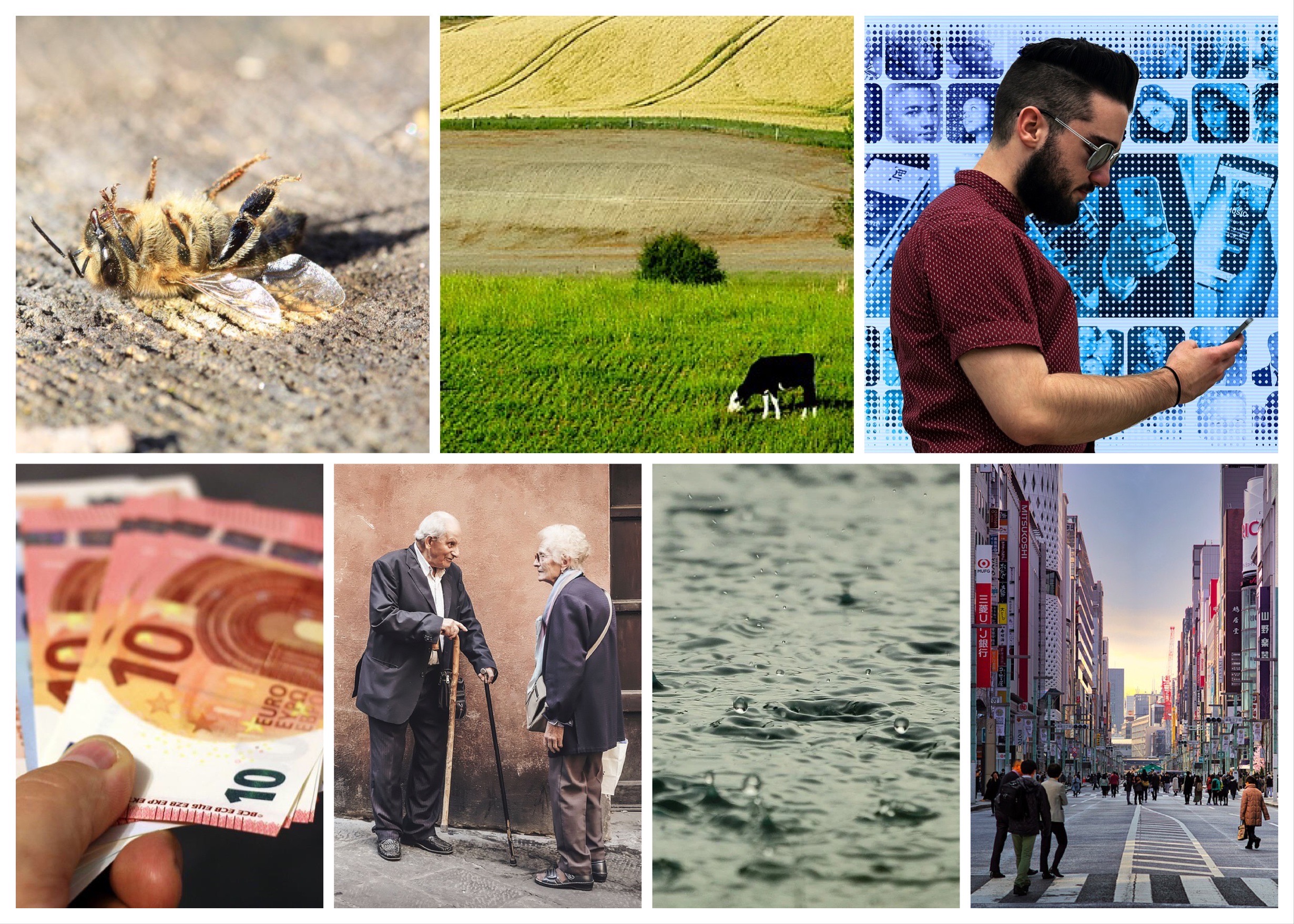
  • Extinction of nature experience – with measures of urban population and adults over 65 years old.
  • Consumption and commerce – with measures of average income, energy use and smartphone ownership.
  • Use and control of nature – with measures of cultivated land, biodiversity and material footprint.
  • Negativistic factors – with measures of risk of natural disasters and average rainfall.

The full rationale for these indicator groups and measures is provided in the full paper, but the aim was to gain insight into how factors such as affluence, technology, consumption and loss of nature are associated with a weaker, or stronger, human-nature relationship.

As an exploratory study, these relationships were simply explored across the 14 countries with correlations. These show the strongest associations to the human-nature relationship were:

  • The country’s level of biodiversity – more wildlife was related to people having a closer relationship with nature.
  • The age of the population – populations with more older people tended to have a closer relationship with nature.
  • Average income – countries with a higher average incomes had a more distant relationship with nature.
  • Smartphone ownership – the more people owned a smartphone, the more distant the relationship to nature.

There were also moderate associations to the human-nature relationship for:

  • Arable land: The more land used for growing crops the higher the closer the relationship with nature.
  • Pasture land: Higher levels of pasture land were linked to a more distant relationship with nature.
  • Urban population: The more people lived in urban areas the more distant the relationship with nature.
  • Rainfall: Wetter countries had a more distant relationship with nature.

This table provides a summary of the correlations between nature connectedness and each country level metric – the closer to 1 or -1 indicating the strongest relationships, with zero indicating no relationship.

Metric Correlation to Nature Connectedness Metric Correlation to Nature Connectedness
Biodiversity 0.806 Energy Use -0.295
Proportion Aged 65+ 0.640 Urban Population -0.402
Arable Land 0.400 Pasture Land -0.433
Natural Disasters 0.059 Rainfall -0.457
Material Footprint -0.065 Income -0.555
Smartphone Penetration -0.784

The results show strong or moderately strong relationships within each of the three broad indicator groupings of extinction of nature experience, consumption and commerce, and utility and dominion. This suggests that extinction of experience, consumption and commerce and utility and dominion are country level factors that are linked to the individual human-nature relationship.

Across all the measures, biodiversity and smartphone ownership had the strongest relationships to nature connectedness, with average income and proportion of older adults providing the next strongest relationships. There’s much more discussion of these results in the full paper, but when it comes to country-level factors and the failing human-nature relationship it is fair to say:

  • Biodiversity really matters – more nature is strongly linked to more connection.
  • Consumerism, technology and prosperity are linked to the human-nature relationship.
  • The way we use our land is linked to individual relationships with nature – with some uses being positive, others negative.
  • Populations with fewer older adults (or more children) tend to have a lower connection with nature – perhaps a sign of shifting baselines and decline in nature connection that mirrors the decline of nature.

The direction of any causality can’t be determined by these results, but the point of the analysis is to show that country-level factors are related to individual relationships with nature. Causality isn’t an issue when there is no relationship. So, the presence of moderate to strong relationships in this relatively homogenous group of countries suggests that the broad macro level impacts on the individual levels of nature connectedness – that is important to know.

Whether it is the weakening relationship with nature that leads to the loss of wildlife or the loss of wildlife that damages the relationship, is a moot point as neither is beneficial – but it is clear that the two are strongly related. Also, research suggests that there is a reciprocal relationship between biodiversity and nature connectedness – both directions are probably important.

Although correlation does not show causation, proposals can be made. It’s fair to propose that national indicators such as urbanisation, land use, biodiversity and income have a long gestation period that could affect individual perceptions of nature connectedness. However, it may still be the case that a long-standing culture of nature connectedness in a country brings about conditions which give rise to higher biodiversity, less urbanisation and lower income.

Causality can also be suggested when there’s other evidence of causal effects, for example increased nature experience (which links to biodiversity and urbanisation for example) and increasing nature connectedness. Or where there is evidence at the individual level for the key relationships, for example nature connectedness has been found to be linked to biodiversity and smartphone use. With immersive digital environments emerging and planned there is also a need to consider the impact of such technology on the human-nature relationship.

A further aspect to consider is that the countries with the greater disconnect to nature tend to be those that have experienced the most economic growth since 1820, with personal income increasing 13-fold in Western Europe, compared to sixfold in Eastern Europe and tenfold in Southern Europe. Affluence is related to consumption and unsustainable trends – the exploitation of natural resources and reduced biodiversity. Especially in these countries nature has given for free and now owe a debt to nature.

In sum, nature connectedness has often been considered at the level of the individual, with programmes and interventions designed to help bring people closer to nature. However, the analysis in this work also shows the need for macro perspectives. The way land is used, how people engage with that land and the impact of land use on biodiversity matters for the human-nature relationship and a sustainable future. Further, the analysis shows that the nature of society matters, the nature of its consumer economy, urbanisation and intergenerational activity are also related to the human-nature relationship. This unique country level analysis adds power and direction to the need for a new relationship with nature for a sustainable future. It also highlights the debt to nature we must repay.

Read Part 2 of this blog here.

Richardson, M., Hamlin, I., Elliott, L.R. et al. Country-level factors in a failing relationship with nature: Nature connectedness as a key metric for a sustainable future. Ambio (2022). https://doi.org/10.1007/s13280-022-01744-w


Posted in Uncategorized | Leave a comment

Actions for visible biodiversity help noticing nature and nature connectedness

Having a strong connection to nature leads people to undertake actions that help conserve the natural world. Recently we wondered whether this relationship is reciprocal. That is,  whether taking steps to conserve biodiversity might actually connect people more strongly to nature. The pathways to nature connectedness suggest care for nature is important, but it’s also the case that pro-conservation behaviours can increase a second pathway – sensory contact with nature. Pro-conservation behaviours vary in terms of how much visible
biodiversity, and therefore contact with nature, they produce. We thought it is likely that conservation behaviours that support higher visible biodiversity will create more sensory contact with nature and therefore increase nature connectedness. The paper on this research has just been published in Ecopsychology, where the final version can be accessed. The accepted version is available here.

Pro-conservation behaviours vary in terms of how much positive visible feedback they provide in terms of habitat and biodiversity, and therefore sensory contact with nature, they produce. For example, a shady log pile under your shrubbery most likely has less visible biodiversity and positive feedback than a sunny patch of nectar-rich flowers. And berry-bearing trees and shrubs such as Rowan and Cotoneaster, although visible habitat, probably support less visible biodiversity throughout the year than a bird feeding station – which in itself is visible but not a sensory nature experience.

We hypothesised that conservation actions that lead to more visible biodiversity and feedback (e.g. planting and maintaining pollinator-friendly plants and providing food for wild animals such as birds) will result in more sensory contact with nature than other conservation actions, such as maintaining fruiting plants and creating log piles or other shelters for wildlife. Furthermore, we hypothesised that this increased sensory contact will in turn lead to greater levels of nature connectedness.

Creating visible biodiversity by planting pollinator-friendly plants

We investigated this using data from Natural England’s People and Nature Survey in the UK, a large national survey that includes items that measure noticing nature, nature connectedness, and pro-nature conservation behaviours. We looked at responses from 4206 people. As we worked with an existing survey choices of pro-nature conservation actions were limited. There can also be some debate about whether the actions produce attractive habitat or visible biodiversity – or both. And that will also be subjective. So further work will be required, but the current work provides proof of concept.

As we expected, the two conservation actions that provided the most visible biodiversity and feedback – maintaining wildflowers and putting out food for wildlife – were significant predictors of the extent to which participants reported noticing nature. In contrast, the two other conservation actions, which would be expected to produce less visible biodiversity and feedback (maintaining fruiting plants and creating log piles), were not related to the amount of nature that participants reported noticing. It’s interesting that of the two more visible habitat actions one was non-significant and the bird feeders that clearly attract wildlife were significant.

How much noticing nature people reported was in turn positively related to their levels of nature connectedness. Importantly, the relationship between pro-nature conservation behaviours and nature connectedness was mediated by the extent to which participants noticed nature. Or another way of putting it: the results suggest that certain nature conservation actions lead to people noticing more nature, and this increase in noticing nature leads to an increase in nature connectedness.

These results also mirror previous findings that increasing the amount of nature noticed leads to a stronger connection to nature and extends those findings by showing how noticing is also facilitated by conservation actions that promote visible garden biodiversity and feedback.

Taking actions to create visible biodiversity helps noticing nature which improves nature connectedness, which motivates actions for biodiversity!

These results point to a relatively simple way to boost human connection to nature: encourage garden behaviours that boost visible biodiversity.

The results also have implications for the design and management of green spaces. When creating and managing green spaces, consideration should be given to creating green spaces that contain features that promote positive visible feedback and biodiversity. For example, particular attention could be focussed on creating areas rich in flowers that attract salient pollinators, such as bumblebees and butterflies, or wetland areas that attract easily-viewed wildfowl, such as ducks, swans, coots and moorhens. Similarly, providing long vegetation in places around the otherwise neatly mown edges of urban ponds should provide places for dragonflies and damselflies to shelter, allowing them to be easily viewed by visitors.

Additionally, habitat features that promote salient biodiversity should be located in salient places. For example, if a woodland planting project contains some mast-bearing species such as oak or beech, then it would be desirable if some of these species were planted close to paths, so that the jays, nuthatches, squirrels and other species they attract can easily be seen by site users.

The results from this study also fit well with previous research and we’ve captured this in the figure below. The figure presents our previous findings that noticing nature is important for building nature connectedness, that nature connectedness is linked to improved wellbeing through noticing nature; that nature connectedness is linked to greater pro-nature behaviours through noticing and that the pro-nature behaviours that increase biodiversity are linked to improved wellbeing. The results above complete the reciprocal relationship between nature connectedness and pro-nature behaviours through noticing nature.

The key role of noticing nature

When we consider improving the human-nature relationship at a societal scale, a key aspect is sensory interaction with nature and creating positive feedback loops to combat the extinction of experience. The present research suggests that visible biodiversity is important. Visible wildlife can be amplified through programmes, events, community involvement in the places where nature recovery networks and people mix.

In sum, biodiversity loss is a sign that the human-nature relationship is failing. A new and sustainable relationship with nature is needed. It is becoming clear that ‘noticing nature’  has a key role to play in improving that relationship for human and nature’s wellbeing. There’s a need to bring visible and salient nature to people and engage them with it. Both through nature recovery networks in urban areas and advice on visible nature conservation actions for the public.


Hamlin, I., & Richardson, M. (2022). Visible Garden Biodiversity is Associated with Noticing Nature and Nature Connectedness. Ecopsychology. Advance Online publication: https://doi.org/10.1089/eco.2021.0064.


Posted in Uncategorized | Leave a comment