Is attachment to things a barrier to caring for nature?

Nature is in crisis and human behaviour is the cause. The UN Secretary-General has summarised the situation starkly, “Humanity is waging war on nature”. There is global recognition that a sustainable future requires a new relationship with nature. While much research has studied broadly carbon-cutting pro-environmental behaviours, there has been far less research into habitat creating pro-nature conservation behaviours. Our latest research looks into the relationship between nature connectedness, engagement with nature’s beauty, nonattachment and dualism and how these factors explain pro-nature conservation behaviours. The paper has just been published in Ecopsychology, where the final version can be accessed. The accepted version is available here. The thinking underpinning the study is quite involved and can be read in the full paper, but a flavour is given in this summary.

It starts long ago, with the once-dominant worldview, still found in Indigenous peoples worldwide who have spiritual traditions such as animism – where objects, plants, wildlife and places are viewed as having a spiritual essence. This embedded relationship with the rest of the natural world has great relevance to nature connectedness. It also raises interesting questions about how nature connectedness relates to the philosophy of consciousness and our modern relationship to the objective world.

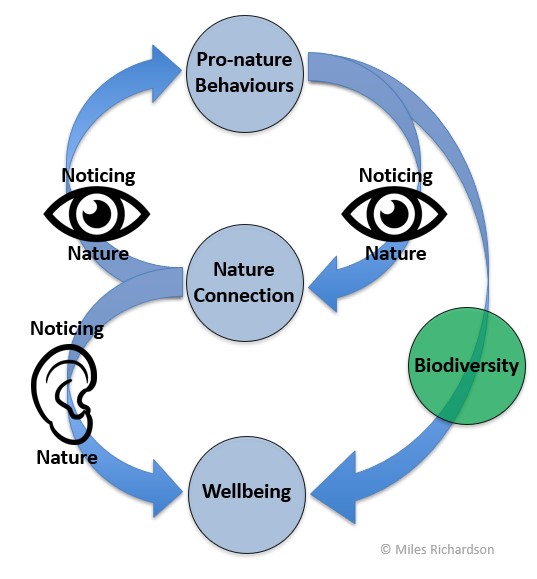
Famously, the Cartesian view sees the subject as separate from the object, and this is reflected in nature connectedness, most accessibly through a key measurement tool. The Inclusion of Nature in Self scale uses overlapping circles to reflect the extent to which an individual’s view of self is separate from nature. This reflects a fundamental construct in Western thinking; the disembodied Cartesian self is a common notion in Western societies. And those that place themselves outside nature tend to show less care for nature – and have lower levels of wellbeing.

Gregory Bateson saw this Cartesian dualism as a key cause of the destruction of nature, writing that if humans continue to think in that way, “it is doubtful whether a species having both an advanced technology and this strange way of looking at its world can endure”. So the study included a measure of dualism.

In Buddhist thought, suffering arrives from our attachment to these separate external objects and impermanent states. Here a more accurate worldview is that all things, including people, are devoid of a ‘self’. So, dualistic behaviours, including craving for things we desire, perpetuate a cycle of suffering – whereas being free from this cycle involves nonattachment. A non-dualistic form of awareness is a central concept of Buddhism. Nonattachment is a state of detachment from objects and concerns, overcoming an attachment for things. Ultimately, all of us are temporary – attachment can’t be a permanent state. Nonattachment is the second measure in this study.

The lotus symbolizes nonattachment in some religions owing to its ability to grow in muddy waters yet produce an immaculate flower.

Human thought has considered beauty for millennia. Western philosophy considers beauty a fundamental aspect of our existence that strongly influences our behaviour. Our relationship with nature includes the beauty of nature – engaging with it is a pathway to nature connectedness. Gregory Bateson felt that engaging with beauty was key to a closer relationship with nature and the wider ecology. Although a link between nature connectedness and engagement with nature’s beauty has been established, the link to pro-nature conservation behaviours has received little attention. Therefore, a measure of engagement with nature’s beauty was included in the study.

These measures, plus one for nature connectedness and pro-nature conservation behaviours, were included in a survey. As well as looking at the relationship between these factors, the analysis looked at the relationship to nature conservation behaviours. The insight gained potentially informs new ways to encourage people to take action for nature’s recovery.

The strongest relationship between the factors was found between nature connectedness and engagement with nature’s beauty, which was linked to pro-nature conservation behaviours. There was a weak to moderate relationship between nonattachment and nature connectedness and a weak, yet somewhat surprising, association between dualism and nature connectedness. In comparison, nonattachment was unrelated to a dualistic worldview. These are discussed in the paper.

Of more practical interest, the significant predictors of pro-nature conservation behaviours were nature connectedness, nonattachment, and engagement with nature’s beauty also having a role. Nonattachment and engagement with nature’s beauty explained similar levels of pro-nature behaviours, with nature connectedness having a stronger relationship, about twice as strong.

The results build on previous work showing the importance of nature connectedness in explaining pro-nature conservation behaviours. They also provide some initial insight into other factors that explain a person’s inclination to actively care for nature. This suggests that in addition to nature connectedness, interventions that foster nonattachment and appreciation of nature’s beauty may have a role in effective programmes to aid nature’s recovery.


Barrows, P. D., Richardson, M., Hamlin, I., & Van Gordon, W. (2022). Nature Connectedness, Nonattachment, and Engagement with Nature’s Beauty Predict Pro-Nature Conservation Behavior. Ecopsychology.

Posted in Uncategorized | 2 Comments

The Curious Tale of Adolescent’s Nature Connection

Several studies have now found that there is a ‘teenage dip’ in nature connectedness. In this latest research, expertly led by Durrell Wildlife Conservation Trust, we looked into children’s nature connectedness in more detail. It’s been published in Current Research in Ecological and Social Psychology where the full paper can be read. This blog provides a summary.

Disconnected from favourite places?

The survey focussed on one geographical area and surveyed 1872 children between 7 and 18 years old. The survey included a measure of nature connectedness plus a range of other questions to explore the factors that may be related to nature connection. These were things like type of school funding, urban/rural location and access/engagement with nature-based activities, plus wider questions about screen time, favourite places and activities.

As with previous research, the results revealed a ‘teenage dip, in nature connectedness, which was more pronounced in boys than girls. It can be seen this was already in decline at the age of 7. Curiously, despite this dip, the survey found that adolescents’ favourite places were natural spaces. So, although adolescents appreciate nature their emotional attachment and feeling of being part of nature is diminished.

Children’s nature connection by age

There was variation though, those young people who preferred natural places, both in general or for relaxation, had higher levels of nature connectedness. While those selecting home as a favourite place had the lowest.

When asked about barriers to getting out into nature, the most frequent response at 43% was that nothing was preventing them from going outside into nature. The second largest barrier was weather (21%), followed by health (10%), school/work (9%) and safety (5%). Similar to our work with adults on smartphones, we found a strong negative relationship between nature connectedness and self-reported screen time, and this was consistent across all age groups and in both sexes.

Whereas favourite places were natural spaces, favourite activities were not in nature. Sports were the most frequently mentioned activities (56% of people), then arts and crafts (35%), fitness (26%) and games such as computer games (18%). Several nature-based activities together came in below 5% and several of those activities weren’t necessarily related to building or maintaining nature connectedness.

As we know that certain types of activity in nature and engagement with nature are key to nature connectedness, it seems likely that the focus on non-nature activities is important. However, the preference for natural spaces provides a path through to increasing more nature based activities, perhaps combining them with other popular activities such as arts and crafts which are well placed to explore the pathways to nature connectedness.

The survey also found that rural schools provided greater access to nature, particularly at primary level, than their urban equivalents. So, it’s little surprise that children in rural schools had higher levels of nature connectedness than children in urban schools – although this effect was weaker when only secondary level students were considered. We also found that children attending non-fee-paying schools had lower nature connectedness levels than those at fee-paying schools, particularly at primary level.

So, in sum, while children’s favourite places are natural spaces, their favourite activities are not nature focussed and the levels of nature connectedness reflect this. To form a closer relationship with nature and access the benefits for mental health and pro-nature behaviour, there is a need for nature to move from a special place, to a place of engagement with nature – from a passive to an active relationship.


Posted in Uncategorized | Leave a comment

Combining Nature Connectedness and Biophilic Design

Biophilic design is a building design concept used to increase occupant connectivity to the natural environment. Stephen Kellert was one of the pioneers of biophilic design and with Elizabeth Calabrese published The Practice of Biophilic Design. However, their basic principles around the need to foster engagement, emotional attachment and positive interactions are often overlooked. Instead, people often focus on the categories of the biophilic design, these aspects can be seen as material and physical elements for inclusion and can be ‘ticked off’. Our latest paper outlines how the pathways to nature connectedness can be integrated into Biophilic Design to maximise the benefits it can bring and it has just been published in Building Research & Information. The accepted version can be downloaded here.

Why consider nature connectedness?

‘Nature connectedness’ refers to the way we relate to and experience nature. A strong connection with nature means feeling a close relationship or an emotional attachment to our natural surroundings. Greater nature connectedness delivers better mental health and is key for both carbon cutting pro-environmental behaviours and wildlife friendly pro-nature conservation behaviours – more so than passive exposure to nature. Some interpretations and applications of Biophilic Design can focus on built elements and exposure alone. However, incorporating the pathways to nature connectedness brings the original Biophilic Design principles of meaningful and emotional engagement with nature back to the fore.

Biophilic Design Principles

In The Practice of Biophilic Design, Kellert and Calabrese state five basic principles essential for the successful application of biophilic design. Three of these are highly related to nature connectedness:

  • Biophilic design requires repeated and sustained engagement with nature.
  • Biophilic design encourages an emotional attachment to particular settings and places.
  • Biophilic design promotes positive interactions between people and nature that encourage an expanded sense of relationship and responsibility for the human and natural communities.

These principles are of great relevance to nature connectedness and overlap with some of the pathways to nature connectedness, which are based on Kellert’s values of Biophilia. They are more behavioural elements of the eventual users of a biophilic design.

The Application of Biophilic Design

In The Practice of Biophilic Design, the categories of the biophilic design framework are described as:

  • Direct experience of nature – actual contact with environmental features such as natural light, air, plants, animals, water, landscapes, fire and ecosystems.
  • Indirect experience of nature – contact with images of nature, natural materials, colours, shapes and forms that evoke and mimic nature
  • Experience of space and place – providing spatial features characteristic of nature that have advanced human health and wellbeing. Such as open views and places for retreat and refuge within organised diversity, clear pathways with natural waypoints and cultural and ecological elements that help develop attachment to place.

Considered alone and apart from the basic principles, the dimensions can be seen as material and physical elements for inclusion. If this becomes the focus, the need to foster engagement, emotional attachment and positive interactions to build a relationship with nature can be lost.

Integrating the Pathways to Nature Connectedness into Biophilic Design

The pathways to nature connectedness can be combined with the three categories of biophilic design application to create an extended biophilic design framework. The pathways to nature connectedness focus on active engagement and have provided a new approach to nature engagement design. For example, in national programmes such as 30 Days Wild from The Wildlife Trusts and 50 things to do before you’re 11¾ from the National Trust.

Rather than design elements such as plants, wildlife and water, the pathways to nature connectedness outline the types of activity to prompt with those natural elements. They provide a framework with great flexibility of application. The pathways are:

  • Senses: Provide opportunities and prompts to notice and actively engaging with nature through the senses. Simply listening to birdsong, smelling wildflowers, or watching the breeze in the trees.
  • Emotion: Provide opportunities and prompts to engage emotionally with nature. Spaces to notice and reflect on the good things in nature, to experience the joy and calm nature can bring. Provide opportunities to express and share feelings about nature with others.
  • Beauty: Provide opportunities and prompts to find beauty in the natural world. Create spaces and moments to appreciate beauty in nature and to engage with it through art, music or in words.
  • Meaning: Provide places to use and explore how nature brings meaning to life. How nature appears in songs and stories, poems and art. Provide spaces to celebrate nature.
  • Compassion: Provide opportunities and prompts to care for nature. Spaces to take action for nature, such as creating homes for nature or planting insect friendly plants.

The matrix below shows how the pathways and biophilic design categories can be combined to ensure interactions of different types across the three categories of application. For example, the direct experience of water provides an excellent opportunity for calm and a place of refuge. Further, pathways and design categories will interact and combine, a place to care for nature can facilitate direct and sensory experience through creating more nature. All the pathways do not need to be activated at every point, the matrix provides a prompt to design in the opportunity for interaction when the opportunity arises without becoming contrived.

Biophilic Design & Nature Connectedness Framework

From Design to Use: The Need to Prompt Engagement

Research evidence, pathways and principles show that biophilic design cannot be passive. The space and features must be used and engaged with. Sadly, evidence shows that most people do not notice nature. Therefore, there is a need make the natural elements salient, and to prompt and provoke people to notice. To use design to demand attention and the power of affordances to encourage interaction.

Moving from the design of a physical space and features within it, to the behaviour of people occupying that space is a difficult process, especially when the principles require emotions to be fostered. So, although good design can influence behaviours, guidance on how users might enjoy and use a biophilic building should be considered. Especially as research evidence can challenge assumptions, such as nature connection comes from knowledge and identification or simply spending time in nature.

A biophilic workplace may need guidance on break taking (e.g. 30 Days Wild) and wellbeing programmes that facilitate sustained engagement with nature. A biophilic school may need guidance on opportunities for extra curricula activities (e.g. 50 Things), or even a biophilic curriculum. Otherwise a biophilic space could soon become more of a background for work or learning rather than a place of positive interactions between people and nature. The interactions that encourage a close relationship and emotional attachment that can help deliver wellbeing and a sustainable future.

Three Key Points

  1. Use the pathways to enact the biophilic design principles
  2. Prompt direct experience of natural elements rather than passive exposure
  3. Provide guidance and ideas for those using biophilic designs.


Richardson, M., & Butler, C. W. (2021). Nature connectedness and biophilic design. Building Research & Information, 1-7.


Posted in Uncategorized | Leave a comment

Double award win for University of Derby nature connection research

The impact of our nature connection research has received national recognition at the prestigious Green Gown Awards 2021, which recognise the exceptional sustainability initiatives being undertaken by universities and colleges across the world.

The University of Derby’s Nature Connectedness Research Group won the ‘Research with Impact – Institution’ award. This focussed on our ‘Pathways to Nature Connectedness’ which provide a design framework for improving the human-nature relationship, which has been used by The National Trust, 30 Days Wild by the Wildlife Trusts, and many others. The pathways also inform the Connecting People with Nature stream of the government’s Green Recovery Challenge Fund and the Green Influencers Scheme.

Research with Impact Winner

Judges thought the submission, linking the natural world and wellbeing, was a “fascinating, holistic, and timely project, combining social and environmental benefits. The impact has benefitted hundreds of thousands of people and is underpinned by strong research.”

I’m thrilled that our research into people’s relationship with nature won this award. A new relationship with nature is essential for a sustainable future, and I’m pleased we’ve been able to produce the new knowledge and tools that others can apply at scale. It is their openness to new ideas and creative application that has made this recognition of our research possible.

The celebrations didn’t stop there, as Lea Barbett, a PhD student I’ve been supervising at Derby, won the ‘Research with Impact – Student’ category. This was in recognition of a tool she developed – a Pro-nature Conversation Behaviour Scale – for measuring behaviours that specifically aim to support nature conversation and biodiversity, which is being used by researchers, conservation organisations and Natural England’s People and Nature Survey.

Commenting on the awards success, Professor Kathryn Mitchell DL, Vice-Chancellor at the University of Derby, said: “The research into Nature Connectedness being undertaken is having a wide-reaching impact on pro-nature behaviours both nationally and internationally. We are therefore delighted that this important work has been recognised with these Green Gown awards.”

For further information on the impactful research taking place at the University of Derby visit https://www.derby.ac.uk/research/


Posted in Uncategorized | 2 Comments

Can the Joy of Birds improve nature connection and wellbeing?

A blog with Dr Carly Butler.

We’re always on the lookout for new and simple ways to connect people with nature, for their own, but also nature’s wellbeing. As the days get colder and shorter many of us will be stocking up bird feeders in our gardens and outside spaces. Our generous provision of bird food is often motivated by a sense of compassion and care, helping birds survive as temperatures drop and natural food sources become harder to come by. For many, feeding birds is also a way of connecting with wildlife and experiencing the pleasure that comes from watching our garden visitors.

The joy of birds

Last winter, a Masters student I was supervising ran a research study to see if a simple twist in the way we watch birds could enhance wellbeing and nature connection. The twist builds on an idea I had of focussing on the emotions birds bring. Thanks to promotion by the Self Isolating Bird Club and assistance from the Alpkit Foundation, 156 people took part in the study and they were randomly allocated to one of two groups. The first group (the ‘Count’ group) were asked to watch the birds in their garden for thirty minutes, identifying each species and counting how many individual birds of each species visited (similar to the RSPBs Big Garden Birdwatch). The other group (the ‘Joy’ group) also watched and identified birds in their garden, but instead of counting them they were asked to rate their feelings of joy on seeing each species. All participants filled out a survey before and after the activity, which measured their feelings of wellbeing, anxiety and connection to nature.

We’ll share the full results when the research is published, however the headline results showed that participants in both groups had improved wellbeing, decreased anxiety, and stronger connection to nature, but the decrease in anxiety was greatest for those in the ‘joy’ group whose anxiety levels dropped by over 20%. This suggests that paying attention to feelings of joy can enhance the psychological benefits gained from watching birds.

After the project we also took the opportunity to explore which species brought the most joy. Long-tailed Tits came out on top, followed by Robins and Goldfinches. The lowest joy ratings were given to Woodpigeons, followed by Magpies and Carrion Crows. The smaller birds brought 50% more joy than the larger birds. Indeed, we expected woodpigeons and corvids to get the lowest ratings as they are disliked by many. Interestingly, while some birds brought more joy than others, that didn’t appear to impact on the benefits – it seems it is the act of noticing emotional responses itself which leads to the improvements in  anxiety.

Our most joyful bird?

Given the involvement of members of the Self-Isolating Bird Club, our sample was not representative of the general population as participants were already keen garden bird watchers and we found they had very high levels of nature connectedness to begin with. While this in itself tells us something about the beneficial impact of feeding birds, we’ve found in other interventions that impacts are greater amongst those with lower levels of nature connectedness. As such, we could expect much greater increases if people who weren’t already connected to their local birds took part in the activity. It’s be great to repeat this work with more people, and more birds!

Meanwhile the research offers evidence for the psychological benefits of watching birds, and suggests that taking part in citizen science projects like the Big Garden Birdwatch can bring about enhanced wellbeing and connection to nature. However, greater improvements in anxiety are gained by paying attention to the positive emotions experienced while watching birds.

This is a simple activity that anyone can do at home, or any outside space where birds are present: take the time to watch birds and notice how you feel when you see them. A structured activity involving joy-watching birds could be used in green prescription schemes, adopted by school and community groups, or used alongside ‘bird therapy’ stations in workplaces. As recent research has suggested bird feeding could have a negative impact on some bird species, care would be needed in designing such schemes. However, as bird feeding increases the nature connection that brings pro-nature behaviours, there’s a need to consider the wider picture.

Our research has shown consistently that noticing nature is a critical first step towards connecting to nature for improved wellbeing. Noticing our emotional responses to nature takes us further towards building a new relationship with it. We know that those who feel close to nature are more likely to take action to help it, so appreciating the joy of birds could lead to more planting for birds and insects, better feeder hygiene, and more eco-aware behaviour.  So, next time you fill up your feeders, stop, watch, and – most importantly – enjoy the birds who come to feed.

Posted in Uncategorized | 1 Comment