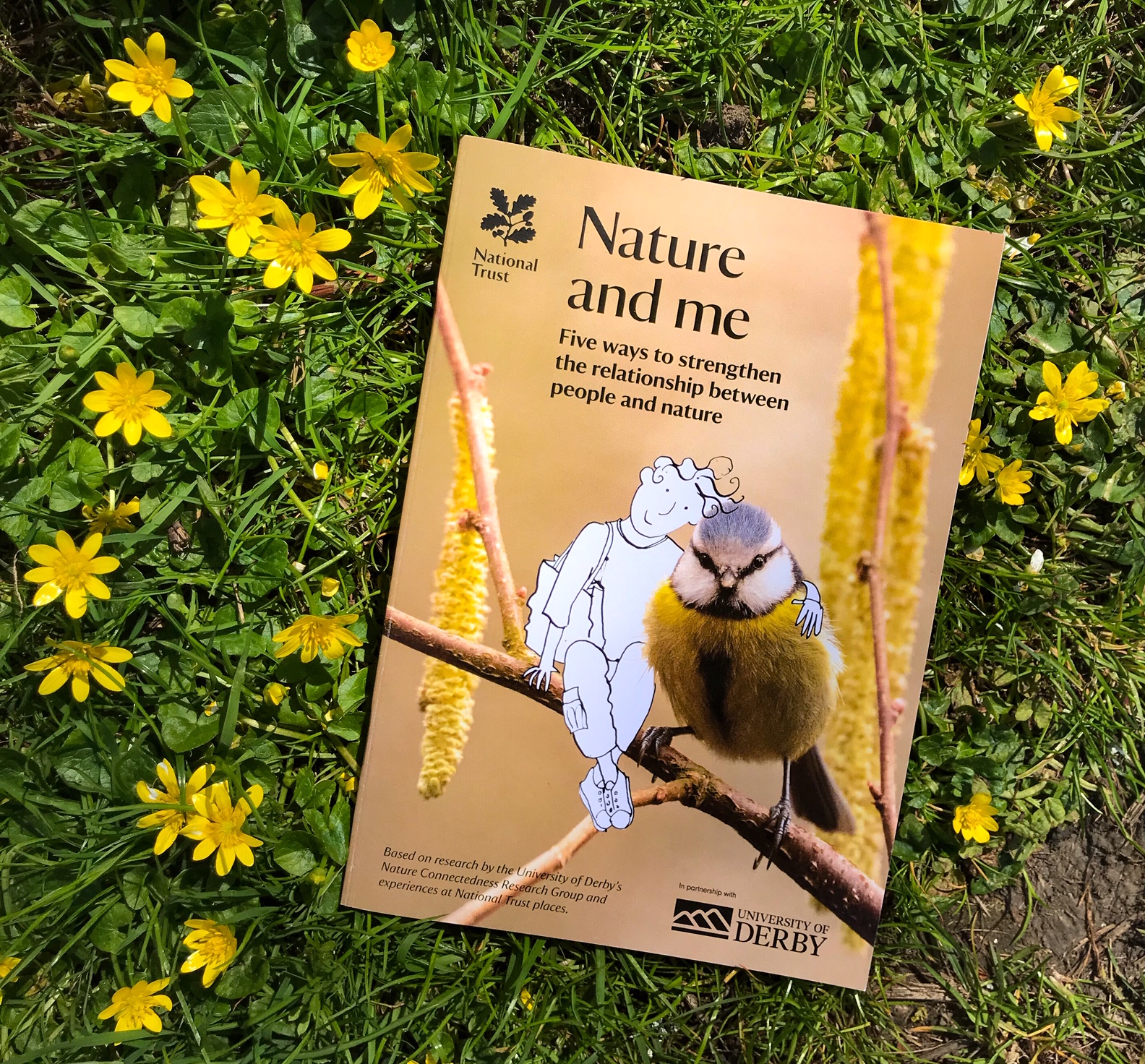
Nature and Me – a new guide to strengthening the relationship between people and nature

The warming climate and loss of wildlife show that our relationship with nature has been failing. However, during the restrictions to control the coronavirus pandemic people have turned to nature. This brings hope that people are ready for a new relationship with nature. During our work with the National Trust we’ve been thinking about, and actively building those new relationships with nature. A closer connection with nature that can boost the wellbeing of people and the wellbeing of the natural world we inhabit.

We want to share what we’ve learnt far and wide. So we’ve launched Nature and Me. A short guide with suggestions on how to get close to nature and the benefits this can bring. Nature and Me has two parts. Understanding the human-nature relationship and a guide to practically improving that relationship. It is based on research by the University of Derby’s Nature Connectedness Research Group and experiences at National Trust places. Please download a copy here.

Part one introduces the concept of nature connectedness, the level of an individual’s relationship with nature. A summary of some of the research findings is then introduced. How life feels good when people have a strong connection with nature. How it’s possible to feel close to nature in towns and cities. How people who feel more connectedness are more likely to protect nature. How teenagers fall out of love with nature, and most adults do not notice nature. The guide then introduces the five pathways to nature connection, a practical framework to inform the design of experiences in nature.

Part two shows that framework at work, using examples form National Trust places to explain how to rethink the approach to nature engagement. How that shifted from what people understand about a place, to the way people experience a place. This new mindset yielded powerful results. From the way places were managed, their habitats and views, to approaches to wellbeing that were more meaningful and mindful. The approach informed learning and education too, with remarkable results. The pathways helped in the celebration and sharing of nature conservation work and outdoor activities for children and adults.

We hope the guide is only the beginning. There are so many ways we can apply the five pathways to nature connection. Read the guide and imagine the results if we applied this thinking more broadly, in our schools, workplaces and cities to create a new relationship with nature for human and nature’s wellbeing.

Posted in Uncategorized | Leave a comment

Tune into Nature Music Prize 2021

To mark World Earth Day it’s great to announce the second running of the Tune Into Nature Music Prize. The launch in 2020 saw 180 entries and resulted in the inaugural winner, I Eden by LYDIAH. The Oak Project is supporting the the prize this year and with a judging panel including musicians Martyn Ware, Sam Lee, Supriya Nagarajan and poet Zena Edwards we are in search for a piece of original music that tunes into nature – helping to highlight the need for a new relationship with nature and provide vital support for young creative practitioners.

LYIDAH: winner of the 2020 Tune Into Nature Music Prize, photo Paula Baines

The Tune Into Nature Music Prize is a strand of artistic programming by the Oak Project, a newly established partnership between Yorkshire Sculpture Park (YSP), the University of Derby and the Bronze Oak Project Ltd, a not-for-profit that promotes contact with the arts to create nature connection. The Oak Project is an initiative that aims to inspire and motivate public action for nature and climate through arts, culture and creativity.

The winning entry will receive a £500 grant to support their work and also benefit from a free professional remix produced by award-winning songwriter and producer Martyn Ware, Principal of Tileyard Education. They will also be invited to perform at Timber, the International Forest Festival, in 2022 – last year’s winner LYDIAH will perform at the 2021 festival. In addition, two further selected entrants will each benefit from a £250 grant.

The Nature Connectedness Research Group at the University of Derby has found that the connection between young people and nature dips during teenage years and takes more than a decade to recover. Research also shows that references to nature in contemporary music have decreased consistently since the 1950s. This matters as a close connection with nature helps both the wellbeing of people and our planet, as people who are tuned into nature are more likely to care for it.

As highlighted in the recent pandemic, the human relationship with the rest of nature is essential for our wellbeing, yet the climate and environment emergencies show that the human relationship with the rest of nature is broken. Nature means less and less in our lives and is disappearing as a reference in our music. We need, now more than ever, a new and more connected relationship with nature and music is a great way to celebrate nature and it’s essential role in our lives.

The competition is open to anyone aged 16-29 and resident in the UK. The track should not be longer than six minutes, contain lyrics and, this year, spoken word entries are welcome to be submitted to the prize. Applications close on 30 July 2021.

The idea is simple: To tune in and celebrate nature.

For inspiration – research shows that a closer, healthier and more sustainable relationship with nature comes through tuning into nature, noticing it, finding beauty, joy, calm, meaning and compassion. Further details and how to enter can be found at https://oakproject.org.uk/projects/tune-into-nature-prize/ 

For some further inspiration, here’s some of my favourite classics and more recent tracks (and as a playlist) that are tuned into nature through the pathways to nature connectedness: senses, beauty, emotion, meaning and compassion:

I’m looking forward to listening to the entries later in the summer.

Posted in Uncategorized | Leave a comment

Moments, not minutes: The nature-wellbeing relationship

A great deal of valuable research has shown that being out in nature is beneficial for human wellbeing. Much of this work uses time and visits to nature as a key measure – they are both straightforward to record. However, this research has largely overlooked the relevance of person specific factors such as nature connectedness – put simply a love of nature. Also, few studies have considered the various ways people engage with nature in concert to establish which types of activity relate best to well-being.

We have been working with the National Trust exploring how being connected and engaging with nature in simple ways relates to pro-nature behaviours and wellbeing. Our paper on pro-nature behaviours was published last year in People and Nature. The second paper on wellbeing has now been published open access in the International Journal of Wellbeing. This blog provides a summary of quite a long and involved research paper.

In sum, we found that a close relationship with nature and simple moments with nature really matter for wellbeing – so much so that the impact of spending time in nature was not significant. Building on our work on ‘noticing nature‘ you can see the impact of such findings in today’s launch of #BlossomWatch by the National Trust.

Noticing blossom matters for wellbeing

The Research

Let’s look at latest research paper in more detail. We looked at data from a nationally representative YouGov survey of 2096 adults to explore how the factors below related to hedonic wellbeing (i.e., happiness), eudaimonic wellbeing (i.e., worthwhile life), illbeing (i.e., depression and anxiety), and general physical health:

  1. nature connectedness,
  2. time in nature (days a week spending more than an hour in nature),
  3. engagement with nature through simple everyday activities,
  4. indirect engagement with nature (e.g. nature TV and books),
  5. knowledge and study of nature.

Our primary focus was on examining, when considered simultaneously, the relative importance of these five nature-engagement approaches.

Full details of the complex statistical analysis are provided in the paper, but a consistent pattern of results emerged across multiple analytical approaches (i.e., correlations, linear regression, dominance analyses, commonality analysis). We found that time in nature was not the main (or significant) predictor of wellbeing – nor were indirect contact with nature or knowledge/study of nature.  Rather, nature connectedness and engaging with nature through simple activities (e.g. smelling wildflowers) consistently emerged as being the significant and prominent factors in explaining mental health and wellbeing.

Even when we considered two basic components of a good life, the basic psychological needs of autonomy (i.e., a sense of control over one’s life) and relatedness (via relationship status), nature connectedness and engaging with nature through simple activities still emerged as being significantly related to happiness, feeling that life is worthwhile, and lower rates of illbeing.

Although there are many complex factors involved in wellbeing, these results support suggestions that nature connectedness itself—tuning into nature—is a core psychological need and basic component of wellbeing.

The finding that spending time in nature is a lesser-factor may seem odd.  After all, solid research has demonstrated that time in nature is important for wellbeing. However,  as noted above, this research has generally not included individual factors of nature connection and engagement.  Findings from the current study suggest that when added to the equation, these person-based factors have stronger relationships with wellbeing than does time in nature. Previous research using time alone is likely to be measuring a close connection with nature and various forms of nature engagement – but not as well as using specific measures of connection and engagement.

Or put another way, imagine if dietary research had focussed on time spent eating and visits to the fridge. Dietary advice would focus on those. Of some use, but it’s what you do in nature, or what you eat, that really matters. Measuring fat content, calories and exercise means time eating would drop from significance. Recommendations are based on what is measured.

There are many different ways to spend time in nature and different types of engagement with nature. Not all are related to wellbeing.

Being connected and engaging with nature generally involves spending time in nature, yet time in nature may not involve active engagement with nature.  Time does not tell the full story.  What matters is how that time is spent—developing and being in a close relationship with nature.

Does amount of time spent together provide an accurate indication of the closeness of a relationship?

The ‘dominance analysis’ showed that nature connectedness completely dominated all the other nature-related factors in predicting a worthwhile life and lower levels of illbeing, and engaging in simple nature activities was ranked as second.  For happiness, engaging with nature through simple activities completely dominated all other nature-related factors, with nature connectedness being ranked second.  It is important to note that “complete dominance does not typically occur in real data” (Kraha et al., 2012, p. 4).  This speaks to the powerful impact that nature connectedness and engagement with nature through simple activities has on our mental health and wellbeing.

This prominence of nature connectedness and engaging in simple nature activities in accounting for the variance in mental health and wellbeing was also evident in the results of the commonality analyses.  Nature connectedness and engagement with nature through simple activities each uniquely accounted for far more of the explained variance in happiness (17%, 20%), a worthwhile life (25, 15%), and lower wellbeing (31%, 15%), than did time in nature.  Indeed, time in nature uniquely accounted for only 1% of the explained variance in each of happiness, a worthwhile life, and lower illbeing.

Time in nature is a better indicator of levels of physical activity – it often involves walking, cycling etc. So, when looking at general physical health, it was time in nature and nature connectedness that emerged as significant predictors of general physical health. These findings remained significant even when considering control over one’s life and relationship status.  The dominance analysis revealed a tie for first ranking between nature connectedness and time in nature. Previously we’ve found that visits to nature, rather than nature connectedness, was linked to health.

It should be noted that relaxing in the garden and smelling wildflowers were the key significant items in the simple activities group – although correlated to wellbeing outcomes, items such as listening to birdsong or watching wildlife did not emerge as significant individual items in the regression. While smelling wildflowers is a simple engagement activity, relaxing in the garden could include non-nature engagement activities. Hence results could also reflect the benefits of having a garden rather than simple engagement with nature.

That said, the consistent pattern that emerged across correlational, linear regression, dominance, and commonality analyses with respect to nature-related factors and individual wellbeing provides strong support for the notion that time is not the main factor in the nature-wellbeing link.  Rather, the key factor is a close connection with nature. Further, these results mirror, and go further, than the findings in our study on another national daaset published last year. The importance of connection and noticing nature was also confirmed in our recent analysis of a third national dataset. From three national datasets, a clear picture is emerging: that nature connectedness and noticing nature are key for wellbeing. Time and visits have role, but should not be the focus.

By not being tuned into the nature around us, our lives are poorer in terms of happiness and meaning.  Yet, as these findings suggest, tuning into nature—through simple acts like smelling wildflowers while relaxing in a garden—help to explain differential levels of happiness and meaning in individual’s daily lives.  Tuning in to nature is not about time, not about minutes.  It’s about moments. Feeling connected to nature and engaging in simple activities in nature explains mental wellbeing better than time spent in nature.

The Implications

The results also have important practical implications for nature-based programmes and governmental policies.  Perhaps foremost at a programme and policy level, would be a shift from focusing on getting people to visit and spend time in natural (often more remote) spaces to focusing on how people can tune in and connect with everyday nature through everyday simple activities. This would also help to enhance nature connectedness and thereby wellbeing – of people and nature. Additionally, the results suggest the importance of provision of garden’s for rest and relaxation.

The pathways to nature connectedness can be applied at a wider scale to inform cultural programmes and urban designs to foster and prompt engagement with everyday nature. City planners could invest beyond islands of urban parks to ensuring that nature is brought to all residents, for example, by ensuring that city streets and neighbourhoods have trees and flowers alongside (or at least visible from) walkways and routes to public transport and shopping areas. Long-term planning for urban “greenways” connecting parks, public, transit, schools, and basic-necessity shops would improve the lives of all residents – if they were prompted and understood the value of noticing nature. As we know from previous research, most people do not notice nature.

#BlossomWatch is a great example of a campaign to notice and celebrate nature and it’s meaning in our lives. The National Trust is inviting people wherever they live to emulate Japan’s Hanami– the ancient tradition of viewing and celebrating blossom – the Trust is now making it an annual tradition, asking people to share the joy and hope that the sight of blush-tinted blooms will bring to help lift spirits and enable everyone to celebrate nature together. 

The findings also have relevance to mental health practitioners.  That nature connectedness predicted greater happiness, greater levels of feeling that life is worthwhile, and lower prevalence of illbeing (i.e., depression and anxiety) beyond feeling one has control over their life and relationship status, indicates that nature connectedness measures may be a valuable tool when assessing clients’ wellbeing.  Simple, pathways-informed, nature activities could be prescribed to clients – indeed we’ve found that noticing the good things in nature brings clinically significant improvements in mental health.

Finally, national policies aimed at raising levels of nature connectedness, and tracking this growth, are required as an expansion to current policies which, in general, are often geared towards measuring time in or visits to nature. We join Lambert and colleagues (2020) in their call for nature connectedness to be included as a standard metric of wellbeing; we also expand this call to national and civic governmental bodies.

The results confirm an emerging and important finding: that connection to and simple engagement with nature bring benefits over and above those derived from spending time in nature. We need to tune into nature and develop greater nature connectedness if we want to maximise the benefits to our own, and nature’s wellbeing. There’s a need for greater public understanding that a close connection with nature is a key component of a worthwhile life, a sustainable life—a good life.


Richardson, M., Passmore, H. A., Lumber, R., Thomas, R., & Hunt, A. (2021). Moments, not minutes: The nature-wellbeing relationship. International Journal of Wellbeing, 11 (1).
https://doi.org/10.5502/ijw.v11i1.1267


Posted in Uncategorized | Leave a comment

Nature Connectedness – For a new relationship with nature: Free Online Course

There’s no wellbeing without nature’s wellbeing. Climate warming and wildlife loss show that the existing relationship between people and the rest of nature is failing. Through a focus on nature connectedness, this free, online short course will show how we can build a new relationship with nature – for the wellbeing of both people and the rest of the natural world.

The Nature Connectedness Research Group at the University of Derby is leading the development of ground-breaking evidence that explains what nature connectedness is, how it can be measured, its benefits for human and environmental wellbeing – and, importantly, how it can be improved. This free MOOC covers that work.

The Nature Connectedness MOOC – for human and nature’s wellbeing

The course provides an opportunity for you to learn about nature connectedness and the value of having a strong relationship with nature. Made up of eight short units, the course encourages you to actively consider our relationships with nature, for our own well-being as well as for the longer-term benefit of nature and the natural world.

  • Unit 1 – What is Nature Connectedness?
  • Unit 2 – Why Nature Connectedness Matters: People
  • Unit 3 – Why Nature Connectedness Matters: Wider Nature
  • Unit 4 – Improving Nature Connectedness: Noticing
  • Unit 5 – Improving Nature Connectedness: The pathways framework
  • Unit 6 – Pathways Case Studies
  • Unit 7 – Using the Pathways Framework and Evaluation
  • Unit 8 – Scaling up – Societal Application of the Pathways

During the course, you will look at why nature connectedness matters and how it can be improved. You’ll learn about our Pathways to Nature Connectedness Framework and will look at how you can use this framework to positively impact our connections with nature, pro-nature and environmental behaviours and our wellbeing.

The course content is informed by nationally recognised research and written by Professor Miles Richardson, a Professor of Human Factors and Nature Connectedness, together with colleagues from the Nature Connectedness Research Group.

The course is open to anyone and will be of particular interest to those who feel passionate about mental wellbeing, nature and pro-nature behaviours. Those completing the course will gain:

  • An understanding of the psychological construct of nature connectedness
  • An understanding of why nature connectedness matters for human and nature’s wellbeing
  • An understanding of how to improve nature connectedness

You can find out more and sign up for the nature connectedness MOOC here.

Posted in Uncategorized | 1 Comment

Benefits of Connecting with Green Spaces: An Evaluation Toolkit for Children and Young People

By Dr Gulcan Garip & Prof Miles Richardson

Our relationship with nature is failing, as evidenced by the loss of biodiversity and climate warming. This has led to calls to reconnect people with nature, particularly children. Programmes in green spaces are important for encouraging and enabling people to connect with nature and adopt pro-environmental behaviours, but there is a need to evaluate the outcomes. The Green Spaces Learning Places (GSLP) in London offered a range of activities for children and young people to encourage engagement with nature. In our latest study published in the Journal of Environmental Education, an evaluation toolkit was co-developed by researchers and practitioners to identify the impact of participating in the GSLP programmes on the following outcomes:

(1)            Understanding: Participants understand the value and importance of green space.

(2)             Confidence: Participants are confident to use green spaces, as part of our activities
or independently.

(3)            Nature connection: Participants develop a sense of place with green spaces, and
pass this down through generations.

(4)            Wellbeing: Participants have restorative and meaningful experiences in green
spaces.

(5)            Involvement: Participants take positive action for, and get involved with, green
spaces.

Sixteen schools took part in Green Spaces, Learning Places (GSLP). The evaluation resources were used with a pre-post survey of 504 school-aged children (5-10 years) and 54 young people (13-19 years), observation of 62 children, and interviews with 26 children and young people. Due to the young ages of some participants in the GSLP programs, existing traditional and validated scales were not appropriate for all participants and some outcomes required a bespoke approach. Therefore, a series of single item measures that directly corresponded to understanding, confidence, nature connection, wellbeing and involvement  were developed and used across all ages for consistency. Briefly, these were:

  • Understanding: ‘do you think parks and places like this are important?’ A ‘happy face’ response demonstrating a participant perceiving green spaces as important.
  • Nature connection: ‘how special are green spaces like this to you?’ A ‘happy face’ response indicated participants may experience a sense of place and meaning
  • Wellbeing, participants were asked ‘how does being in nature make you feel?’ A ‘happy face’ response indicated participants reported positive feelings about being in nature.
  • Involvement: ‘I want to take care of nature and green spaces?’ A ‘happy face’ response to this item indicated participants’ pro-environmental attitudes and likelihood of pro-environmental behaviour,
  • Confidence: ‘how confident or good are you at exploring nature and parks?’

Participants were asked to respond on a 5-point Likert scale to indicate their level of agreement with the items, an example has been presented in Figure 1.

Figure 1. Single-item measure to collect data on understanding.

Based on survey responses from the school-aged children (5-10 years) and young people (13-19 years), our findings suggest the GSLP programmes had a positive influence on increasing participants’ outcomes for the five dimensions we measured. Furthermore, interviews with participants and observation indicators were useful in providing contextual insights that supplemented the findings from the survey.

It was found that participation in GSLP programs significantly improved children’s (ages ranging 5-10 years) before and after ratings of the five outcomes, as shown in Table 1. Although the differences were significant, the changes were relatively modest.

Table 1. Primary School Mean Changes from baseline to follow-up – primary years

Baseline means Follow-up means % Increase
Understanding 3.51 3.62 3.1
Wellbeing 3.34 3.46 3.6
Nature connection 3.30 3.48 5.5
Confidence 3.27 3.46 5.8
Involvement 3.37 3.52 4.5

For the Green Talent program, 54 participants (aged 13 to 19) completed the survey questions with the smiley face response scales. A significant improvement across all dimensions was observed following participation in the program. Interestingly, the differences were much larger, as can be seen in Table 2. National surveys have found a notable ‘teenage dip’ in nature connectedness, this means there is a need for interventions with this age group and these findings suggest they can be very successful. Given the relationship between nature connection and mental wellbeing in adolescents, this is an area for further activity and greater returns.

Table 2. Green Talent Mean Changes from baseline to follow-up – Teenage Years

Baseline means Follow-up means % Increase
Understanding 2.55 3.19 25.1
Wellbeing 2.65 3.11 17.4
Nature connection 2.44 2.93 20.1
Confidence 2.35 2.98 26.8
Involvement 2.02 2.78 37.6

The findings from the psychological evaluation show significant positive influences based on before and after self-reports and qualitative findings related to the five outcomes, which supported the aims of the GSLP programmes. Ensuring sustainable delivery of these programs, with opportunities for children and young people to engage with green spaces as part of these programs, can allow for longer-term evaluation of the effects on participants, as well as on the conservation of green spaces.

The paper shows the value of the collaborative process which provides a model for others in evaluating similar programmes. Furthermore, the positive results related to the five outcome measures highlight the value of engaging children and young people with nature and green spaces through participation in well-designed programmes, not just for the positive impact on wellbeing for participating individuals but also for the conservation of our natural world.


Garip, G., Richardson, M., Tinkler, A., Glover, S., & Rees, A. (2020). Development and implementation of evaluation resources for a green outdoor educational program. The Journal of Environmental Education, 1-15.

Posted in Uncategorized | Leave a comment