Looking ahead to Nature Connections 2019

Our 5th Interdisciplinary Conference, Nature Connections 2019 takes place Tuesday 2 July 2019 at the University of Derby and the NCx2019 Draft Programme is now available. Thirty talks and a range of posters will share the latest projects involved with engaging people with nature and present research evidence on the links between nature connectedness, well-being and pro-nature behaviours. These will include important findings from a large scale population survey and a world first for pro-nature conservation behaviours! Key themes will include:

  • Nature connection in practice
  • Lifespan and Children’s Connection
  • Connecting with Nature through Art
  • Mental health and well-being
  • Tools and Policy

Our keynotes speakers are Dame Fiona Reynolds DBE and Marian Spain, Interim Chief Executive of Natural England. We then move into a couple of key talks, the first sharing results from a large scale national survey which shows how nature contact and nature connectedness differ, but work together to bring health, wellbeing and pro-environmental behaviours.

Given the positive news about the benefits of nature connectedness we’ll move onto the next step, improving people nature connection with a talk from the National Trust about applying the University of Derby’s pathways to nature connectedness. This will show how nature-based activities can be designed and delivered to improve nature connection for different types of people, in different types of spaces, and in different contexts.

The draft programme is subject to change, but at present the first of two parallel sessions will consider a key emerging topic, nature connection through the arts. From nature-based art interventions for engaging the public to how drawing can improve nature connectedness. This session will also include the role of technology and of museums in nature connectedness and living and ageing well before travelling the linescapes of Britain with Hugh Warwick.

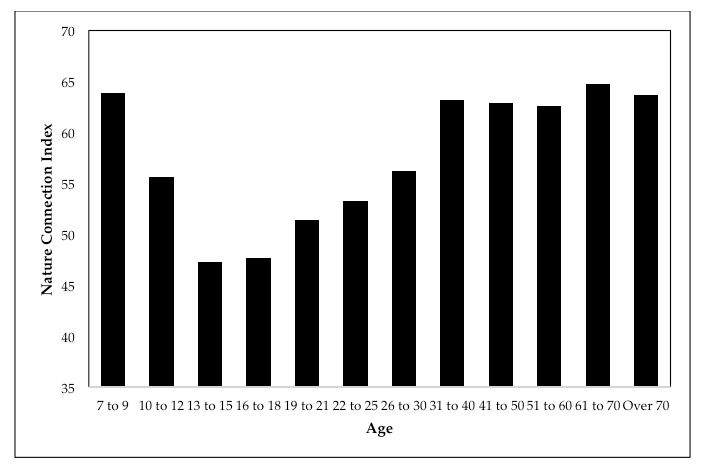
The second parallel session will consider nature connectedness in children and across the lifespan. It opens with more detail from the Nature Connection Index project, including the dramatic  ‘teenage dip’ in nature connectedness. A topic expanded on by the RSPB’s Joelene Hughes and co-authors. We’ll then hear from a large scale evaluation of a green space educational programme and how nature connection and wellbeing can be delivered to children in an urban environment. This will be complemented by an extended framework for practitioners before closing by considering how age and gender affect nature connections and pro-environmental behaviours of urban youth.

One session will cover tools delegates may find of use and a world first! A new scale to measure pro-nature conservation behaviours – amazingly all existing scales look at carbon footprint focussed pro-environmental behaviours, so a great addition as the scale of biodiversity loss becomes more apparent. They’ll also be Greenkeeper – an online toolkit for valuing the multiple benefits of urban green spaces and more on standardising images for nature related research. The RSPB will also share their work on ENACT, a tool for evaluating nature activities for connection.

After the lunchtime poster session, one parallel session will consider young people’s engagement with a semi-wild, disused space and an ethnographic study of a fast-track nature reconnection practice. Prof. Helen Lomax then considers farmers and families connections to landscapes. Finally, there are talks on rewilding people and places, and how nature work develops interconnectedness, compassion, cooperation, and responsibility.

The second parallel session covers mental health and well-being. Delegates will hear how the nature connectedness intervention of noticing the good things in nature can improve wellbeing and mood in people recovering from depression and anxiety. Potential mechanisms for those benefits, namely managing our moods, will then be considered. Dr Rachel Bragg will talk about the growing care farming project – nature connection and green care in policy. We then move onto mindfulness and whether the natural environment enhances its effectiveness for stress reduction. Finally, the relationship between psychopathic traits and nature connectedness will be introduced.

The final parallel session covers the value of NHS green space for workplace wellbeing and nature connection, mental health, and environmental sustainability mind-sets in West Wales. Prof Marcus Grace will introduce the “wonder of nature” project which blended cognitive and emotional approaches to engagement before a post-qualitative narrative of (co) emergence.

As ever, it’s a full and fast moving programme, with plenty of breaks and opportunities to catch-up with speakers and other delegates. If you want to know what nature connectedness matters and how to improve it, book a place at Nature Connections 2019!


Posted in Uncategorized | Leave a comment

Nature Connection and Wellbeing: Feeling Good and Functioning Well

A guest blog by Alison Pritchard – Nature Connectedness Research Group PhD Student

We have all, at times, felt different emotions when we get close to nature. Depending on our circumstances, and the types of places we visit, our relationship with nature can make us feel happy and joyful, contented and thoughtful, or overawed and full of wonder. Or any mixture of these! But how often do we consider the possibility that, as well as making us feel good, nature may also be important for our psychological functioning?

Our latest paper, just published in the Journal of Happiness Studies provides a review of 50 research studies, involving 16,396 people and the links between their connection with nature and two types of happiness – feeling good and functioning well.

Positive emotions are a reflection of what is known as ‘hedonic wellbeing’, which relates to feeling good, the pleasantness of our experiences, and the extent to which our desires are fulfilled.  Also important for our wellbeing is our ability to function well psychologically – which is often referred to as ‘eudaimonic wellbeing’.  Eudaimonic wellbeing includes factors such as autonomy, self-acceptance, meaning and purpose in life, and personal growth.

We know that eudaimonic wellbeing is related to, but distinct from, hedonic wellbeing (eudaimonia and hedonia tend to be associated with different motives, behaviours and experiences), and both types of wellbeing are important: people with high levels of both types of wellbeing are considered to be flourishing.  Understanding how these different types of wellbeing relate to nature connection is important if we are to gain a complete picture of any possible causal mechanisms involved.

Our recent meta-analysis (Pritchard et al 2019) has shown that connection to nature in adults is associated with higher levels of eudaimonic wellbeing. Thus, individuals who are connected to nature are more likely to be flourishing and functioning well psychologically. Although it is not possible to infer causation from the results of a meta-analysis, this finding may help guide us towards possible mechanisms involved.  For example, nature connection may benefit eudaimonic wellbeing because it provides a route through which basic psychological needs – such as autonomy, competence and relatedness – can be met.  In this way the basic psychological need for relatedness could be met by being with nature, which in turn is known to increase feelings of connectedness to nature.

In relation to the need for autonomy, nature could be a route through which individuals are enabled to express their personal distinctiveness, and not feel constrained by external influences such as the values imposed by society.  Ridder’s (2005) concept of a ‘nature-inspired autonomy’ describes the importance of recognising the value of naturalness as a means of gaining a personal sense of freedom and escaping from the dissatisfaction caused by extrinsic influences of society.

Competence needs could be met through learning about natural environments and ecosystems, as well as through enhanced self-knowledge and self-development gained from being connected to nature.  Outdoor learning, outdoor play and wilderness expeditions have all been linked with improved well-being, cognition, personal, social and emotional development, as well as higher achievement and increased motivation to learn

In the meta-analysis, one aspect of eudaimonic wellbeing – personal growth – appeared to have a significantly stronger relationship with nature connectedness than the other types of eudaimonic wellbeing (e.g purpose in life and autonomy).  What are we to make of this finding? If nature connectedness in adults is associated with their personal growth, how much more important could nature connection be for children’s growth and development?  It has been speculated that there may be a window of opportunity in childhood for connecting to nature, similar to the window of opportunity for language development.  If this is the case, the consequences for nature disconnection in childhood could be long-term, and not easily repaired by experiences in adulthood. Kellert (2002) lamented the possibility that we live in “a society so estranged from its natural origins that it has failed to recognise our species’ basic dependence on nature as a condition of growth and development.”

How could we explain a relationship between nature connection and personal growth? Personal growth is concerned with self-realisation and is akin to Maslow’s concept of self-actualisation and self-transcendence. The uplifting experiences we experience in nature do not leave us unchanged: emotions such as awe and wonder, which are often associated with transcendent experiences, could be a key influence in the relationship between nature connection and personal growth. Awe has been defined as ‘an emotional response to perceptually vast stimuli that overwhelm current mental structures, yet facilitate attempts as accommodation’ (Shiota et al. 2007, p 944). Thus, the sense of awe felt in nature could lead to an expansion in individuals’ mental structures and frames of reference, as well as an expanded sense of self, and so foster personal growth.


Kellert, S. R. (2002). Experiencing nature: Affective, cognitive and evaluative development in children. In P. H. Kahn, & S. R. Kellert (Eds.), Children and nature: Psychological, sociocultural, and evolutionary investigations (pp.117-151). Cambridge, MA: MIT Press.

Pritchard, A., Richardson, M., Sheffield, D., & McEwan, K. (2019). The Relationship Between Nature Connectedness and Eudaimonic Well-Being: A Meta-analysis. Journal of Happiness Studies, 1-23.

Ridder, B. (2005). Reorienting environmentalism to nature-inspired-autonomy. Griffith Journal of the Environment, 1, 1–26.

Shiota, M. N., Keltner, D., & Mossman, A. (2007). The nature of awe: Elicitors, appraisals, and effects on self-concept. Cognition and Emotion, 21, 944-963.

Posted in Uncategorized | 2 Comments

IPBES Report on Nature Loss: How Nature Connectedness Can Help

Last week saw the publication of a landmark health-check of life on Earth. The Intergovernmental Science-Policy Platform on Biodiversity and Ecosystem Services global assessment report on biodiversity and ecosystems. It was compiled by 145 expert authors from 50 countries over the past three years, with inputs from another 310 contributing authors. The report assesses changes over the past five decades based on the systematic review of around 15,000 scientific and government sources. The report contains many findings about the decline of the natural world, for example:

  • Nature is declining globally at rates unprecedented in human history.
  • One million species are threatened with extinction with ‘grave impacts on people around the world now likely’.
  • Three-quarters of the land-based environment and about 66% of the marine environment has been significantly altered by human actions.
  • Plastic pollution has increased tenfold since 1980.
  • Human actions threaten more species with global extinction now than ever before.

The report notes that “nature is essential for human existence and good quality of life. That most of nature’s contributions to people are not fully replaceable, and some are irreplaceable.” Yet, nature has been significantly exploited by people and the drivers of change have accelerated over recent decades, “with the great majority of indicators of ecosystems and biodiversity showing rapid decline”. Clearly, the dominant human relationship with nature has been one of utility and control; food and homes are needed for a rapidly growing population. We have exploited the natural world to build our modern world, but nature is essential for life and is in decline. The report notes that nature is declining less rapidly in the land of indigenous peoples, those with a closer connection to the natural world perhaps.

The goals for conserving and sustainably using nature cannot be met with the existing relationship with nature. Transformative changes are required across economic, social, political and technological factors to develop a new relationship. To foster transformative change towards sustainability the report notes (Section D3: Summary for policy makers) that efforts need to be directed at key leverage points – where these efforts can yield exceptionally large effects. These key levers are:

  • visions of a good life
  • total consumption and waste
  • values and action: unleashing existing widely held values of responsibility to effect new social norms for sustainability, especially by extending notions of responsibility to include impacts associated with consumption
  • inequalities
  • justice and inclusion in conservation
  • externalities and telecouplings
  • technology, innovation and investment
  • Education and knowledge: promoting education, knowledge generation and maintenance of different knowledge systems, including the sciences and indigenous and local knowledge regarding nature, conservation and its sustainable use.

Nature connectedness, and the work of the Nature Connectedness Research Group at the University of Derby, can inform several of these key efforts. Nature connectedness helps describe our current relationship with nature and the social context. We can measure it. We’ve developed interventions to improve it. We know it’s associated with a good life. It’s associated with values and actions that link through to consumption and waste. It can help examine the value-action gap. It’s inclusive and accessible across the population. It can inform innovative new approaches to urban infrastructure. To foster nature connectedness research shows that the focus of education needs to change.

In a recent interview on BBC Radio 4’s Costing the Earth, Sir Bob Watson, lead scientist of the report, said we need to ask how do we become more in tune with nature? What makes us happy? How do we relate to nature? How do we enjoy nature? The science of nature connectedness can help answer these questions. We know that the ‘pathways to nature connection’ developed at Derby can help people tune in. As can our ‘3 Good Things in Nature’ intervention. We know from our work on the 30 Days Wild campaign and on the Improving Wellbeing through Urban Nature project that improved nature connectedness brings happiness – two types of happiness, both feeling good and functioning well as shown in our recently published systematic review. Our research has also shown that increased nature connectedness is associated with pro-nature behaviours. Were developing the first measure of pro-nature conservation behaviours. The work of others has shown that nature connectedness explains 30 times more pro-nature behavior than knowledge based environmental education. We need to live and foster a closer relationship, a new relationship, a tuned in and happier relationship with the rest of nature.

Our new relationship with nature needs to recognize that we are incredibly integrated into the ecosystems and connected to the secret network of nature. We can’t survive without it. We’re happier when tuned in to it. We need to accept that we have destroyed much of the natural world and that the dominant exploitative relationship with nature has failed. The answer lies, not in looking back, but forward to a new relationship with nature incorporated into decision-making, business, agriculture, social and cultural life – into every part of our lives because it is our lives. A new social norm of deep nature connectedness based on tuning in with the senses, letting nature manage our emotions and well-being, cultural celebrations of the meaning and beauty of nature – and above all treating nature with respect. Research shows that these are the pathways to nature connectedness, the types of relationship needed for nature’s recovery.


Posted in Uncategorized | 1 Comment

Nature and Wellbeing: Tapping into the Secret Network

In nature everything is connected. Wolves, bears and fish; deer and trees; ants and aphids – as described by Peter Wohlleben in The Secret Network of Nature. The ecosystem is so complex that simple rules of cause and effect don’t apply. A small change can have unintended large consequences. Yet in science we strive to control variables and seek causality in order to obtain the evidence to inform our decisions – evidence that nature is good for humans.

Research accuracy can suffer if all confounding factors are not included in our analyses, yet we can’t fully comprehend all the connections in nature. It’s impossible to evaluate the overall balance, for example between ants and trees and the interactions that are key to the wellbeing of each. Sometimes it seems sensible to accept the network of relationships and focus on finding creative ways to engage with those relationships, rather than getting bogged down in trying to evidence that they exist.

People do not question whether fish need a river, birds the sky or apes the forest, yet people want evidence that humans need nature. Decision makers require (and we are working to supply) more evidence on the benefits of the relationship between people and the (rest of) nature. Those that question whether a close relationship with nature is good for our wellbeing should perhaps consider some fundamental questions. How did we arrive here? Are we part of the natural world? Sadly, when asked, most people are not sure that they are part of nature. Little surprise, as relationships in nature can be fragile, and our detachment from nature is reflected in our thinking, our discourse and increasingly in our culture. This is also reflected in traditional models of human health that view people as separable from their environment. The biomedical model of medicine is based on a deviation from ‘normal’ – health being a function of the individual. Recently, ‘one health’ models of health have been proposed that recognise that humans are embedded within the rest of the natural world

Another parallel from ecology is that when we change conditions to ensure the survival of one species we can put the survival of another in jeopardy. When we focus on one relationship we weaken another. Stephen Kellert, professor of social ecology at Yale, described nine types of human relationship with nature, and a similar perspective can be taken. The dominance of our utilitarian and dominionistic relationships has weakened our moralistic relationship with nature. The dominance of the scientific relationship has weakened the emotional and aesthetic relationships with nature. When we studied the nine types of relationship, we found five predicted a close connectedness with nature. Four did not.

As humans within a wider ecology, we too need balance, in what we do, in what we eat, in what we feel and in our relationships with nature. A sustainable relationship with nature is more than science, more than knowledge, more than facts, more than a resource, more than a challenge, more than a threat. It is also a network of joy, calm, meaning and beauty. We should do all that we can to sustain nature and therefore ourselves.

I increasingly see all things in terms of balanced relationships, people physically embedded in the wider ecology of life and mentally embedded in the wider environment. Our bodies and minds themselves a network of relationships. Although extended cognition and psychological arguments that firmly embed us in the environment exist, these relationships are not fully accepted – you guessed it, more evidence is needed.

Gregory Bateson (1904-1980), the social scientist, anthropologist and systems theorist wrote that we should not be working towards control based on our imperfect understanding of the natural world. Instead we should be using our curiosity to work towards tapping into the secret network, improving our connection with nature and the wider ecology.

The secret network of nature is the secret network of wellbeing, the secret network of our thoughts, the secret network of our being. If a small change can have large consequences in an ecosystem, and humans are of that ecosystem, then it should come as no surprise that small interactions with nature can have a large positive impact on our wellbeing. That is why it is important to notice the good things in nature and ensure that there is a variety of nature to notice.


Posted in Uncategorized | Leave a comment

5 Ways to Wellbeing with Nature

The New Economics Foundation Five Ways to Wellbeing from 2008 provide straightforward and popular guidance on the steps we can take to look after human wellbeing and they can be applied to nature based activities. People have also found that our 5 pathways to nature connectedness provide a valuable framework for engaging people with nature – for both human and nature’s well-being. I’m often asked how the two might work together, so this blog post suggests 5 Ways to Wellbeing – with Nature.

The National Trust have been using the 5 Pathways to Nature Connection

The 5 pathways to wellbeing are based on an evidence report that, in 317 pages, includes no specific nature based solutions. There are just two sentences noting that access to green space contributes to well-being. Similarly, guidance on the 5 ways to wellbeing from the NHS & Mind overlooks nature – we seem to be obsessed with ourselves, other humans and our work, but not the natural world that sustains us. So it’s no surprise that a subsequent NEF report on applications also provides very little on the role of nature based solutions, with brief mention in planning policy of ‘opportunities to traverse green space’ on foot or bike can influence activity levels. Green space is not just an environment to cross – we can pause to take notice. Ten years on it’s time for an update that reflects the latest evidence and ‘one health’ perspective.

This situation is no surprise as despite increasing recognition of the health and well-being benefits we get from nature, and a connection to it – nature is not apparent in our everyday lives, in models of workplace wellbeing and models of health. Recently a ‘One Health’ model of health in BMJ Global recognises that humans are embedded within the rest of the natural world – that the fundamental pathway to wellbeing is a healthy planet. Key guidance on wellbeing such as the 5 ways to wellbeing should recognise this.

Curiously, the role nature plays in our wellbeing is recognised in policy, for example the UK Government’s 25YEP.  Further, the latest evidence suggests nature connectedness is additive and more important for wellbeing than visiting natural places. Nature connectedness also brings pro-nature conservation and pro-environmental behaviours – essential as the one way to a global crisis in wellbeing is an unhealthy planet – and we’re currently heading to a permanently unhealthy world.

So let’s combine the 5 ways to well-being with the 5 pathways to nature connection and propose 5 Ways to Wellbeing with Nature:


Connect – social relationships are important for wellbeing, be with and talk to people – about anything, about nature! We are social animals and as part of the wider natural world nearby nature also helps us feel connected – nature offers socially isolated people a way of feeling connected. Connecting with the beauty of nature also brings pro-social behaviours.

Take notice – be aware of the world around you, savour the moment, notice nature. Noticing nature, its beauty, your emotions in nature and what it means to you are key to developing a closer relationship with nature – which is good for you and provides something to talk to others about.

Give – take part in community life, do something for a friend – do something for nature.

Be active – walk or cycle when you can, to green spaces to connect with others, to notice, to give and learn – connect actively with nature. Research shows that activity in natural environments also brings greater benefits than exercise elsewhere.

Learn – try something new, rediscover your childhood wonder for nature, learn that people are part of the wider natural world and nature matters for human health.


So, in sum the overlap between the 5 ways and 5 pathways can be seen as follows:

Connect – with nature, bringing together the 5 pathways to nature connectedness – Senses, Beauty, Emotion, Meaning & Compassion.

Take Notice – of nature – Senses, Beauty, Emotion, Meaning are pathways to nature connection.

GiveCompassion and caring for nature is a pathway to nature connection and a healthy planet.

Be active – connect actively with nature.

Learn – Learn about your relationship with nature, share your experiences.

As you can see there’s plenty of scope to include the benefits of nature, and connection to it, within the pathways. There’s a need to revise and widen existing human-centered guidance on the 5 pathways to wellbeing which overlooks nature. Because it’s easy, because nature needs to be in our health, and in every decision we make. As ultimately there’s no wellbeing without nature’s wellbeing.


Posted in Uncategorized | 3 Comments