The Unseen Crises of Human-Nature Connection

Too often, we are oblivious to interconnectedness and our relationship with nature. Over the last three years, me and over 100 leading experts from over 40 countries have been working on changes needed to halt biodiversity collapse. It was a massive undertaking, and the week before Christmas, 147 governments approved this report, and a second, by the UN founded Intergovernmental Platform on Biodiversity and Ecosystem Services (IPBES). The report covered the Transformational Change needed to tackle the root causes of the biodiversity crisis. The second report focussed on the ‘nexus’ between the multiple global crises we face.

The IPBES Nexus Report, was widely covered by major news outlets such as the New York Times and the BBC, but the Transformative Change Report received little similar attention. Looking at major news outlets I only found coverage in Le Monde and a little later, a column by William Hague for The Times (more on that in the box below). Broadly, the Nexus report shows that the global crises are interconnected. Secondly, the Transformative Change Report shows that the root cause, our unsustainable focus on the domination and consumption of nature, requires a fundamental shift in how people view and connect with the natural world. It is an essential story of our time.

The Unseen Crises of Human-Nature Connection

The current mainstream narratives for saving the planet include recycling and reducing emissions, for example by not flying, or stories of expensive schemes to capture carbon. But these IPBES reports tell us we mostly need to change how we think and feel.

When looking for solutions we tend to let more tangible single issues dominate. Climate change, with its increasingly dramatic impact and technical solutions receives over eight times more press than biodiversity loss. Yet, the Nexus report highlights the need to tackle the five interlinked global crises in biodiversity, water, food, health and climate change in unison. The key messages of the report captured how biodiversity is essential for food and water supplies, our health, and stability of the climate – yet the rapid loss of biodiversity continues, with wildlife populations plummeting by 73% since 1970. The Nexus report highlights how society’s fragmented approach exacerbates the problem. Continuing with compartmentalized, “siloed” responses and focussing on one element above another, will lead to greater negative outcomes and financial costs.

The Transformative Change Report offers a different, yet equally critical perspective. To deal with the biodiversity crisis, it calls for fundamental shifts in how people view and interact with the natural world. Challenging the pervasive, unsustainable relationship of domination and consumption of nature ingrained in society and institutions. This aligns with the views often held by Indigenous Peoples, advocating for practices that respect and are in harmony with nature. Relational worldviews that lie submerged beneath centuries of modernity. A situation that will persist if it goes unreported.

Thankfully, William Hague thought differently, featuring the report in his column Destruction of nature is harming us all. Given the 73% decline in wildlife populations since 1970, he noted the significance of the 3-year global assessment by a UN panel of scientists, approved by almost 150 countries.

Recognising how a narrow focus on climate can lead to policies that inadvertently damage nature, the column included evidence of nature’s benefit to wellbeing, such as how woodland can manage moods and the benefits of microbes – as I’ve detailed at length in Reconnection: Fixing our broken relationship with nature.

William Hague argues that destroying nature, which is vital for our health, has huge implications for government policies. He recognises that progress will depend on a key recommendation of the IPBES report, that we have to change views and values to recognise that humans and nature are interconnected. He hopes that in 2025 we realise that poor mental health is connected to laying waste to the ecosystem of which we are part as the “the evidence shows that all need the connection with nature that we have so nearly lost”.

The column recognises that humans and nature are interconnected, although the focus of the column, perhaps necessarily just now, is on nature as a benefit for humans. Shifting away from human centric values to that interconnection is the key message of the second IPBES report. Policies noted in the column, such as access to green spaces don’t change such values on their own. After all, we had access to 73% more nature around us in 1970, but didn’t protect it.

Both reports share a common theme: interconnectedness. The lack of coverage of the Transformative Change Report underscores the key messages of both reports, the need to appreciate interconnectedness and shift dominant societal views to recognise and prioritise human-nature connection because it can unite both human and nature’s wellbeing. The current unsustainable relationship with nature is so deeply embedded it is unseen by many and unchangeable by a few.

Even if the timing of the reports was not ideal, the oversight of this report reflects a lack of consciousness of our failing relationship with the rest of the natural world. It is also a missed opportunity to inform, to play a role in creating a positive vision of a flourishing future with nature. The report found that visions are fundamentally important to inspire transformative change and that there is a role for every person and organisation to create change.

However, rather than interconnectedness, our collective focus, both in policy and public discourse, has been predominantly on managing symptoms — restoring habitats, mitigating pollution and, overwhelmingly, reducing carbon emissions. The latter often a negative story of a life without things we are accustomed too. Yet, such actions are merely bandages on the deeper wound of our relationship with nature. This relationship, rooted in viewing nature as a resource for human use rather than a partner in our existence, perpetuates the very problems we seek to solve.

Even when there are calls to reconnect with nature, they often frame nature as a resource for human well-being, perpetuating a human-first mindset. True relational thinking doesn’t focus on a dose of nature being a ‘pill to pop’ for our wellbeing. It sees nature as interconnected with human life and fostering this interconnectedness unites the wellbeing of people and planet – and can even improve relationships between people.

Policy tends to focus on tangible features, reducing nature to terms like “green infrastructure,” taking the subjective decisions to focus on ‘objective’ physical and measurable aspects and thereby failing to inspire visions of human-nature connectedness. Even when included, the less tangible concept of nature connectedness is often overlooked. For instance, the UK Government’s Dasgupta Review on the Economics of Biodiversity, considered and noted the importance of nature connectedness, but this was lost in policy summaries. Yet policy recognises that relationships do exist – marriage makes them tangible in law.

Understandably, the news focuses on reporting the (increasing) symptoms also. The lack of coverage of the Transformative Change Report is a stark reminder of the widely neglected crises of our disconnection from the rest of nature. A sustainable future is not just about saving habitats or reducing carbon footprints; it’s about rethinking our relationship with the natural world at a fundamental level. The second IPBES report shows that we must delve deeper into these narratives and make them more visible, presenting visions of integrating nature connection across the public realm and encourage more people to play a role in making them a reality.


Thanks to Dr Carly Butler for comments on a draft of this blog.


Posted in Uncategorized | 1 Comment

Human-nature connectedness: A powerful strategy for transformative change.

Deep, fundamental shifts in how people view and interact with the natural world are urgently needed to halt and reverse biodiversity loss and safeguard life on Earth, warns a landmark new report by the Intergovernmental Platform on Biodiversity and Ecosystem Services (IPBES). The Transformative Change Report has been approved by representatives of 147 Governments at an IBPES meeting in Windhoek, Namibia. The new report will inform policy and action on the underlying causes of biodiversity loss and the kind of system-wide changes needed for a more just and sustainable world. The three underlying causes identified by the report include the ‘disconnection of people from nature’. Human-nature connectedness is recognised as a powerful strategy for transformative change.

Prepared over three years by more than 100 leading experts from 42 countries from all regions of the world, the report explains what transformative change is, how it occurs, and how to accelerate it. I was one of Government nominated lead authors, so it is fantastic that the Summary for Policy Makers has been approved and published.

The report defines transformative change as fundamental system-wide shifts in views – ways of thinking, knowing and seeing; structures – ways of organising, regulating and governing; and practices – ways of doing, behaving and relating. Promoting and accelerating transformative change is essential to meeting the targets of the Kunming-Montreal Global Biodiversity Framework. This vision of living in harmony with nature describes a world that is just and sustainable, where all life can thrive. The new assessment focuses on transformative change that deliberately contributes to achieving the 2050 Vision for Biodiversity and global sustainability

The Transformative Change assessment took three years, so clearly there’s a lot of content. This blog simply selects content from the Summary for Policy Makers most relevant to nature connection, which is straightforward as it is identified as one of three main causes of biodiversity loss and one of the five areas for action.

Key Messages

The summary for policymakers recognises that transformative change is urgent, necessary and challenging – but possible. It contains six Key Messages, one of which (KM3) is the identification of four principles to guide deliberate transformative change: equity and justice; pluralism and inclusion; respectful and reciprocal human-nature relationships; and adaptive learning and action.

The principle of respectful and reciprocal human-nature relationships acknowledges relational values and responsibilities based on human-nature connectedness and represents a move from instrumental relationships of extraction, exploitation, domination and control towards fostering values of care, respect, solidarity, responsibility and stewardship.

5 Strategies

Embracing insights and evidence from diverse knowledge systems, disciplines and approaches, the report also identifies five strategies and actions to overcome the human domination over nature. These are:

  1. Conserve, restore and regenerate places of value to people and nature that exemplify biocultural diversity
  2. Drive systematic change and mainstreaming biodiversity in the sectors most responsible for nature’s decline
  3. Transform economic systems for nature and equity
  4. Transform governance systems to be inclusive, accountable and adaptive
  5. (KM12) shifting dominant societal views and values to recognise and prioritise human-nature interconnectedness.

 Human-nature interconnectedness is recognised as a powerful strategy for transformative change. Cultivating feelings of nature-connectedness is seen as important. For example, targeted policy measures that support and enhance the visibility of nature connection can catalyse and sustain new social norms and behaviours. This should include experiential nature appreciation and knowledge co-creation by combining different knowledge systems including Indigenous and local knowledge. Also recommended is ‘integrating nature connectedness into education, health, spatial planning, communication and art, and by fostering the understanding that human well-being and quality of life are dependent on nature’. Additionally, practices like, systems thinking and transdisciplinary approaches can help embed nature’s values into decision-making.

Visions of Transformative Change Visions

Shared positive visions and their development are fundamentally important to inspire transformative change (KM13). It is especially important to recognise socio-ecological interdependencies and the agency of non-human life. Visions, which include narratives and stories, are desirable future states of people and nature, including Mother Earth, shaped by values and worldviews. Transformative visions value nature in multiple ways and no single vision is appropriate to all contexts, but visions that promote Indigenous and local knowledge and recognize and combine intrinsic, relational and instrumental values are the most promising. However, one of the knowledge gaps identified by the report is the imagination gap in envisioning positive futures where humans are seen as an integrated part of nature and living in harmony with nature.

Five core themes emerged from an assessment of over 800 visions with transformative aspirations for desirable futures for humans and nature. These are: 1) regenerative and circular economies, 2) community rights and empowerment, 3) biodiversity and ecosystem health, 4) spiritual reconnection (between humans and nature) and behavioural change, and 5) innovative business and technology.

Roles for All

A key message from the report is that there is a role for every person and organisation to create transformative change at multiple levels. Transformative change is system-wide, therefore, to achieve it requires a whole-of-society and whole-of-government approach that engages all actors and sectors in visioning and contributing collaboratively to transformative change.

Closing thoughts

After forming the Nature Connectedness Research Group in 2013 and seeing the rapid increase in research over recent years, it’s great that, having considered the evidence, such a range of experts are emphasising the importance of nature connectedness and advocate integrating this concept into various sectors alongside fostering positive visions of a harmonious future with nature.

I’ve always believed nature connectedness is an essential and powerful strategy for the transformative change needed to address the environmental crises. We’ve suggested policy measures to mainstream nature connection, such as integrating nature connectedness into education, health, urban planning. We’ve also considered visions, narratives and stories that provide people with a positive future with nature, rather than a life without things like, cars, gas boilers and air travel.

Shifting dominant societal views and values to recognise and prioritise human-nature connectedness is a massive undertaking. The pull of the status-quo akin to escaping the Earth’s gravity.

With the disconnection of people from nature identified as a central issue and nature connectedness as a solution, there might be more awareness and willingness to engage. Environmental policy tends to focus on addressing the symptoms of the environmental crises, for example restoring habitat and cutting carbon. Although important, this can miss the root cause, so it is great to have our relationship with the rest of nature clearly identified as an underlying cause and solution.

Policy tends to focus on physical connections, on tangible features and often reduces nature to terms like ‘green infrastructure’. This does little, if anything, to inspire visions and recognise human-nature connectedness. The less tangible concept of nature connectedness is often not considered. Take, for example, the Dasgupta Review. The consideration of nature connectedness in the full report, was lost in the policy summaries. Yet, the IPBES Transformative Change Report highlights the urgent need for that focus. I hope this report, approved by 147 Governments, will be a major boost to tackling the root cause of the environmental crises, our failing relationship with the rest of nature.

Posted in Uncategorized | Leave a comment

Threads

Two years ago today I made an unexpected discovery. This blog post is a more personal story, a departure from the usual content, although all about connections. A story shared to the Internet in the hope that one day it might lead to the completion of a very difficult puzzle, or maybe a photo to illustrate the story.

In Reconnection I considered the history of our failing relationship with nature. A journey from the landscape of evolution, hunter-gatherers and through revolutions of farming and industry. Very often difficult lives, but successful ones given the 10,000 or so generations that have led to our co-existence here and now. The success of our parents, their parents and the thousands of others who came before represents a thread of life. I’ve always been keen to trace these threads. My father’s family of pipe organ builders from Marylebone in London and my mother’s family that has lived locally for centuries.

Threads

After finishing writing Reconnection and having hit the buffers in my family tree research, I took a DNA test in the hope of finding out more. And I found out more than I ever imagined, the father who brought me up, was not my biological father. My family tree was suddenly missing a branch. However, the results that took away so much in one instant, also revealed very little about my biological father. My DNA matches were mainly 4th and 5th cousins.

The story of the search has taken many twists and turns and is still incomplete. This blog doesn’t tell the story of the search, that’s for another time, it simply shares where we’ve got to in the hope that this thread on the Internet might be picked up one day by someone researching some of the names that follow.

I say “we” as the search is complex, involving specialist skills. I called upon the Executive Director of GenGenies.org and investigative genetic genealogist, Britta Brewer, based in the US. She was able to sort and triangulate hundreds of the small matches from the various consumer databases that have my DNA results.

These DNA facts, together with clues from the sports columns of 1960s newspaper archives, helped identify truths and untruths, link people by time and place and refine the search. Such that a possible father did genetically line up with many of my probable paternal grandmother’s other descendants. So, it seems likely from piecing together the distant DNA matches, that my paternal grandmother could be Alice Whorwood who was born on 4 April 1910 in Two Gates, Tamworth. She married William Edward Adcock, they had three children and Alice died on 7 April 1977 in Lichfield, Staffordshire. Britta and I are at a point where my likely newfound cousins will need to take test to confirm the findings, but that is not a straightforward request!

How distant DNA matches (pink boxes) come together to identify ancestors

So, before wrapping up the story, here goes with several names and relationships, those threads that others might find via Google and pick-up.

Alice’s mother was Agnes Louisa Holland, born 15 September 1883 also in Two Gates. She married George Whorwood in January 1904 in Tamworth. They had eight children, so plenty of descendants who might take a DNA test to help confirm my paternal line, or otherwise. Agnes died on 30 September 1964.

There are several distant DNA matches that support my ancestors on this side being Holland’s, Stokes’, Simmons’ and Parker’s from the Warwickshire and Staffordshire area.

Agnes was the daughter of Thomas Holland, born April 1842 in West Bromwich. He died on 5 September 1924 in Tamworth having many children with Hesther Simmons, born 6 August 1846 in Wilnecote, Warwickshire and died in April 1915 in Tamworth.

Back to Alice and her husband, and my great grandfather, George Whorwood, born on 27 February 1881 in Fazeley, Staffordshire. He died on 4 March 1943 in Sutton Coldfield, Warwickshire and was buried in Tamworth, Staffordshire.

Again, there are many distant DNA matches to support this paternal line, via his mother, my likely 2nd great grandmother, Fanny Sandland born on 5 July 1856 in Wilnecote, Warwickshire. She died in July 1935 in Tamworth and her mother Harriet Alsop, my potential 3rd great grandmother, born 25 January 1817 in Polesworth, Warwickshire, died in April 1886 in Tamworth once again.

That’s my paternal grandmother’s line, mainly miners and labourers. The paternal grandfather line is more complex. Some DNA matches line up with my paternal grandfather’s mother, but his father is missing matches, meaning his father is also likely different to the paper trail. This complicates the search, but the overwhelming DNA evidence pointing toward my likely father negates the one missing link.

What we do know is that line is descended from my 3rd great grandfather James Brockley, born in 1828 in Wolstanton, Staffordshire. A farmer of 296 acres, he died in January 1907 in Newport, Shropshire. He married Sarah Frost born in 1830 in Wolstanton, who died in 1895.

My closest DNA match, a 2nd or 3rd cousin is on this side, suggests that a descendant of Joseph Nield and Mary Tatton could be linked to Alice Whorwood, several lived in the same area around Tamworth. Like Joseph, Henry, William and Cecil Nield of Middleton.

Joseph Nield was born on 10 October 1874 in Wolstanton, Staffordshire. He married Mary Tatton on 31 October 1893 and they lived in Middleton, Warwickshire. Mary Tatton was born further afield in Barnes, Surrey on 22 October 1876.

So, they are the main threads. The DNA test also revealed very distant threads, mainly from England, but traces to Sweden, Norway, Germany and Ireland.

On my maternal side, I am a descendant of a European woman who lived around 13,000 years ago. Her ancestors migrated into Europe from the Middle East as the Ice Age receded. An illustration of the ever-growing tree from a few distant roots.

Wider Origins

My paternal line took a different journey domesticating plants and animals in the Fertile Crescent of the Middle East, before pushing east into Central Asia and north into the Caucasus Mountains. Some of them eventually reached the steppes above the Black and Caspian Seas. Pastoral nomads, herding cattle and sheep across the grasslands, others to the south developed bronze tools and weaponry. Around 5,000 years ago they spilled east across Siberia and down into Central Asia. To the west, they pushed down into the Balkans and to central Europe. Over time, their descendants spread from central Europe to the Atlantic coast.

The DNA threads can even identify individuals from this era, and thereby illustrate the journeys above. Like around 1 in and 100 others I’m related to an infant buried between 1379 BC and 1196 BC in Kazakhstan. And also, a few centuries later, a man of the Tagar culture, an Early Iron Age culture that farmed in southern Siberia.

Fast forward, a thousand years and like around 1 in 300 others, I’m related to a Seafaring Warrior from Sweden, buried with weapons in a ship after an conflict between 700 and 800 AD in Salme, Estonia. Closer still, like just a few thousand people in the UK, I’m more closely related to young Danish Viking raider of 880 AD to 1002 AD found in a mass grave of massacre victims at St. John’s College at Oxford University.

Of course, similar threads run through wildlife, but across many more generations, with far more failures as populations dwindle. Looking further back in time to our ancestors brings continuity, connects us with place and shapes our personal identity – I’ve been to Tamworth for the first time! As I explore in The Blackbird’s Song, that link to the past can be used to encourage us to look forward and think about becoming good ancestors ourselves, by restoring the natural world and our relationship with it and others.


Posted in Uncategorized | Leave a comment

Network Insights: The emotions and activities that are central to nature connectedness experiences

To tackle the environmental crises we need a new relationship with the rest of nature. To do science, and for simple messaging, we often isolate the factors that are important for a new relationship with nature. Yet, in reality these factors form a network and do not work in isolation. Life and relationships are complex. In our latest research, published in the Journal of Environmental Psychology, we aimed to capture there interrelations by treating nature connectedness experiences as a network using principles adapted from social network analysis. The results showed the approach works well, confirming previous research using other approaches, but suggesting novel insights too.

The details of network analysis and how it was done are in the full paper, but very briefly it involved asking a couple of hundred people to complete a card sorting task about their nature connection experiences, moving network factor cards to show which were present or not. One study looked at the emotions that may or may not be part of nature connection experiences, such as joy, fear or love. The second study considered the activities that may or may not be part of nature connection experiences, such as watching nature or learning about nature.

The Emotion Network

All emotions, especially the positive ones, seemed to have at least some degree of influence on nature connectedness. Let’s look at negative influence first. The most noteworthy (i.e., the biggest and reddest nodes) were boredom, irritation, and disgust. These negative emotions were highly and distinctly absent from peoples’ nature-connection experiences.

The most noteworthy positively influential emotions (i.e., the biggest and greenest nodes) were awe, joy, inspiration, excitement, love, and gratitude. These positive emotions were highly and distinctly present in peoples’ nature-connection experiences. Some of this is known or suggested from previous research using other methods, thereby showing the network approach works well.

The network analysis did though produce some more novel insights. First, eco-anxiety may not be an obstacle to nature connection, see this recent blog for more on this relationship. Second, boredom, which may serve as a barrier to positive experiences, but has surprisingly received little attention. Third, the role of nostalgia and curiosity. Curiosity is a desire to know more, it turns knowledge, which does little on its own to increase nature connection, into an emotion.

Nostalgia is an emotion found across cultures that makes life more meaningful and provides a bridge between the past and present. Like nature connection, nostalgia is a positive emotion and helps us feel part of something beyond the here and now. Many nature connectedness interventions focus on mindfulness and being ‘in the moment’. There is far less work that considers time and looking back. Such ‘beyond the moment’ narratives and traditions—such as those more that feature more prominently in the more harmonious Indigenous relationships with nature—are likely to have a role in negating emotions such as disgust and boredom and generating positive emotions, together with interest, curiosity, and hope from reflecting on the bigger picture. At the very least, the evident role of nostalgia here may give reason to broaden our scope beyond in-the-moment and mindfulness-based interventions to consider narrative and remembering-the-past based interventions (see this recent blog for more).

Further, the network also shows ‘centrality’. The three most positively central emotions were inspiration, love, and excitement. So, when inspiration, love, and excitement are present, many other positively influential emotions are likely to be present, and few negatively influential emotions are likely to be present (see this recent blog for more on love).

Finally, three distinct clusters emerged in the network; drive, contentment and threat. These clusters mapped strongly onto my accounts of how nature helps play a role in affect regulation and well-being. The fact the emotions in nature connectedness experiences clustered in a way that mirrors this model of emotion regulation, suggests a novel point of convergence between nature-connectedness, emotion regulation in nature, and physiological responses to nature, helping, for example, to explain how nature connectedness brings wellbeing.

The Activity Network

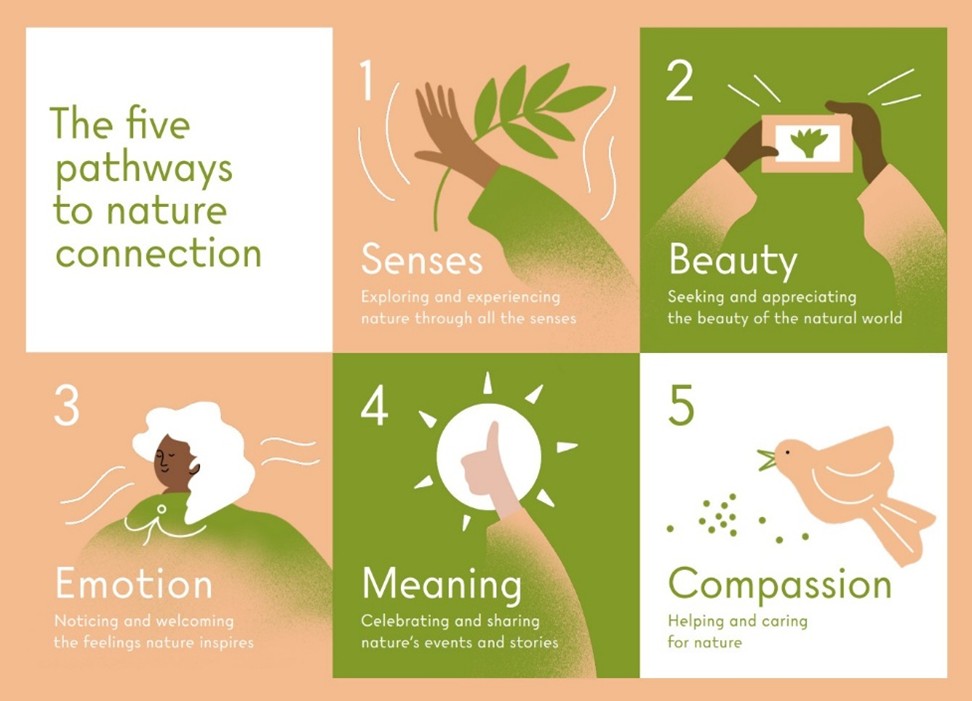
The good news here was that the pathways to nature connection came through strongly as being highly and uniquely present in people’s nature connection experiences. So they were confirmed by a completely different method, but the network analysis showed how they may work together. It also confirmed that scientific engagement is not an important pathway, but can be a stepping stone. Our pathways suggestion has always been to make the science emotional or meaningful.

Interestingly, basic engagement with nature was necessary, but not sufficient, it needs to be meaningful. This returns us to a common theme, there’s a need to move beyond access as nature connection is about moments not minutes.

In terms of barriers, discomfort and distraction (e.g. thinking about things to do or listening to music) came through as barriers to nature connection, which tie into irritation and boredom from the first study. The separate roles of stewardship and social engagement were further novel insights that need to be explored further.

So, some key take aways:

  • The key role of emotions in the human–nature relationship, but they feature little in policy.
  • The need to move beyond access to meaningful and deliberate engagement.
  • The importance of inspiration and love.
  • The role of nostalgia and ‘beyond the moment’ narratives and traditions.
  • Disgust, boredom, and irritation seem to get in the way of nature connectedness.
  • The pathways to nature connection were confirmed.

To summarise, the research demonstrated the utility of the situation network approach. Its validity was supported by its ability to corroborate existing research findings, such as the importance of key positive emotions (e.g., awe and joy) and key pathways to nature connectedness (e.g., meaning and beauty). Further, the generativity of the approach, even within a well-established body of literature, was supported by its ability to identify novel findings. That’s useful for further research, but for application, this approach has highlighted the need for policy to recognise interrelationships and move beyond limited notions of access to include active and meaningful engagement with nature, through targeting key emotions such as inspiration from or love for nature and combating irritation and boredom.


Lengieza, M.L., Richardson, M. & Aviste, M (2024). Situation Networks: The emotions and activities that are central to nature-connectedness experiences, Journal of Environmental Psychology.


Posted in Uncategorized | Leave a comment

The Out-Group Effect: How Human Focus Undermines Eco-Responsibility

Nature connectedness, our love of nature, shapes our identity and values and is a decisive construct in influencing people’s values and behaviours and an important ‘leverage point’ for a sustainable future. Similarly, connectedness to Humanity, our sense of connection with others, is associated with behaviours focused on achieving harmony between the individuals within society. An interesting new research study explores how they interact to bring responsible eco and social behaviours.

Although we divide nature into fragments to inspect and understand, it is relationships that make the world go around. Relational worldviews are perhaps the original worldviews, split apart by revolutions of science and consumption, to the point reality is forgotten. Cognitive science shows us that mind, body and the wider environment are one. Connectedness matters.

This recent study measured both nature and social connectedness, plus eco and social values and responsible consumption, of close to 500 adults from the UK and USA. Some complex statistical modelling tested how nature and social connectedness effected values and responsible consumption.

As you might expect, nature connectedness contributed to eco-responsible consumption, and socio-responsible consumption lesser extent. And social connectedness contributed to socio-responsible consumption, and eco-responsible consumption to a lesser extent – but independently of the common factor of connectedness. Again, as you might expect, biospheric values were involved in the link between nature connectedness and eco-responsible consumption, while altruistic values were involved in the link between CH and socio-responsible consumption.

Now for two really interesting findings! First, nature connectedness was a better predictor than connection to humanity of altruistic values that go on to promote socio-responsible behaviours. This suggests that nature connectedness is a more encompassing and profound form of connection that extends to both the natural and social environments. Second, connection to humanity had a negative contribution to biospheric values and thereby eco-responsible consumption.


These results are discussed with reference to in-group and out-group dynamics or us and them. The suggestion being that nature connection involves aligning with an out-group. Whereas, being solely connected to humanity, the in-group, could lead to the othering and rejection of nature. Alternatively, it could be that nature connection is a broad concept that includes humans, as we are of nature. Whereas connection to humans is a narrower concept that does not include nature. Further, there’s also a theory that people emotionally absorbed in human concerns can neglect the more than human world. And more and more people are becoming absorbed in human concerns. I discuss research into the rise of individualism in Reconnection. Cultivation of identities, the increase in personal pronoun use and individualistic phrases leading to whole in-groups of people believing that they deserve special treatment, thereby generating hostility towards those outside the group, leading to yet more preoccupation with human concerns.

In-group, out-group is a foundational component of psychology, so is our need for affiliation with others. Yet, contemporary society seems to foster disconnection, from family structures to technology and high-rise living, within economic and business systems that disconnect consumers and producers. Counterintuitively, the study of social and nature connectedness above suggests a solution lies on focussing on affiliation with nature.

In sum, an exclusive focus on human connections can lead to nature being viewed as an out-group, thereby undermining eco-responsible behaviours. Whereas focussing on nature connectedness can enhance both nature’s and human wellbeing.


Stinus, C., Shankland, R. & Berjot, S. Connectedness to humanity and connectedness to nature as a leverage point for eco and socio-responsible consumption. Curr Psychol 43, 30429–30445 (2024). https://doi.org/10.1007/s12144-024-06621-1

Posted in Uncategorized | 1 Comment