
Erasmus Darwin moved to Derby in 1781, and the garden to his townhouse on Full Street, stretched back to the banks of the River Derwent, with a further orchard on the opposite riverbank. Darwin found great delight in plants, both in gardens and beyond, and the garden and orchard were used to study plant physiology, growth and reproduction.
The house and garden are long gone, but his writing from that time remains. The Temple of Nature published posthumously in 1803 was a long poem written while living in Derby. The work outlines Darwin’s belief that all living things share common origins and developed progressively from simple aquatic life. Such ideas anticipated aspects of evolutionary thinking later associated with his grandson Charles Darwin.
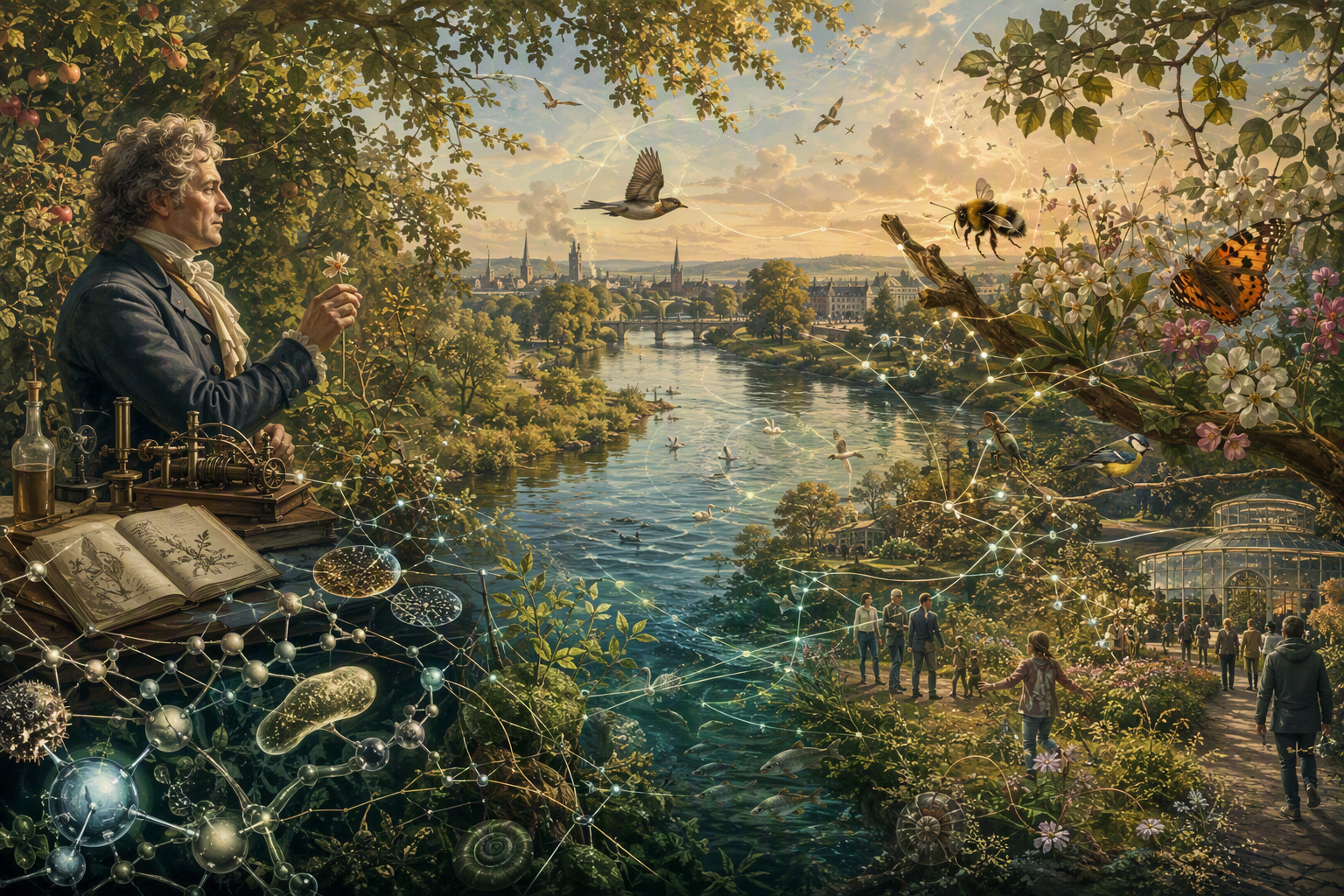
Ideas in The Temple of Nature are remarkably close to the contemporary definition of nature connectedness as a sense of being part of nature and experiencing an emotional relationship with it. Erasmus Darwin repeatedly argued that humans are part of nature, not separate from it, describing how “Organic Life began beneath the waves” and ultimately gave rise to “Imperious man“. The poem suggests that wellbeing and meaning emerge through engagement with the living world, as we found in our 2019 research. He also describes a mechanism that echoes contemporary research on beauty, emotion and the “soft fascination” central to Attention Restoration Theory, writing that “Beauty’s fine forms attract our wondering eyes, / And soft alarms the pausing heart surprise,” linking encounters with natural beauty directly to emotional response as we do in research papers on beauty and emotion.
The Temple of Nature goes further still to suggest that love, sympathy, and social connection emerge from the same natural processes that produce life itself, mirroring research on nature and pro-social behaviours. Darwin presents sympathy as a natural force that helps us understand others and “teach the selfish heart what others feel“, leading on to the notion that society is founded on emotional connection, with nature providing the template for connection between people – ideas explored in our 2024 research paper. Darwin portrays the natural world as a system of relationships in which forces bind atoms, minds and societies together. Taken together, these ideas suggest a world where people, communities and nature are connected through the same underlying processes.
If one were looking for an eighteenth-century intellectual ancestor of the nature connectedness work developed in Derby, The Temple of Nature could almost be read as an early philosophical poem about nature connectedness, two centuries before the construct was formally defined.
Excitingly, the Derby Riverside Phase 2 proposal includes gardens on the site of Erasmus Darwin’s former riverside orchard, referred to in the brochure, as the Erasmus Darwin Gardens. The vision already includes themes around innovation, engineering, medicine and botany, creating an opportunity to celebrate one of Derby’s most remarkable scientific thinkers while connecting his ideas to contemporary research and innovation.
From atoms to ecosystems, from steam engines to systems thinking, Erasmus Darwin recognised that the world works through connections.
Darwin’s Temple of Nature provides a remarkable historical bridge between Enlightenment science and contemporary research being conducted in Derby. Long before modern ecology, systems science or evolutionary biology, he described humans, animals and plants as part of a single living system. In one of the poem’s most famous passages, he challenges readers to recognise their place within nature: “Stoop, selfish Pride! survey thy kindred forms, / Thy brother Emmets, and thy sister Worms!”
So, it’s interesting to consider ideas for how a garden could reflect this historical bridge. A Living Chain Walk could connect the different areas of the site, telling the story of how Darwin linked engineering, botany, medicine and natural philosophy. Inspired by his description of the forces that “Press drop to drop, to atom atom bind“, the trail could explore the science of connections, from rivers and ecosystems to communities and innovation. This would provide a contemporary interpretation of the human-nature relationship, one of the defining environmental challenges of our time according to the UN’s Intergovernmental Platform on Biodiversity and Ecosystem Services (IPBES).
Darwin’s view of the ‘social chain’ where society emerges from natural relationships, suggests an Orchard of Relationships where each tree represents aspects of connection, to nature, family, community and future generations. Or a place to demonstrate the links between pollination, food production, biodiversity and human wellbeing.
A Temple of Nature Garden could provide a quieter space for reflection, incorporating selected quotations that highlight Darwin’s scientific curiosity and sense of wonder. The inscriptions could emphasise observation, beauty and discovery. Such as:
“Beauty’s fine forms attract our wondering eyes, / And soft alarms the pausing heart surprise,”
“Press drop to drop, to atom atom bind.”
Together these ideas could create a distinctive identity through celebrating a continuing Derby story: from Darwin’s riverside orchard to contemporary nature connectedness research, Derby has been exploring humanity’s place in nature for more than two centuries.


