
Funded projects, be they nature-based or otherwise, are typically asked to demonstrate impact. Whether funded by government, trusts, health partners or environmental organisations, there is an understandable desire to know: does this work?
The usual response is for each project to commission or develop its own evaluation. While well intentioned, this can result in lots of small studies, lots of different measures, lots of reports, but little collective learning.
Our latest paper in the journal Ambio, explores a different approach: a tool that facilitates evaluation while pooling evidence across projects. Rather than treating each project as a separate piece of evidence, the tool enables different organisations to collect the same core data and combine results across many initiatives. The findings suggest this approach can provide insights that individual projects simply cannot generate on their own.
At its heart, the idea is simple. Projects use common surveys before and after participation. Project managers also provide some basic information about the activities they’re offering. The survey data then feeds into a dashboard that gives individual projects useful feedback while also contributing anonymous data to a larger evidence base – as illustrated below.
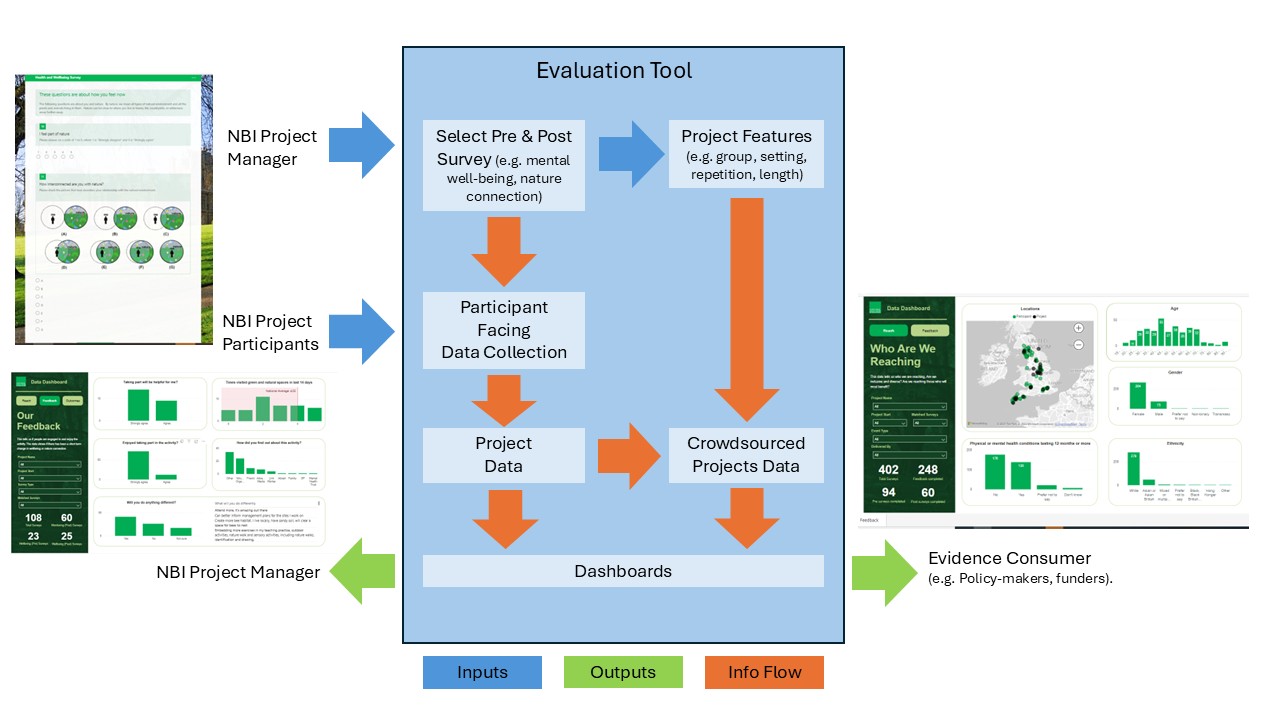
This has clear benefits for projects. Many organisations do not have access to research expertise, large evaluation budgets or analytical support. A shared tool removes some of that burden. Instead of creating surveys and analysing results from scratch, projects can focus on delivery while still gathering meaningful evidence.
The real value, however, comes when data are pooled across projects.
The proof-of-concept study in the Ambio paper combined data from eight different nature-based projects. Individually, most projects would not have had enough participants to explore broader questions about what works best. Together, they created a dataset capable of identifying patterns across the sector.
The first finding was encouraging. Across projects, participants reported increased nature connectedness after taking part. This is important because nature connectedness is increasingly recognised as a key outcome, linked to both wellbeing and pro-environmental behaviour.
More interestingly, the pooled data allowed exploration of project characteristics associated with larger improvements. One pattern stood out. Projects explicitly using the Pathways to Nature Connectedness framework appeared to achieve greater increases in nature connectedness than projects that did not use the pathways. Together, eight projects revealed a pattern that none could have detected alone.
That’s good news, but it’s proof of concept, so the finding should be treated carefully. The sample was relatively small, with only eight projects involved, and the study was not designed to establish cause and effect. We cannot conclude that using the pathways caused the higher outcomes. Other factors may have been involved, such as organisational experience, enthusiasm or the use of structured frameworks more generally.
However, that is precisely the strength of this approach. The purpose of a shared evaluation system is not necessarily to provide definitive answers. Instead, it helps identify promising patterns that deserve further attention. It acts as an intelligence system for the sector, highlighting where more focused investment, research or programme development might be worthwhile. Without pooling data, this signal around the pathways would probably have remained invisible.
There is an important point here for funders and policymakers. Too often, evaluation requirements unintentionally fragment evidence. Every grant programme requests something slightly different. Every project develops its own framework. Every report sits in a separate folder. As a result, considerable effort is invested in evaluation, but relatively little cumulative knowledge is generated.
A shared monitoring system offers a different model. Rather than funding dozens of isolated evaluations, investment can support a common measurement framework and data infrastructure. Individual projects still receive the evidence they need for reporting and learning, but the wider sector also gains a growing dataset capable of identifying trends, benchmarking performance and informing strategic decisions.
The approach is not limited to nature connectedness. It could be applied to wellbeing, loneliness, physical activity, environmental education, citizen science or other shared outcomes. Any area with multiple projects pursuing common goals could benefit from combining data rather than dividing it.
For project leaders, the message is straightforward: good evaluation does not always have to mean doing everything yourself.
For funders and policymakers, the challenge is perhaps greater. If we want stronger evidence, we should think beyond evaluating individual projects and start building systems that enable collective learning. The future may lie not in funding more bespoke evaluations, but in creating shared evidence systems that allow projects to learn from one another.
Lengieza, M.L., Richardson, E. & Richardson, M. Amplifying social benefits from multiple nature-based initiatives by crowdsourcing nature connectedness and wellbeing data: A proof of concept. Ambio (2026). https://doi.org/10.1007/s13280-026-02472-1


