
Forty years ago today I started working, 11th August 1986. I didn’t enjoy school, so left at the first opportunity aged 16, off down the dual carriageway on my speed restricted 50cc Suzuki. I was an apprentice at Rolls-Royce, learning the basics, from filing metal and turning, to grinding and electrical installations. To the exacting standards expected of those building jet engines.
The first task was to make a ‘box with hinged lid’ from tin plate. Four days of cutting, folding and soldering. The box was finished on Friday 15th August and still works perfectly. It is still one of my most satisfying outputs.

‘Box with hinged lid’ – 1986 and 2026
Then came technical drawing, fitting and a tin plate funnel, also still in use. Then wiring, circuit boards and ring mains. For the milling instructor, talking was not allowed. He roved the rows of machines with his micrometre, silently assessing your work. If the measurements were a tenth of a millimetre out a week’s work would be flung into the bin. It’s one way to set high standards.
The first anniversary in 1987 was spent wiring toroids, I’d been placed onto the ‘instrumentation’ pathway, no more metal work, just electrical work, wires, cables, circuit boards and out onto site, in the test beds with the jet engines, checking gauges and meters.
The workplace was divided into works and staff (each with their own toilets!), I was on a works route. Overall, I was realising that I wasn’t heading in the right direction for me, although I wasn’t sure what I was looking for. It felt like there was little room for creativity, other than my ever more elaborate logbook illustrations, see below. So, I left in 1989, a month or so before the 3-year apprenticeship was complete.
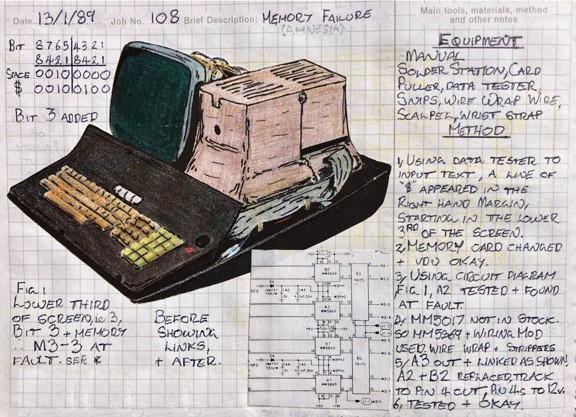
Memory Failure
It’d be 7 more years, including 3 years at University, until I found a workplace where I fitted, and where managers recognised potential, and encouraged me to do a PhD. That’s not a criticism of the system at Rolls-Royce, after all a football manager can’t be expected to identify a good cricketer. I’d started on the wrong path, and I had to spot that myself.
While some may recognise difference, or not fitting in, others, if they have the right perspective, may spot aptitude. Careers are rarely planned, they are often about moments of opportunity, doors that open, but that may not lead to a favourable destination. I’ve given up jobs I wasn’t enjoying twice, in order to try and open doors elsewhere.
Back to the tin box, such manual skills are wonderful to have and develop. They still felt of their time in 1986, rather than a craft to marvel over on TV, but computers were appearing in the workplace, although it’d be 1996 until I had one on my desk.
When new technology arrives it creates opportunities for creative thinking. In 1999 a few of us repurposed a Sun Microsystems SPARCstation into a web server to host online course materials for students, for all modules by 2000. This was soon followed by discussion forums and the first online degrees, undergraduate psychology in 2005 and my Masters in Ergonomics with a ‘virtual workplace’ soon after. This was acknowledged by the professional body as having “transformed student learning in the discipline across the UK and internationally” – confirming that the point wasn’t the technology itself, but the improvements it could bring.
In the early years, some wanted to shut down this rogue use of technology, but by 2011 it was seen as distinctive and standard setting. It was celebrated, replicated and claimed. People with ideas can be seen as mavericks, even problems when they act on those ideas, but they can be establishing a prototype that more formal systems can adopt.
Fast forward 25 years, the online degrees have been highly successful, and AI is presenting similar opportunities for innovation and transformation. Once again, existing systems are challenged and there can be a similar desire, by some, to hold things back. As with the Internet, it’s clear this new technology is here to stay. Those that adopt it well early can still be front runners decades later.
Back in the late 1990s, I also did online research, developing some of the first online psychology experiments, and using AI to facilitate research has been my focus over the past 18 months or so. Rather than asking AI to do the thinking for me, I’ve used it as a research assistant, programmer and data analyst.
One project explored how our relationship with nature has changed over the past two centuries, analysing millions of words from digitised books to reveal long-term cultural trends and the social factors linked to them. An idea quickly became reality, whereas previously it would have remained in my mind. Another involved building an agent-based computer model that simulated the lives of thousands of virtual people, families and communities to explore how nature connection is passed between generations and influenced by changes in society, cities and culture – more on that here.
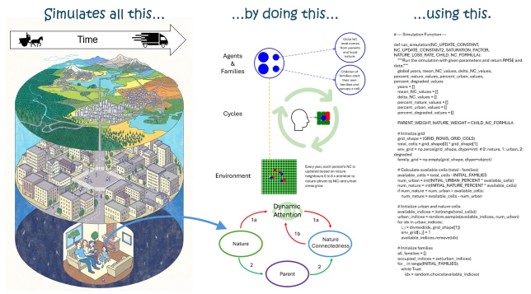
Agent Based Model: From idea to reality
What’s exciting is that the agent-based model was something I’d wanted to build for over a decade. I could imagine it, how people, places, culture and nature might interact over time, but turning that idea into working software always felt beyond the programming skills I had available. AI changed that. It helped me translate concepts into code, test ideas rapidly and create a simple model that behaved as intended. That was followed by a second, far more sophisticated model that incorporated regional differences, cultural trends and future scenarios.
Overall, working with AI on and off for eight months from February 2025, I produced four research papers published between August 2025 and March 2026. The latest project has returned to the cultural-trends project, this time using the rapidly evolving AI tools to automate it. I enter the factors I’m interested in, and it does the rest, gathering the data, running the analyses, validating the findings, and drafting the results section. A project that took me several days in 2025 now takes a few minutes of my time.
In the same way that the internet allowed me to move teaching online 25 years ago, AI has allowed me to turn ideas into reality. Enabling me to explore approaches that would previously have remained as sketches in a notebook.
How many people have ideas, talents or ways of thinking that never quite fit the systems around them? Looking back, the most important moments in my career were not promotions or job titles, but the moments when someone recognised potential, or when a new tool opened a door that had previously been closed. Perhaps the challenge with AI is the same as it was with education, apprenticeships and the internet: will it help us spot and develop different kinds of talent, or simply become another way of selecting people who best fit the existing system?
“Imagination is more important than knowledge. For knowledge is limited, whereas imagination embraces the entire world, stimulating progress, giving birth to evolution.”
Albert Einstein, 1931 in Cosmic Religion and Other Opinions and Aphorisms. |
For me, that is where the real opportunity lies. Not in replacing expertise, judgement or creativity, but in amplifying them. The most powerful use of AI is perhaps not getting answers, but helping people build things they could previously only imagine. AI is a power tool, just like those that enabled me to shape metal in 1986. The craft still matters, the judgement still matters, the ideas still matter, but the right tool expands what is possible. Forty years after making that tin box, I find the same satisfaction in building something useful from raw materials. The materials are no longer sheets of metal, but data, code and ideas.


