Finding a Friend in Nature: Embracing relationship theory in policy, practice, and research

Joint blog with Dr Mike Lengieza from Durham University

Major environmental institutions around the globe are realising that the failing human-nature relationship with nature is a root cause of environmental issues. Yet, designing for human–nature connection is yet to become mainstream in practice. Although there have been successful interventions and frameworks such as the pathways to nature connectedness, more can be done to facilitate targeting the human-nature relationship in policy. First by establishing it as a target for change, then by drawing parallels between nature connectedness research and research on interpersonal relationships. This provides new routes to a closer human–nature relationship – and pro-environmental action. Our latest paper published in Sustainability reviews recent references to the human–nature relationship in policy documents and then draws on theories of interpersonal relationships to illustrate how they can inform efforts to repair the human–nature relationship for a more sustainable future.

Like elsewhere in life a close & sustainable relationship with nature should be built on intimacy, commitment, interdependence, reciprocity and trust.

Few would deny the existence of relationships between people, that some are close, others more distant. And that these interpersonal relationships motivate behaviour. Yet, many overlook the human-nature relationship, focussing instead on the tangible symptoms of that failing relationship: biodiversity loss and climate warming without considering the underlying problem. For current sustainability efforts to be successful there is also a need to reverse our growing disconnection from the rest of nature.

Human-nature Relationships in Policy

Thankfully, in recent times, major environmental institutions are recognising this and have been advocating for a profound shift in our relationship with nature. The UN Environmental Programme’s report, “Making Peace with Nature,” proposes that we must change our values and mindsets, moving away from material consumption and recognizing nature’s integral role in a good life. The Kunming-Montreal Global Biodiversity Framework, adopted at COP15, acknowledges the exploitation of nature driven by societal values and behaviours as the root cause of biodiversity loss. It emphasizes living in harmony with nature and includes nature connection as a target.

The push for greater specificity in policy has seen references to “nature connectedness” research in various documents. Stockholm+50: Unlocking a Better Future underscores the need to redefine our relationship with nature, shifting from extraction to care. The EEA briefing, ‘Exiting the Anthropocene? Exploring fundamental change in our relationship with nature,’ delves into the deep interconnection between humans and ecosystems for a sustainable future.

Similarly, the Dasgupta Review commissioned by the UK Government delves into the spiritual and sacred aspects of the human-nature relationship. It highlights the distinction between mere contact with nature and true connectedness, emphasizing that the latter goes beyond personal well-being to motivate environmental behaviour.

While there has been progress in recognizing the importance of our connection to nature in policy, the challenge lies in operationalising it fully. One key area of concern is the lack of specificity in policy language. Many policies use ambiguous terms, leaving the emphasis on the human-nature relationship implicit or vague. To address this, the psychological construct of “nature connectedness” should be used more widely as a focal point for targeted and effective policy actions. While there is progress in acknowledging the benefits of nature connectedness for both human health and nature conservation, it is yet to become mainstream in practice.

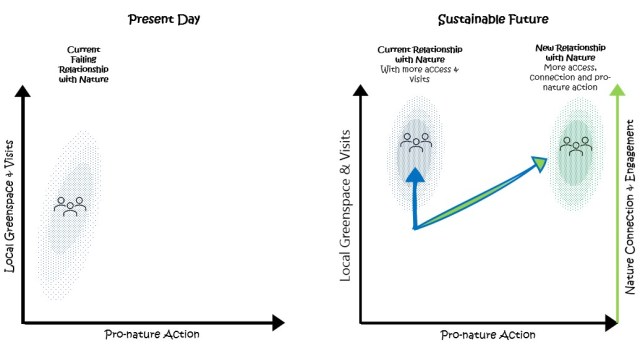
Another issue lies in the sufficiency of policy aims. While some policies claim to address the human-nature relationship, they often focus on outcomes that fall short of genuinely influencing the relationship. Merely promoting access to nature, while essential, is not enough to increase nature connectedness – in the terms of interpersonal relationships, having access to the room doesn’t mean you’ll develop a close relationship with those inside.

To successfully target the human-nature relationship in policies, there must be explicit recognition that the human–nature relationship is a relationship and that it must be a clear and explicit target. Policy language must also be more precise. In the paper we argue that the human-nature relationship is as real as any interpersonal relationship and policymakers should draw from wider theories on interpersonal relationships to operationalize the human-nature relationship effectively; specifically, it can be easily operationalized as nature connectedness. By addressing these areas of weakness, environmental policy can play a more significant role in nurturing a harmonious and sustainable relationship with nature.

Interpersonal Relationships

Relationships play a fundamental role in shaping our lives, fulfilling our needs for self-expansion and belonging. By including others in our sense of self, we enhance our resources and well-being. These vital connections affect not only our psychological wellbeing and identity but also influence how we treat others and engage in pro-social behaviours. Close relationships, where we prioritize the interests of our partners and the relationship itself over self-interest, lead to greater willingness to sacrifice and accommodate during conflicts. Fostering stronger interpersonal bonds benefits both individuals and society, creating a more caring and supportive community.

The significance of interpersonal relationships in our lives has led to extensive research on factors influencing closeness and commitment. While spending time together is crucial, the quality of interaction plays a pivotal role in relationship development. Self-disclosure fosters intimacy, and engaging in novel activities strengthens closeness. Mutual influence, or interdependence, contributes to a lasting, committed relationship. Commitment stems from investing time and resources, fulfilling crucial needs, and lacking attractive alternatives.

In human-nature relationships, the importance of going beyond mere contact becomes evident. Discussions often revolve around facilitating contact with nature, but the principles of interpersonal relationships show that true connection requires more. Intimacy, excitement, and interdependence are vital ingredients for nurturing meaningful bonds. Emphasising these aspects can provide valuable insights for fostering a deeper and more committed relationship with nature.

Parallels between Interpersonal Relationships and Human–Nature Relationships

The concept of relationship closeness, where we include others in our sense of self, also extends to our relationship with nature, known as nature connectedness. This implies that our bond with nature can be seen as just another form of relationship. Interestingly, nature connectedness and interpersonal relationships share many parallels in their associations with important outcomes – a summary of key concepts and their parallels to human–nature relationships can be found in Table 1 of the paper.

Nature connectedness fulfils our need for relatedness and expands our sense of self. It is linked to well-being, behaviour, and prosocial actions. Furthermore, nature connectedness is deeply intertwined with our sense of identity, showcasing its similarities to interpersonal relationships.

Considering the similarities between nature connectedness and interpersonal relationships, it’s reasonable to believe they might have similar determinants. Treating nature connectedness as a type of relationship can offer a fresh perspective on our disconnect with nature; if one recognizes that nature connectedness is a relationship, it becomes obvious that merely promoting contact with nature is necessary, but wholly insufficient to repair our relationship with nature. By applying principles from interpersonal relationships to nature connectedness, we can uncover new insights, identify areas for further research, and make meaningful implications for policy and practice.

Implications for Policy and Practice

The research suggests that human-nature relationships share some striking similarities with our close relationships with other people. Just as we seek emotional intimacy and a sense of interdependence with our loved ones, these elements also play a crucial role in fostering a deep bond with nature. But here’s the thing—while we know that spending time in nature is beneficial, it’s not just about mere contact. We may spend hours together in the workplace, but that doesn’t guarantee a close relationship. Like in interpersonal relationships, the quality of our interaction with nature matters too.

Imagine walking barefoot through the grass, experiencing the joy of planting a tree and seeing it begin to grow, or visiting your favourite nature spot, like you would a long time friend. These acts of intimacy and meaningful interdependence with nature can have a profound impact on our nature connectedness. Similarly, the way we learn about nature is important. Environmental education should move beyond textbook knowledge and focus on exciting activities that create a personal connection with nature. Moreover, our cultural and societal norms heavily influence how we view and interact with nature. The history of Western society reveals a complex relationship with nature, often dominated by use and control. This societal relationship must be re-evaluated.

We should recognise that different types of relationships exist, and it’s no different for our bond with nature. Some relationships are self-centric, driven by personal gain, while others are ‘ecosystemic’, emphasizing mutual concern and wellbeing. Encouraging ecosystemic relationships with nature is crucial for positive treatment of the environment.

Like any relationship, trust plays a pivotal role in our connection with nature. Trusting that nature will be benevolent and responsive is vital for forming a strong bond. However, trust in nature is often understudied, especially in childhood. It’s essential to nurture this trust early on, and societal attitudes can influence how we perceive nature’s reliability.

As we navigate the complexities of our modern lives, we must recognize the barriers that hinder our human-nature relationship. Stress, societal norms, and alternative ways to fulfil our needs can all interfere with fostering a deep and authentic connection with nature. It’s vital to confront these obstacles and identify ways to overcome them.

In essence, understanding the similarities between interpersonal relationships and human-nature relationships can transform the way we approach our connection with nature. By building trust, promoting intimacy, and diversifying our interactions with nature, we can foster a more profound and lasting bond. A summary of specific policy recommendations can be found in Table 2 of the paper.

The Trusting and Reciprocal Relationship Challenge

Through the fascinating connection between human-nature relationships and interpersonal relationships, we encounter some thought-provoking challenges. While trust plays a vital role in both types of relationships, trust in nature may not adhere to the same principles as trust in people. Nature’s behaviour can be less predictable, making it challenging to perceive its reliability and intrinsic benevolence. Many may even perceive nature as a nuisance or at times dangerous.

Additionally, interpersonal relationships involve reciprocity, with both parties contributing to the relationship’s development. However, human-nature relationships are often perceived as one-sided, with nature being seen as inanimate and non-reciprocal. Bridging this gap requires recognising the concept of animacy, where nature is viewed as autonomous and communicative, and comprised by relational beings. Embracing this animistic philosophy may help foster a deeper sense of reciprocity in our connection with nature. This requires a larger cultural shift away from the Western worldview that perceives nature as a mere resource to be used and controlled. Embracing diverse worldviews and incorporating relational nature education could be essential steps toward nurturing a more meaningful and reciprocal relationship with nature.

Conclusion

This review reminds us of the profound impact relationships have on our lives, not just with other people but also with nature. Understanding the parallels between interpersonal relationships and nature connectedness sheds light on the importance of nurturing our bond with the natural world. This connection is essential, not only for our own well-being but also for the well-being of the planet.

To mend our broken relationship with nature, we need a cultural shift. Our modern world, driven by scientific and industrial revolutions, has disconnected us from nature, viewing it as a resource to be used and controlled. However, hope lies in recognising that past cultural shifts have occurred, and we can envision a more sustainable future where human-nature relationships are valued.

This vision must be supported by meaningful actions and policies. Environmental policy should acknowledge the tangible impact of relationships and guide urban planning to create spaces for shared care of nature. Cultural policy and incentives can foster exciting engagement with nature, while education and health policies can promote animistic thinking essential for healthy relationships with nature. Furthermore, legal frameworks can grant nature rights and personhood, legitimizing it as a valued member of our planetary community. By embracing a relationship-focused approach, we can pave the way for a sustainable future where humanity and nature thrive in harmony.


Lengieza ML, Aviste R, Richardson M. The Human–Nature Relationship as a Tangible Target for Pro-Environmental Behaviour—Guidance from Interpersonal Relationships. Sustainability. 2023; 15(16):12175. https://doi.org/10.3390/su151612175


Posted in Uncategorized | Leave a comment

One Year of the Biodiversity Stripes

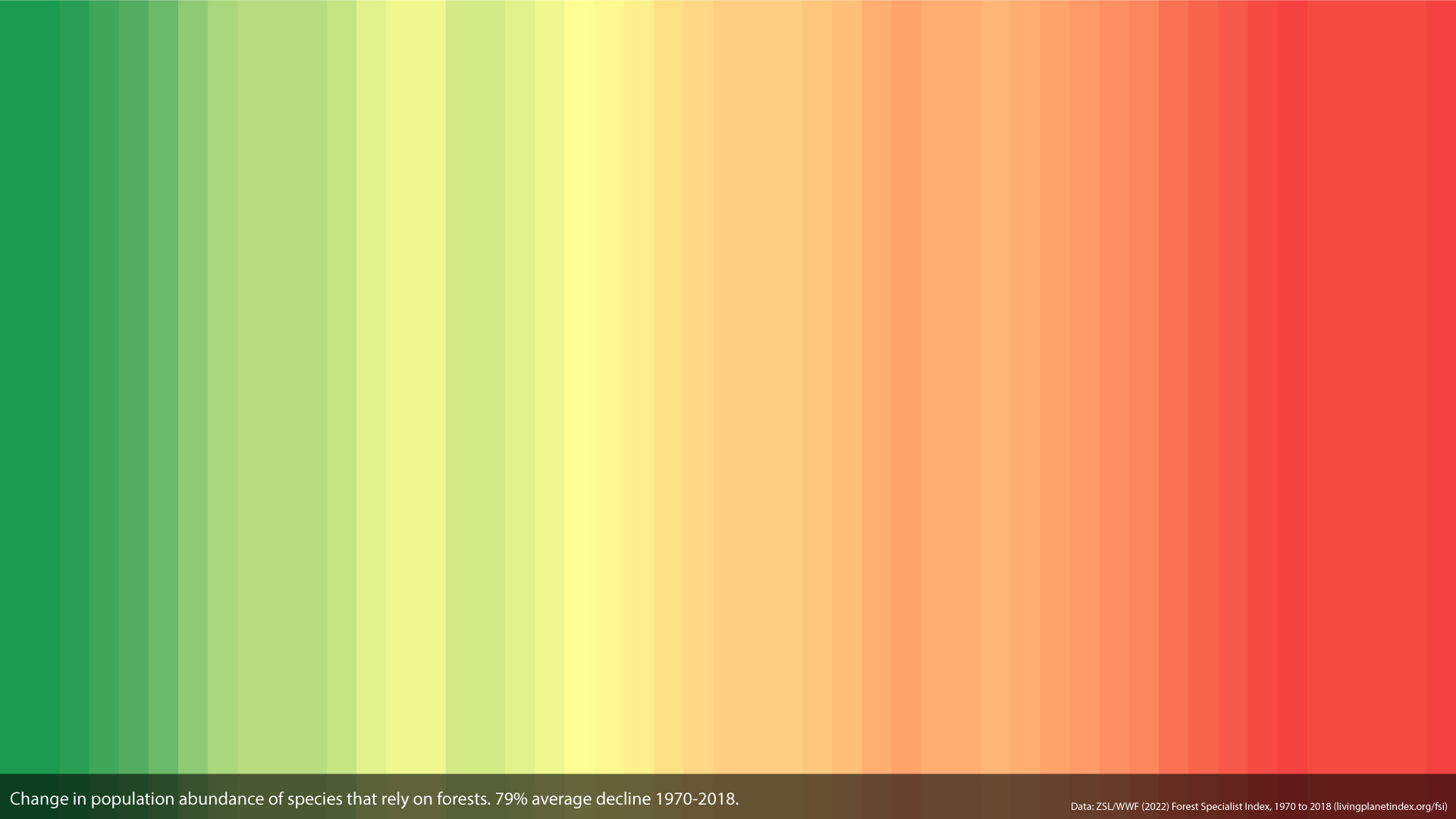
The 8th August 2022 was the day I created the biodiversity stripes and they have had a great first year, from creation at home one evening to Paris, Cairo, Montreal, London and Berlin – picking up an award, press and TV coverage along the way. Most importantly, as summarised in this blog, they are doing what I hoped for when I published them for the first time on 10th August 2022 – to ‘go a little way to raising the awareness of the decline in wildlife’.

A key aspect for a sustainable future is people being aware of the problem. People cannot push for a solution to a problem they do not know exists – and climate change has been found to get up to eight times more coverage than biodiversity loss. Based on the successful climate warming stripes created by Professor Ed Hawkins in 2018, the biodiversity stripes similarly represent complex data simply and in an engaging way.

The Living Planet Index provided the initial data. It includes over 20,000 populations of over 4000 species and tells us that the population of mammals, birds, fish, amphibians and reptiles has seen an average drop of 69% globally since 1970. A catastrophic collapse of the wildlife that makes the Earth, and our brief existence on it, so wonderful, so colourful, and so alive. Human actions, our use and control of natural resources, are causing a mass extinction – a loss of colour, a journey from green to grey.

The green to grey stripes worked. Within a few weeks the biodiversity stripes were available on a variety of Greenpeace tops and appeared in the French National Assembly. Around that time, they were also adopted by the global Nature Positive campaign, a coalition of 32 leading NGOs, to put nature at the very heart of the world’s two biggest environmental conventions, COP27 and COP15 where the stripes decorated the Nature Zone. The Nature Positive campaign offered a vision of optimism, by saying we can reverse the decline in biodiversity. The campaign is deceptively simple, it inverts the stripes so that rather than representing decline they provide a vision that the diverse and sometimes fragmented nature community could collaborate around. This biodiversity stripes themed campaign won the Best Environmental Cause Campaign at the Purpose Awards in June 2023. Supported by industry-leading brands such as PRWeek, the awards recognise campaigns that use creative ideas successfully to further positive causes.

Around the time of COP27 in December 2022 the biodiversity stripes were featured on Channel 4 News and I launched a dedicated home at https://biodiversitystripes.info/ – which was updated to become a twin site of the climate warming stripes in April. Soon after that there was further press and TV coverage, namely in the Financial Times and the national French TV weather forecast. They also appeared at the ClimateNow Conference in Paris and formed the cover of a Spanish Magazine. Highlighting how the concept works without words. The Durrell Tortoise Takeover is one more example of how the stripes can inspire others.

Perhaps most excitingly for me as I was invited to attend, a new set of biodiversity stripes decorated the Hintze Hall at the Natural History Museum in London in June. The new biodiversity stripes provided the theme for the Natural History Museum’s Annual Trustees’ Dinner, attended by 300 guests, from Government ministers to celebrities that care about our natural world. Using the Museum’s 2000 to 2050 Biodiversity Intactness Index the new stripes showed how nature in the UK can recover from previous damage given time, space, and effort. The stripes featured on screens around the hall, menus, invites and the like, with green and yellow lighting illuminating this iconic space. Once again, the message was clear we can, and must, fix our broken relationship with nature.

In addition to raising the awareness of the decline in wildlife another positive is how quickly an individual’s idea can spread with social media and the Internet. The initial blog received 3000 views in the first 24 hours or so, with a total now around 17,000. Add in an update blog that followed and the total is around 20,000 – the new biodiversitystripes.info website has had 1.3 million views since late April. Much of that driven by social media. A few initials tweets launching the stripes in August 2022 received around 100,000 impressions. With a tweet launching biodiversitystripes.info in December getting close to 1.5 million impressions, mainly thanks to a retweet by Greta Thunberg.

Flying the flag for biodiversity at the University of Derby

What next? Profile wise, year one is tough to beat, but the need to address and reverse the stark loss in biodiversity remains. Greater awareness helps, because when people are satisfied with their natural environment they don’t see the need for change. So, there are millions more people to engage, and it seems the biodiversity stripes can help, both in raising awareness of the problem, but also flipped over to provide a vision of hope. So, I hope to see more of the stripes, with new data stretching further back or existing data projected onto landmarks, in the press, on a football kits or with compelling overlays that engage people with the loss of wildlife.


Posted in Uncategorized | Leave a comment

Can nature connection support people with disordered eating?

Guest blog by Mia Morgan

The wellbeing benefits of nature connection are well-documented, but what about its impact on disordered eating? This is a topic discussed and researched far less and is the focus of my current PhD project! In addition to background on the topic, this blog provides information on an opportunity for people with previous experience of disordered eating and professionals who support this population to get involved – further details below.

Nature connection interventions are being developed to improve wellbeing in the general population as well as some clinical groups. However, I am not aware of an intervention focusing on nature connection that has been developed and trialled with people with disordered eating. A growing amount of research evidence suggests that engaging with nature could help this population. Studies with the general population have shown that nature exposure and connection can increase body appreciation, including appreciation of its functions, both of which are protective factors for disordered eating. Additionally, people who have recovered from eating disorders have explained that connecting to nature allows them to re-connect with their bodies – a connection often lost when experiencing disordered eating symptoms. They also expressed how it allows them to experience a sense of belonging, feeling like nature accepts them for who they are without judgement.  These are just a few of the documented benefits! Despite this evidence, consideration around using connection to nature as a potential therapeutic strategy for this population is lacking.

To address this gap, my PhD project will develop a nature connection intervention for people with disordered eating in collaboration with individuals with lived experience of these attitudes and behaviours and relevant professionals. I will then carry out a small-scale trial, to test whether people find it effective and acceptable.  The plan is for this intervention to be available to people aged 16+ who are in the earlier stages of experiencing disordered eating symptoms, so do not have an eating disorder diagnosis. It is hoped that the intervention will made available through social prescribing, a framework that allows healthcare professionals usually working within primary care to refer people to programmes in their community, to ensure as many people can access it as possible. I am lucky to have First Steps ED, a disordered eating charity based in Derby, as a collaborator on the project, supporting me in various ways.

So, how am I developing this intervention? I have decided to use an approach that grounds the development in the experiences and perspectives of the people that will use the intervention, as well as people with other relevant expertise. My first study involves online interviews with people with previous experience of disordered eating and focus groups with professionals who support this population in community settings including third sector organisations. These will explore people’s views and experiences on how nature can support people with disordered eating and their thoughts on how the intervention may look. I encourage people to be as open and creative as possible with their thoughts as this is a brand-new type of intervention for this population.

The findings from these sessions will be used to help design the intervention, so they are a great opportunity for people to contribute to the intervention development and have their say on what they think would make it effective. I am now inviting people to participate in these interviews and focus groups, so if you would like to find out more, please do get in touch (email below). Or follow the link below for more information. I am keen to recruit people of all genders and ethnicities to make sure this intervention is both relevant and accessible to as many people as possible, which is often lacking with disordered eating interventions.

I am also carrying out focus groups (at a later date) with people delivering nature connection interventions in the community to support mental health and social prescribers. These will also be exploring people’s ideas on the design of the intervention. Please also get in touch if you would like to find out more about these.

Following this study, I will create a draft version of the intervention which will be shared with the co-creators (people with lived experience of disordered eating, professionals that support this population, nature-based practitioners, and social prescribers) in various ways. In response to feedback gathered from these individuals, I will refine the intervention before going onto test it out with a group of people with disordered eating. I will measure the effectiveness, feasibility, and acceptability of the intervention through various outcome measures as well as surveys and interviews. If all goes well, I am hoping this will lead to a larger trial (Randomised Control Trial) post-PhD – the ultimate dream!

Overall, my goal for this project is to create an intervention that is as tailored and effective as possible for people with disordered eating. I am determined to develop something that can be accessed and used by as many people as possible, including people from all genders and backgrounds and with different levels of access to nature. I hope the intervention will be a way to teach people skills they can use in their everyday lives, utilising the incredible (free to use!) resource that is nature, which is often taken for granted and not given the appreciation it deserves for how powerful it can be in improving our wellbeing!


Find out more about my study

If you have any questions or would like to find out more about my first study involving interviews with people with previous experience of disordered eating and focus groups with professionals who support this population then please email me. Or follow this link where you can find more information and sign up. Likewise, please do contact me with any queries related to the project, it would be great to hear from you!


Posted in Uncategorized | Leave a comment

Refitting the human to nature

Environmental institutions are realising that the human-nature relationship is a tangible target for a sustainable future, but societal change of that relationship is a challenge involving modifications to both systems and human behaviours. In our latest paper, State of science: refitting the human to nature, we argue that Human Factors and Ergonomics (HFE) with its focus on relationships, interfaces and systems is well placed to contribute. Although it has an HFE focus I think it provides perspectives that are of wider interest. For example, how a range of disciplines can contribute to a sustainable future and the need to ‘de-centre people’. The paper is available open access. This blog provides a brief summary of one key area in the paper, the need to move beyond technological solutions and take a systems perspective.

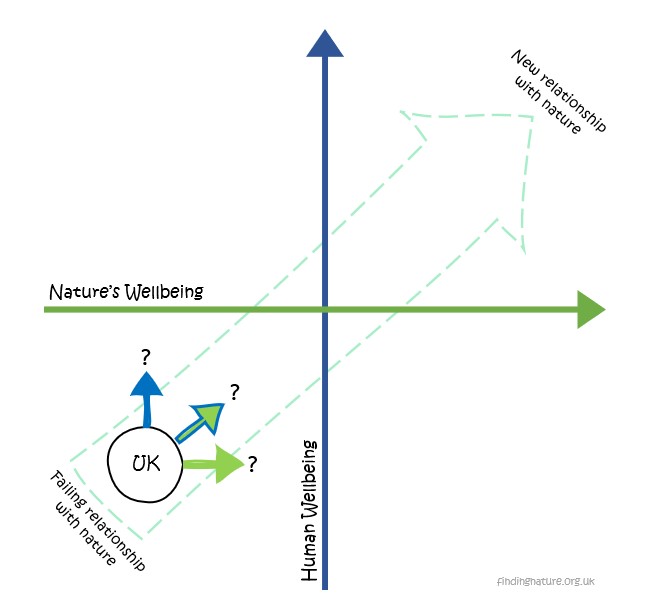
There is growing global recognition that the biodiversity and climate crises are a product of the failing human-nature relationship and that, for a sustainable future, a new relationship with nature is needed. However, in general, humans do not live in harmony with nature, we don’t know what a sustainable future looks like. There is an urgent need for new solutions.

Humans are a ‘technological ape’; a species long dependent on and ever more defined by its technology. This helps explain the focus on technological solutions to treat the symptoms of the failing relationship to deliver sustainability and the difficulty of even starting to consider the worldviews and mindsets that define the human-nature relationship. The fixation on visible issues is captured by a simple representation of systems thinking, the ‘Iceberg Model’. The visible events of biodiversity loss and climate warming are symptoms of unseen factors below the surface at the base of the iceberg such as our mindsets and worldviews that encompass our values, beliefs and assumptions.

The foundation of Western thought is taught and continually reinforced through dominant metaphors, which we reinforce further through using technological solutions in our attempts to deliver sustainability and rebalance the complex systems of nature. This consists of two reinforcing patterns. First, when we distance ourselves from nature through technology and our built environment, we reduce how we value nature. Second, as technological apes we have come to rely on introducing more technologies as the ‘solution’ to the problems we have created. Our solutions are constrained by our worldview. In essence we exacerbate our problems rather than releasing ourselves from an unsustainable cycle.

Proposals to tackle base of the iceberg and achieve a paradigm shift in the human-nature relationship are being made. For example, through taking a systems perspective and combining the ‘pathways to nature connectedness’ with a leverage points perspective we showed how the pathways to nature connectedness could be applied at various leverage points within systems.

This provides a perspective where the pathways can inform cultural and urban design. Interventions to improve the human–nature relationship can target the powerful pathways of sensory, meaningful and emotional engagement with nature. Recommendations across policy areas such as education, health, housing, arts, health and transport, can target leverage points around system goals, design, feedback and parameters to foster closer human–nature relationships across society. The areas for action in the evidence report for the United Nations General Assembly’s Stockholm + 50 meeting draw upon this work as one route towards redefining and strengthening human-nature connectedness in our social norms.

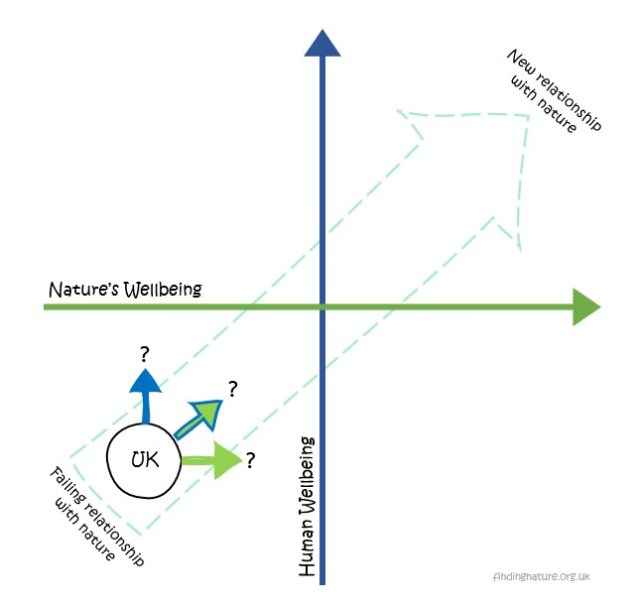
This work shows that the design of infrastructure, places, spaces, organisations, transport, housing and healthcare can be used to build human-nature connections. Different areas with expertise to create visons of sustainable communities, designed to create a new relationship with nature. To achieve this HFE and other areas need to take an unlikely step, to recognise that design should not always be human-centred. That cognitive flip of de-centring humans to being part of nature, both as a person and as a professional, would facilitate a meaningful contribution to a wider new relationship with nature for a sustainable future. This alternative ‘life-centred design’ unites both human and nature’s wellbeing. It is time to move on from solely fitting the world to the human, to refitting the human to nature.
 

Miles Richardson & Andrew Thatcher (2023) State of science: refitting the human to nature, Ergonomics, DOI: 10.1080/00140139.2023.2236340

Posted in Uncategorized | Leave a comment

Trees are our closest neighbours

As part of the ‘Connected Treescapes‘ project we’ve been exploring how people value trees to inform the design of future treescapes. Part of that work was a survey of 1800+ people. They’ll be more involved analysis published in the future, but there are some interesting results in the raw responses, for example, people have a closer relationship with trees than their neighbours!

Let’s take a closer look.

Despite the UK being one of the most deforested nations on the planet around 80% of people in our survey area thought they had plenty of trees within a five-minute walk of their home, and that those trees were very varied in age and species of tree. 25% even reporting that there are plenty of woodlands within 5 minutes of their home. We found similar views on the presence of other aspects of nature, such as wildflowers. These results perhaps reflect a ‘shifting baseline’ where each generation sees the current level of woodland as the norm.

When asking about engagement with trees, over 80% reported that they take notice of trees wherever they are, with only 7% disagreeing. 75% of people felt that large and noticeable trees were important to them, once again with only 7% disagreeing. Such that 50% of people reported having a ‘favourite tree’ they notice frequently. Trees are meaningful to people.

Although reporting the noticing of trees, and having favourite trees, when asked if they had a close relationship with trees, only 16% felt this was very close, although this is notably higher than the 7% who feel that they had a very close relationship with their neighbours. Perhaps people struggle to imagine a close and interconnected relationship with trees, but the difference to neighbours is interesting. Broadening these connections out, over 60% felt their relationship with nature more generally was an important part of their identity, with a similar proportion feeling very interconnected to all living things on Earth.

Although asking about people’s relationship with trees might seem unusual, it is those that feel a close relationship with the natural world who take most positive action towards it – and it tends to contribute to greater wellbeing also. Having a close emotional bond, such as having a favourite tree, is important, but it also important to feel closely connected to trees and the wider natural world. This need for a close bond with nature being needed to drive positive pro-nature behaviours is reflected in another aspect of the survey. Although three-quarters agreed that they always think about how their actions affect the environment, far fewer take action, from half planting pollinator friendly plants to just over a third providing homes for nature in their gardens. Only 8% reported taking action on local nature conservation issues, but then as we’ve seen most people thought there was plenty of trees and nature nearby.

We also asked about the benefits of trees. Over 90% realise and agree that trees bring better air quality (94%) and that they support wildlife (95%). With around 86% knowing that trees help prevent erosions/ flooding. 86% of respondents felt that trees are an important part of our history and heritage, and childhood (93%), with 73% recalling that they had a lot of contact with trees during their childhood.

Turning to threats to trees, 74% of respondents felt that urban development presented the greatest threat to trees, higher than climate change (65%) and diseases and pests (55%). However, although development can be a threat to some trees, in the long-term climate change is the bigger threat, through changes in the weather (e.g. droughts) and by creating more favourable conditions for many pests and diseases.

So, people notice trees, are aware of their benefits and they have a meaningful relationship with them – more so than with their neighbours. In some ways everything is a little too rosy as people tend to think there are plenty of trees and, therefore, unlikely to do a great deal to help restore woodland cover.


Posted in Uncategorized | Leave a comment