The climate emergency and crisis of biodiversity loss show that the human-nature relationship is failing. The scale of these inter-related issues requires a new relationship with nature. Bringing about that new relationship with nature requires interventions and approaches that effect large changes at scale across society. In our latest paper we propose an approach to creating a new relationship with nature at a societal scale based on improving nature connectedness using a framework called the ‘pathways to nature connectedness’. The paper published open access in Ecosystems & People suggests how the pathways can be applied at various leverage points across policy areas such as education, health, housing, arts, health & transport. It’s a long read at around 10,000 words, so this blog presents a summary of some key aspects.
What is nature connectedness and why does it matter?
The psychological construct of nature connectedness describes an individual’s relationship with nature. It can be increased through carefully designed interventions to prompt engagement with nature – such as noticing the good things in nature. Nature connectedness matters because it brings benefits for both humans and nature; it is a causal factor in improved mental wellbeing, increased pro-environmental behaviours and pro-nature conservation behaviours. The evidence of the benefits to wellbeing is such that it is argued that nature connectedness is a basic psychological need. The importance of the construct is further illustrated by proposals for its inclusion in the Gallup World Poll (GWP) which has an international reputation as a tool for global decision-makers.
Calls for ‘reconnection with nature’ have increased, but have been vague, with fragmentation around what nature connection is and with little concrete guidance towards achieving societies that are more connected to nature. The psychological construct of nature connectedness helps with the current diversity of approaches to understanding people’s connection with nature. It provides a measurable focus within this fragmentation, with an evidence base of benefits to the wellbeing of both people and nature.
Introducing the Pathways to Nature Connectedness
The pathways to nature connectedness provide a typology of activities that provide a methodological approach for improving human-nature relationships through targeting and increasing nature connectedness – you can find a summary of the 5 pathways (sensory contact, emotion, beauty, meaning and compassion) on this postcard, but briefly they are:
· Senses: Noticing and actively engaging with nature through the senses. Simply listening to birdsong, smelling wild flowers, or watching the breeze in the trees.
· Emotion: Engaging emotionally with nature. Simply noticing the good things in nature, experiencing the joy and calm they can bring, and sharing feelings about nature with others.
· Beauty: Finding beauty in the natural world. Simply taking time to appreciate beauty in nature and engaging with it through art, music or in words.
· Meaning: Exploring and expressing how nature brings meaning to life. Simply exploring how nature appears in songs and stories, poems and art, or by celebrating the signs and cycles of nature.
· Compassion: Caring for nature. Simply thinking about what we can do for nature and taking actions that are good for nature, such as creating homes for nature, supporting conservation charities and rethinking our shopping habits.
Rather than a detailed model, the pathways present five overarching types of relationship involved in improving nature connectedness. They can be applied at various points, from individual activities in nature, to nature engagement programmes, to the design of infrastructure and school curricula and beyond to improve relationships between humans and nature on a larger scale. In sum, the pathways provide clear direction of the types of relationship for society to foster.
The pathways research was based on Kellert’s (1993) nine values of biophilia. Five of the nine were pathways to nature connectedness, four were unrelated to nature connectedness. These were fear of nature, dominion over nature, utilitarian use of nature and a purely scientific relationship.
Nature is often seen as a resource (utility), or a source of challenges to conquer (dominion), or nature is presented in terms of facts and figures (science), or as a threat (fear of nature). These types of relationship are common, often emphasised within capitalistic societies and can be seen as essential pathways for human survival and progress that, unchecked, have led to nature’s decline – as shown by the red arrow in Figure 1.
The five types of relationship which form the pathways to nature connectedness are included in the green arrow which points towards improved nature connectedness and its benefits: pro-environmental behaviour, pro-nature conservation behaviour and mental wellbeing. Greater focus on the types of relationship with nature that promote nature connectedness can lead to a new, more sustainable, relationship with the natural world.

Figure 1. A graphical summary of the types of human-nature relationships, nature connectedness and their outcomes. Key: Pro-env. = pro-environmental (carbon & resource use reduction); Pro-nature = pro-nature conservation (wildlife habitat creation).
Societal relevance of the pathways approach
The application of the pathways has informed a successful large-scale campaigns (e.g. 30 Days Wild) and visitor experience programming (e.g. at the National Trust and Durrell Wildlife Conservation Trust). However, a paradigm shift in human-nature relationships is required at a larger scale. But which of the five pathways have greatest societal relevance? The full paper discusses this in detail, but here’s a brief summary.
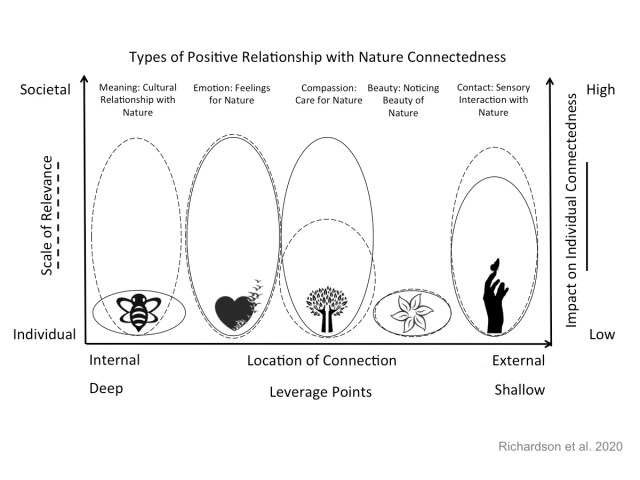
Figure 2. Types of positive relationship with nature and scale of relevance and leverage. The statistical importance for nature connectedness identified by Lumber et al (2017) is represented by the solid oval. The proposed scale of relevance is represented by the dashed oval.
The relevance of the pathways for individual and societal connectedness to nature, and their potential for application at deep leverage points (more on that later), is represented in Figure 2 which considers the location of connection/leverage points (X-axis) and scale of relevance (Y-axis) for the five types of relationship with nature found to be positive pathways to nature connectedness. Let’s consider the societal relevance of each pathways in turn.
Meaning is related to cultural aspects of our lives that have great resonance at a societal scale. This pathway relates to deeper relationships, the symbolic use of nature to represent ideas, and provides an opportunity for societal change. Cultural programmes could be focused on developing these deeper relationships with nature on a large scale – through the cultural celebration of our relationship with nature and renewed appearance of nature in cultural products – and fundamental societal systems such as health care for example.
Emotions can, and have been, targeted on a large scale (e.g. consumerism) and brought societal scale changes. Emotions are fundamental features of human function. As far back as 1928, Edward Bernays targeted people’s unconscious desires in order to manipulate people towards items they didn’t need – creating modern public relations through appealing to people’s emotions. These ideas helped develop consumerism and self-absorption in Western society. Edward Bernays recognised the scale of relevance of emotion, using them to mould public desire, shaping a consumer culture and shifting social norms at a societal scale. Through public relations campaigns, emotions could change social norms to a situation where a good life is seen as a nature connected life, rather than a consumerist life. The recent shift from the desire for experiences rather than consumer goods provides an opportunity to promote pathways focused experiences, rather than basing them on dominion and utilitarianism.
Compassion. Although care for nature is an overall goal of a new relationship, Figure 2 suggests that the compassion pathway doesn’t necessarily present opportunities for deep leverage. This is because it is likely that other changes are required first. Those engaged with pro-nature conservation behaviours typically have higher levels of nature connectedness. So before engaging people with pro-nature conservation behaviours that can require personal commitment, there could be a need to increase connectedness through meaning and emotion. However, humans are a social species, our capacity for co-operation emerged from social connectedness and emotional bonds. Therefore, focusing on the similarity of people with nature, rather than focusing on developing concern for nature directly may function as a more effective societal leverage point. For example, research shows that anthropomorphism can drive nature connectedness. The similarity of people and the rest of nature as a common discourse, rather than consumptive and dominance frames are required together with the provision of more opportunities for people to care for wildlife everyday, for example through access to places where people can easily engage in pro-nature conservation behaviours.
Beauty is a strong theme when people are asked to notice the ‘good things in nature’ – however we know that the beauty pathway works together with other pathways, such as when deriving meaning or evoking emotions. So, it is likely that this pathway doesn’t lever transformational change on its own. Rather, beauty needs to be available for sensory contact and wider meaningful engagement with nature.
Sensory contact is a pathway that relates to interaction, therefore there is a need for engagement with a wide variety of nature – which is provided in accessible and everyday places. Of course easily accessible nature does not have to be engaged with, so there is a need to design places, campaigns and activities to prompt that engagement. Nature contact can have a large scale of relevance and bring societal impact on nature connectedness if the engagement is fostered – through cultural programmes for example. When sensory contact is prompted, for example, through noticing the good things in nature or campaigns such as 30 Days Wild, there is evidence of a positive and sustained impact on nature connectedness. These interventions and our other work also highlight that the pathways to nature connectedness rarely work alone. Sensory contact involves noticing beauty, it elicits emotions, brings meaning and can involve care for nature.
Nature Connectedness, System Characteristics and Leverage Points
A truly sustainable future will challenge basic assumptions on the organizing of a society. Leverage points (Meadows, 1999), consider the parts of the system where maximum impact can be gained from small changes. Meadows (1999) describes twelve leverage points from shallow places where interventions are relatively easy to implement, but less impactful on system behaviours, to deep places where interventions are difficult but can deliver transformational change. Abson et al. (2017) note the twelve leverage points fall into four broad groups:
- The shallowest are system parameters, for example standards.
- Next, interventions can target feedback loops, the interactions between system elements.
- Third are social structures that manage feedbacks and parameters.
- Finally, the deepest group are intentions, the underpinning values and goals that shape the emergent direction of a system.
Where can nature connectedness have greatest leverage? Where can the pathways approach be applied for maximum effect? There’s a more detail in the full paper, but here’s a few examples.
System intentions: values and goals
The values and goals of the system are the deepest leverage points and therefore most important – often simple to write, but most difficult to change. For example, take a look at the priorities of the UK Government’s Department of Education (Sept. 2020):
“We’ll develop world-class education with the following principles:
- ensure our academic standards match and keep pace with key comparator nations
- strive to bring our technical education standards in line with leading international systems
- ensure that education builds character, resilience and well-being”
Standards and well-being are important – but there is no wellbeing without nature’s wellbeing. Revising these principles to include a goal for a sustainable relationship with nature would be a simple change of wording, but very difficult to achieve. Being a deep leverage point, it would though have a great impact on schools, curriculum and teaching.
More widely, facts and research evidence can help establish goals. For example, nature connectedness being four times more important for living a worthwhile life than socio-economic status could help make it a goal for some. However, values come from meaning, which can come from experiences, but also how nature is reflected in society, such as in our models of human well-being. Formally recognising the value of a right to a close relationship with nature would be very powerful. For example, a close relationship with nature could be considered as a universal human right, similar to the right to family life and social connections. This deep leverage is difficult to achieve, but would be a major contribution to embedding a new relationship with nature through wider society.
System design: institutions and social structures
Social structures manage feedbacks and system parameters – these rules, incentives and constraints create the social environment. Given the climate and biodiversity crises, policy and organisational goals should acknowledge the need for a new relationship with nature. Nature connectedness can be coupled into structures as an institutionalizable target – it is measurable so the nature connectedness of the people an organisation works with could be a strategic priority with associated Key Performance Indicator (KPI). A strategic plan and intention to improve nature connectedness can adopt and apply the pathways to nature connectedness.

A strategic plan for nature?
System feedbacks: the extinction of experience
A key reinforcing feedback loop in relation to human-nature relationships is ‘extinction of experience’. The on-going reduction in experience of nature permeates culture and society such that social feedback helps reinforce a social norm of reduced experience of nature. Increased urbanisation, especially when poorly designed, reduces the opportunity to engage with nature – reducing positive feedback. This is then reflected in cultural feedback, for example, the decline of references to nature in cultural products – which all adds to loss of orientation to engage with nature. There is potential to shorten feedback related to the five key relationships identified by the pathways, while disrupting feedback loops related to the four non-pathways relationships. This can include measures to strengthen feedback regarding the positive links between people and local nature and on the health of the natural world.
System Parameters: standards, policy and infrastructure
Standards, policy and infrastructure provide valuable but weak leverage points. Infrastructure is slow to change, however, policy can help show what is valued and also turns on or off the taps of funding. Policy change may be relatively ineffective in influencing behaviour, but can send a clear message on the types of behaviour that are favoured. Therefore, policy changes can contribute to the deeper paradigm shift required for a healthier relationship between humans and the natural world.
We present more details and recommendations in the full paper, there’s also some ideas in our New Relationship with Nature Briefing here.
Summary and Recommendations
The pathways to nature connectedness provide an important framework to help deliver solutions toward a new relationship with nature. It is proposed that the meaning and emotion pathways to nature connectedness can provide the deep leverage required to increase sensory contact. These three pathways have a large scale of societal relevance and the potential to provide solutions across a range of leverage points to foster closer human-nature relationships. Resulting interventions can also encourage people to engage with the remaining two pathways, to engage with nature’s beauty and to care for nature.
As a basic psychological need, nature connectedness should inform the values and goals of our systems for maximum impact on the human-nature relationship for a sustainable future. The pathways to nature connectedness provide a structured means to inform new societal and institutional goals. Using new narratives to highlight the meaning of nature to humans, such as models of health that unite wildlife and human wellbeing, can provide new values and desirable ‘system goals’. Approaches from mass-consumer persuasion through appealing to people’s emotions can also play a role in influencing values and goals on a large scale.
Changes in system values and goals inform the design of institutions and social structures for a new relationship with nature. As a measurable construct, nature connectedness can be a key performance indicator for institutions, such as those delivering health and wellbeing. Targets can be set and the pathways used to inform strategic plans. For example, including the enjoyment of nature in health and social care delivery.
To help create new social norms, a closer relationship with nature can be integrated into social structures with incentives, such as funding for cultural products and urban design informed by the pathways. More sensory contact, sharing of positive emotions, and structures that shorten system feedback along pathways to nature connectedness can counter the extinction of experience and renew the human-nature relationship. Feedback regarding the positive links between people and local nature for wellbeing, and on the health of the natural world can also be enhanced.
Standards and policy provide weak leverage points, but many opportunities to apply the pathways to nature connectedness. For example, education curricula can be informed by the pathways, transport policy can be used to promote pathways relationships and planning policy can help turn public spaces into places that prompt sensory contact, celebrate nature, and elicit positive emotions through engaging with nature. Arts policy should recognise the close links between cultural expression and the pathways to nature connectedness.
In sum, as humans we are deeply affected by emotions and stories with meaning. We want to believe our lives are worthwhile and meaningful. The power of emotions and trust in shared stories have been used to bring millions of people together, to create consumer culture and ultimately disconnect us from nature, damaging the natural world in the process. However, as a species, our story is nature and for a sustainable future, nature needs to re-emerge as the human story through societal values, social structures, feedback and policy. The pathways to nature connectedness provide a framework for improving human-nature relationships within that context.
Enjoyed this blog? Try reading A New Relationship with Nature: what it means and what we can do.
M. Richardson, J. Dobson, D. J. Abson, R. Lumber, A. Hunt, R. Young & B. Moorhouse (2020) Applying the pathways to nature connectedness at a societal scale: a leverage points perspective, Ecosystems and People, 16:1, 387-401, DOI: 10.1080/26395916.2020.1844296