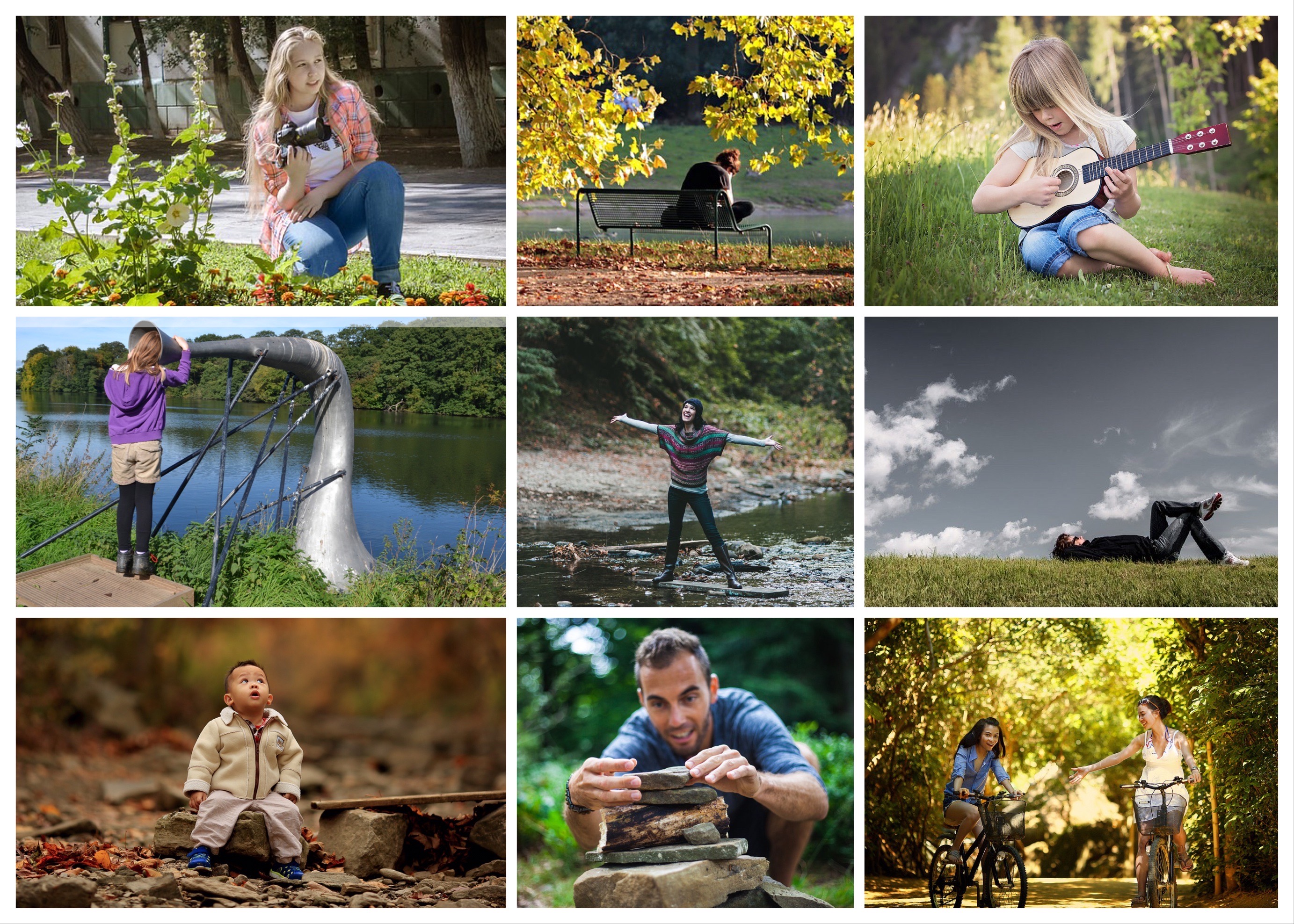
A New Relationship with Nature: what it means and what we can do

The climate crisis and wildlife emergency show that the relationship between people and the rest of nature is failing. This briefing draws together key findings from our research into human-nature connections. The purpose is to inform people of the evidence (there’s been much more since 2020!) and what it means in practice. Download as a PDF, or read the blog.

A new relationship with nature: what it means and what we can do A briefing from the Nature Connectedness Research Group at the University of Derby

A briefing from the Nature Connectedness Research Group at the University of Derby

The challenge – a failing relationship with nature

There’s no wellbeing without nature’s wellbeing. Everyone is at risk from the loss of habitats and a warming planet. The climate crisis, wildlife emergency and Covid-19 pandemic show that the existing relationship between people and the rest of nature is broken. It has become disconnected and narrow. Too often we see nature as something to use, control or as a threat to us. To fix this we need a new relationship with nature and doing so can also help tackle the crisis in our mental health and wellbeing.

In the UK, the Government’s 25-year Environment Plan aims to improve the natural environment within a generation and to reconnect people with nature [1]. To achieve that, people everywhere need to feel that nature matters to them.

The relationship between people and the rest of nature, ‘Nature Connectedness’, is grounded in scientific study, is measurable and accepted internationally. It involves understanding that we are part of nature. It is about our emotional connections and responses to nature, which help to regulate our own feelings and keep us mentally healthy. And it is about a meaningful relationship with the rest of nature rather than seeing it as something other. In short, it’s understanding that as humans nature is our story.

The big ambition – a new relationship with nature

Our ambition is happier and more fulfilled people and a thriving environment created by forging a new relationship with nature.  To build that new relationship, and hence the wellbeing of people and the rest of the natural world, we need to reboot our policies and practices so that they enable people to connect with nature. We must go beyond access and visits to nature. Beyond engaging people with nature through facts and figures. The evidence outlined below tells us we can build a new relationship by focusing on five types of activity: tuning our senses, responding with our emotions, appreciating beauty, celebrating meaning and activating our compassion for nature. We must also moderate our use and control of nature.

The evidence – why our relationship with nature matters

The University of Derby is leading the development of ground-breaking evidence that explains what nature connectedness is, how it can be measured, its benefits for human and environmental wellbeing – and, importantly, how it can be improved.

Science shows we need to go beyond simply enabling people’s access to nature, and enable people to build a connection with nature. It is our connection with nature that supports human and environmental health and wellbeing.

Here are some highlights of our research:

  • Our recent National Statistics survey work [2] [blog] with Natural England and others shows that:
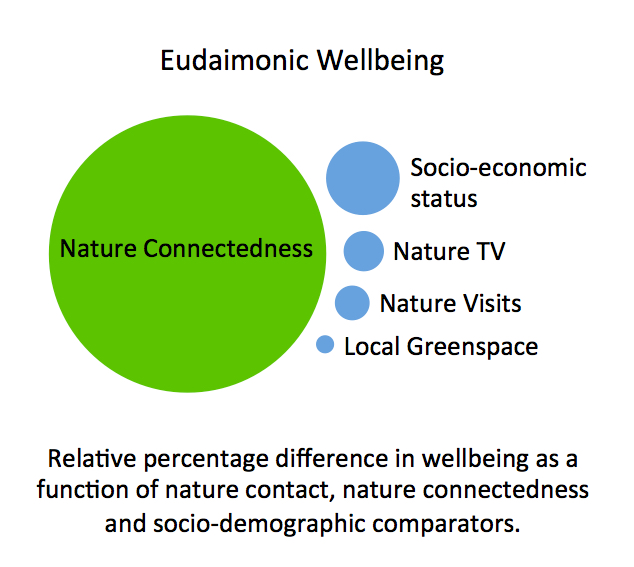
    • People’s nature connectedness, but not their contact with nature, predicts a sense that life is worthwhile – nearly 4 times larger than the increase associated with higher socio-economic status.
    • Nature connectedness predicts pro-environmental conservation behaviours, while the frequency of visits into nature does not.
    • Nature connectedness predicts pro-environmental household behaviours better than, and independently of, the frequency of visits into nature.
    • Levels of nature connectedness in children dip sharply between the ages of 10 and 15 years and can take 20 years to re-establish, to levels that are still insufficient for a sustainable future [3] [blog].
  • Our work with The Wildlife Trusts’ 30 Days Wild public engagement campaign found that people who took part reported sustained increases in connection to nature, happiness, health, and pro-nature behaviours. Simple everyday engagement with nature matters [4] [blog].
  • Our work on pathways to nature connectedness found that sensory contact, emotion, beauty, meaning and compassion connected people to nature more effectively than the traditional approach of facts, figures and science [5] [blog].
  • Our work to develop a smartphone app found that people with common mental health problems who noticed good things about urban nature showed clinically significant improvements in their quality of life [6] [blog].
  • Our work shows nature connectedness is linked to both feeling good and functioning well – notably bringinghigher levels of self-reported personal growth [7] [blog].

Wider research shows that nature connectedness brings pro-nature behaviours [8] [blog]. In sum, Nature connectedness is an essential target to foster a worthwhile and sustainable life. The evidence leads us to simple, low cost and universal solutions to help address the challenges of a warming climate, wildlife loss and mental health.

Simple solutions – improving our relationship with nature

Nature connectedness offers simple solutions to help deal with complex societal problems. Improving our relationship with nature responds to the challenge of the climate emergency and wildlife loss by encouraging care and respect for the rest of the natural world. People will be more supportive of the big changes needed if they are more connected to nature and feel that nature matters to them. A nature connected population will also be more likely to take action for nature – from simple actions at home, such as recycling or wildlife friendly gardening, to those requiring more commitment, such as giving time to take part in conservation volunteering. Also, through a new, more connected relationship with nature people can live a happier, more worthwhile and sustainable life.

Actions – for a new relationship with nature

5 pathways to a new relationship with nature

Improving people’s relationship with nature, their nature connectedness, comes through simple, yet meaningful engagement with nature. Our research has identified five distinct relationships that activate people’s connection with nature. The pathways to nature connectedness provide a new and applied approach to improving human-nature relations. They provide a framework with great flexibility of application, often through simple changes, in a range of circumstances from outdoor activity to the design of infrastructure to improve relationships between humans and nature on a larger scale.

·       Senses: Noticing and actively engaging with nature through the senses. Simply listening to birdsong, smelling wild flowers, or watching the breeze in the trees.

·       Emotion: Engaging emotionally with nature. Simply noticing the good things in nature, experiencing the joy and calm they can bring, and sharing feelings about nature with others.

·       Beauty: Finding beauty in the natural world. Simply taking time to appreciate beauty in nature and engaging with it through art, music or in words.

·       Meaning: Exploring and expressing how nature brings meaning to life. Simply exploring how nature appears in songs and stories, poems and art, or by celebrating the signs and cycles of nature.

·       Compassion: Caring for nature. Simply thinking about what we can do for nature and taking actions that are good for nature, such as creating homes for nature, supporting conservation charities and rethinking our shopping habits.

The pathways are used by the National Trust, Durrell Wildlife Conservation Trust, New Zealand Government’s Department of Conservation and others [blog].

The pathways provide a design framework.

Below we have suggested some areas of action that decision makers and leaders can consider. We have paired them as systemic changes for a sustainable future and actions we can take now to create more opportunities to connect with nature.

Area Systemic change Actions we can take now
Education and learning Consider how education can build the foundations of a new relationship with nature for a sustainable future. A ‘green thread’ of human-nature relationships can run through the curriculum to provide the context and vision for a new relationship with nature. Teaching and learning should include outdoor natural spaces, so that contact and connection with the natural world is at the heart of delivery at primary and secondary school. Education authorities and academies should support outdoor learning initiatives that go beyond just being outside, to actively connecting with nature.

Beyond schools, a national Wildlife Wellbeing Week should encourage all citizens to take action to notice and care for their local wildlife – improving the environment and habitats where they live.

Arts and culture Consider how arts policycan celebrate nature and its meaning in our lives. Encourage people to express their own appreciation and connections with nature. Use creative installations to prompt engagement with nature in public spaces. A national festival of nature to promote our connections with the natural world and with each other. National prizes for music, film and written word by young people that helps build a new relationship with nature.
Urban design and planning Consider how planning can move beyond access to ‘access for connection’. Actively create spaces to offer the prompts and opportunities to pause and notice the ‘good things in nature’.  Create ‘habitats for connection’ – provide an abundance and variety of wildlife to notice through bringing nature recovery networks into urban areas. Urban designers and buildings managers should bring opportunities to connect with and care for nature into the everyday environment – from spaces such as pocket gardens in schools to creating secluded habitats to encourage wildlife, to urban places that prompt meaningful engagement with nature.
Health and social care Consider how health and social can use a new relationship with nature to help people feel good and function well. Build connection with nature into greener social prescribing. Government departments and their agencies are already working to progress the use of nature based social prescribing at the national level and we encourage these initiatives to go beyond contact with nature to connection.

Health and social care professionals can prescribe activities in natural environments that involve the 5 types of relationship above, for example ‘noticing nature’ walks, art or photography workshops, wildlife gardening or providing bird feeders in care home gardens.

Revise the 5 Ways to Wellbeing guidance to include nature.

Housing Consider how housing developments can enable an active relationship with nature: landscape design to prompt engagement with nature, resident management of wildlife-friendly gardens, and new wildlife habitats to surround people with nature. Incorporate principles of nature connectedness into planning design guidance and standards, and encourage developers to create environments that prompt engagement through the 5 pathways to nature connectedness listed above.
Transport and infrastructure Consider how transport can be geared to green commuting, with natural habitats and gardens at transport hubs to create an environment to prompt engagement with nature. Investment should prioritise walking and cycling through green corridors to encourage everyday engagement with nature. Transport planners can map, signpost and promote green routes as alternatives to busy commuter routes. They can encourage wildflower and tree planting on roadsides and verges and create natural waypoints where people can pause and engage with the natural world.
Employment Consider how workplaces can include the benefits of breaks in nature, help employees’ enjoy natural environments where they work, e.g. the NHS Forest initiative A national sign-up scheme for business to ‘look after your space’ could encourage wildlife-friendly workplaces where employees connect with the good things in nature.
Cross-cutting issues Public service providers should make every waiting area – from doctors’ surgeries to bus stops – a place where people can notice the good things about the natural world.

Move beyond access to parks, nature reserves and national parks to meaningful everyday engagement with nature on your door step.

Further Information

Our research into nature connectedness has been named by Universities UK as one of the UK’s 100 best breakthroughs for its impact. Central to that impact has been the application of our research findings to the design of new ways to connect people with nature. For further information and support with building a new relationship with nature visit: www.derby.ac.uk/NCxRG


[1]https://www.gov.uk/government/publications/25-year-environment-plan/25-year-environment-plan-our-targets-at-a-glance

[2]Martin, L., White, M. P., Hunt, A., Richardson, M., Pahl, S., & Burt, J. (2020). Nature contact, nature connectedness and associations with health, wellbeing and pro-environmental behaviours. Journal of Environmental Psychology, 101389.

[3]Richardson, M., Hunt, A., Hinds, J., Bragg, R., Fido, D., Petronzi, D.,Barbett, L., Clitherow, T.J., and White, M. (2019). An Affective Measure of Nature Connectedness for Children and Adults: Validation, Performance and Insights. Sustainability,11(12), 3250.

[4]Richardson, M., Cormack, A., McRobert, L. & Underhill, R. (2016). 30 Days Wild: Development and Evaluation of a Large-Scale Nature Engagement Campaign to Improve Well-Being. PLoS ONE11(2): e0149777. doi:10.1371/journal.pone.0149777

[5]Lumber, R., Richardson, M., & Sheffield, D. (2017). Beyond knowing nature: Contact, emotion, compassion, meaning, and beauty are pathways to nature connection. PLoS One, 12(5).

[6]McEwan, K., Richardson, M., Brindley, P. Sheffield, D. & Ferguson, F.J.  A Smartphone App for Improving Mental Health through Urban Nature. (2019). International Journal of Environmental Research and Public Health, 16(18), 3373 doi.org/10.3390/ijerph16183373.

[7]Pritchard, A., Richardson, M., Sheffield, D, & McEwan, K. (2019). The relationship between nature connectedness and eudaimonic wellbeing: a meta-analysis. Journal of Happiness Studies, 1-23.

[8]Mackay, C. M., & Schmitt, M. T. (2019). Do people who feel connected to nature do more to protect it? A meta-analysis. Journal of Environmental Psychology65, 101323.


Posted in Uncategorized | 3 Comments

Finding a Friend in Nature

Even when we can’t get out and about, nature can still help us keep well. When required to stay at, or close to home, and be socially distant, it’s important to look after your mental wellbeing.

Your wellbeing can benefit from a close relationship with nature. This ‘friendship with nature’ isn’t dependent on taking a trip into distant natural landscapes, it can be made at, or very close to home. Here are some ways everyday nature can lend a hand:

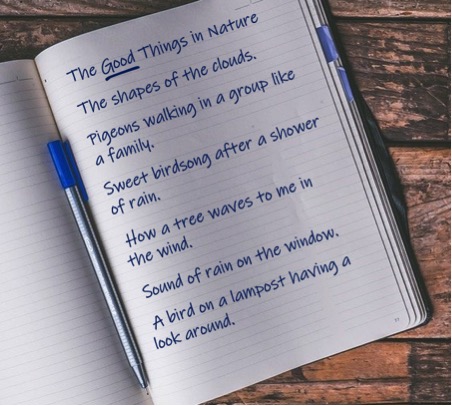
  1. Notice and write down the ‘Good Things in Nature’
  2. Explore your relationship with nature
  3. An audio nature meditation
  4. Virtual Nature – let nature help manage your emotions.

These are four nature-based suggestions to help stay well. You can try a variety of approaches to maintain your wellbeing and find ones that work for you. You can try other ideas and reach out for further support if you feel you need it.


1 – Notice and write down the ‘Good Things in Nature’

If you can see a little nature from your home, a tree, visiting birds or flowers for example, this exercise can be done each day. Simply take a moment to tune in and notice everyday nature. Shown to bring clinically significant improvements to mental health.

Three good things in nature

You can write a sentence about the beauty of small things to the whole of the sky. It could be as simple as noticing a bird singing or the movement of a tree in the breeze. Changes in the clouds or noticing flowers bloom.

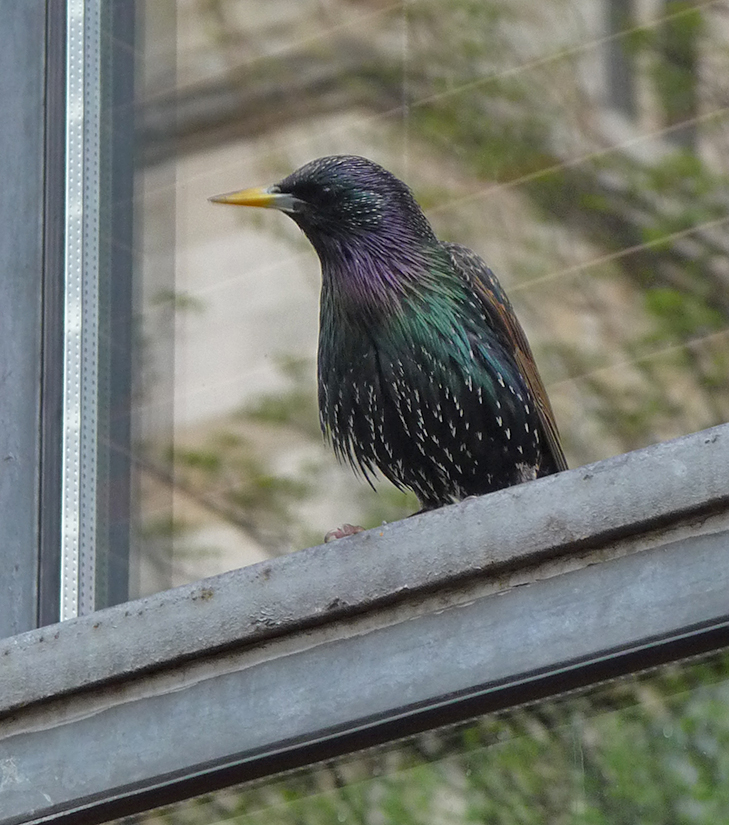
starling in the city

Find a friend in nature, be it the local birds or a favoured tree. If you can, take some action to encourage birds closer to your home – provide food or water for example.


2 – Use art and words to explore your relationship with nature

A close relationship with nature is good for wellbeing. And a closer relationship with nature comes through noticing nature and its beauty, feeling the joy and calm nature brings, celebrating and expressing what nature means to you, and caring for nature.

Explore and deepen your relationship with nature in ways that work for you, outside if you can, but also from home through art, music or words – be creative!

Here are 5 types of relationship with nature to get you started.

Senses – If you can, take a moment to notice any everyday nature nearby. Tune in to everyday nature through the senses.  Listen to birdsong or watch the breeze in a tree.

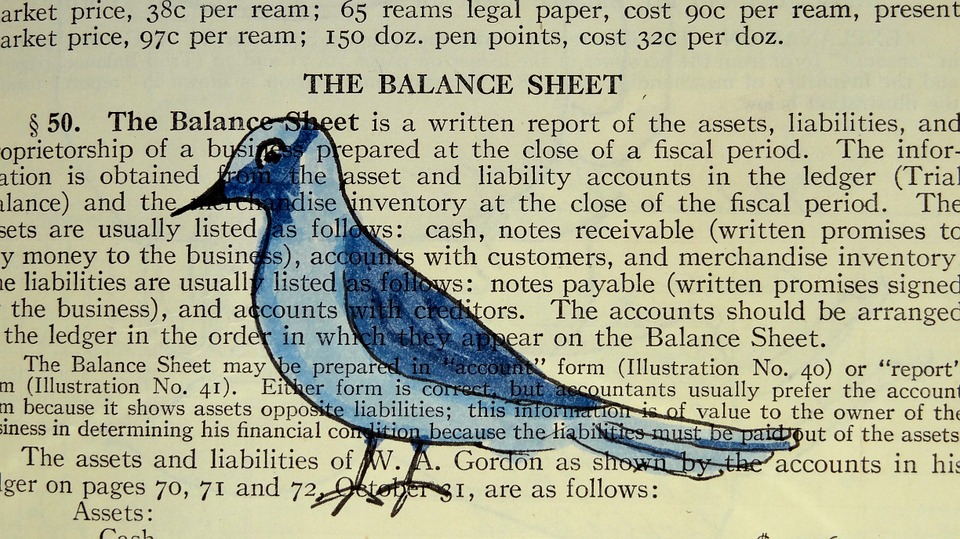
Beauty – Notice nature’s beauty. Take time to appreciate beauty in nature and engage with it through drawing or take a photo of a flower.

drawing of a bird

Emotions –  Notice how nature makes you feel – the joy and calm it can bring. Find happiness and wonder in nature, birds being active, their flight or simply a spiders’ web.

Write down and share your feelings about nature, using social media for example the #NaturalHealthService on Twitter.

Meaning – Some of the greatest works of art and favourite poems are about nature. It means a great deal to people. Find and share songs, stories, poems and art that are about nature.

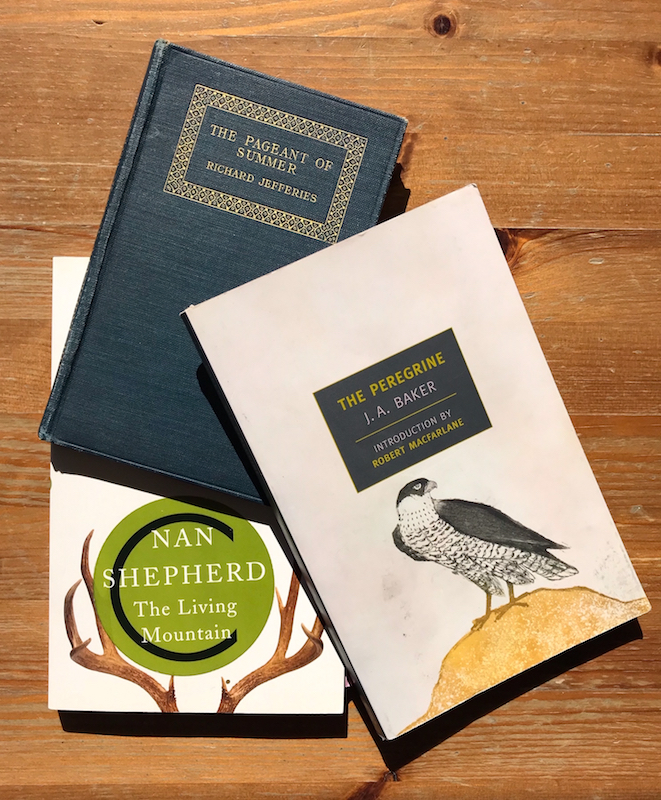
For example, compile a nature playlist, try reading some classic nature writing, work that is immersed in nature such as The Pageant of Summer by Richard Jefferies available for free. Similarly, read some classic poetry about nature, such as On a Lane in Spring by John Clare, is freely available.

nature books

Explore and express how nature brings meaning to your life. Create your own songs, stories, poems and pictures of nature.

Care – Take action for nature. Think about what you can do for nature. If you can, feed the birds, plant some bee friendly flowers, dig a pond and create homes for nature.


3 – An audio nature meditation

If you don’t have access to nature, or would like to try something different, try meditating on nature.

headphones

Make sure to sit in a quiet and undisturbed place for the next 10 minutes. Check that the volume of your speaker or earphones is high enough without being too loud. This recording will guide you through a short meditation. The bell will ring at the beginning and at the end.

Settle into a comfortable position, either on a straight-backed chair, or on a soft surface on the floor. When you are ready to start, try as far as possible to adopt an erect, dignified, and comfortable posture. Allow your posture to express and support your intention to be awake and consciously present.

If sitting on a chair, have the feet flat on the floor with the legs uncrossed. If you sit on the floor, experiment with the height of the cushion or stool until you are comfortably and firmly supported, with your knees lower than your hips. Gently close your eyes as you listen:


4 – Let nature help manage your emotions.

If you can spend a little time outside in greener places, do so. If not, even viewing pictures and videos of nature can help. Take time to notice and share the good things in nature. Let nature help manage your moods and emotions.

Immerse yourself in Virtual Nature

If you can, find a spot away from distractions and use a bigger screen, to view some photos or videos of nature (try 5 or 10 minutes and see how you go), here are two examples:


If nature isn’t working for you

Try to do things you enjoy and keep your mind active. Spend time doing things you enjoy – this might include reading, indoor hobbies, listening to music, favourite radio programmes or watching TV. Play games, do crosswords or puzzles, try drawing or painting. Check out ways to get creative.

Whatever it is, find something that works for you and take time to relax.


Wider Guidance

There’s plenty of general advice available. Visit guidance from trustworthy sources, for example Every Mind Matters in the UK, for example, try to:

  • Connect with others, to enjoy conversation, but also to talk about your worries if needed.
  • Create a daily routine
  • Plan practical things like making a plan to get household supplies.
  • Try to eat healthily.
  • Try to get some exercise.
  • Look after your sleep.
  • Don’t watch too much news – set a specific time and use trustworthy sources.

Finally, there’s also support for those finding the situation very difficult.


Posted in Uncategorized | 1 Comment

At challenging times nature can lend a hand

We are taking our first steps into some difficult months. A serious threat to physical health for some, combined with social restrictions for all, presents challenges for mental health. It’s pleasing that the impact on mental wellbeing is being recognised and that nature can help – thankfully, nature can also help even if you can’t get out and about.

Notice and find a friend in nature

The benefits of being out in nature are increasingly recognised, but those simple freedoms are currently becoming restricted. This is difficult, but recently we’ve found that rather than time and visits to nature, a close relationship matters just as much and at times even more for feeling good and functioning well – being resilient to the challenges life can bring. This close relationship isn’t dependent on taking a trip into distant nature, it can be made at, or very close to home. Here are 3 ways everyday nature can lend a hand.

Notice Nature

Noticing and enjoying the simple things in everyday nature really does make a difference. Listening to the birds sing, watching the breeze in the trees and noticing flowers emerge can often be done close to home, in urban areas, through a window and even to some extent through TV and pictures if needed. We’ve found that actively noticing the good things in nature benefits mental health significantly – particularly for those people who tend to be more distant from nature. During the coming months nature will provide much to notice and enjoy. The birds will be busy and in full song, trees will become green as the days warm and lengthen. Over this time simply notice nature and the coming of spring and summer.

Nature helps manage moods

Nature can help manage our moods and emotions. Regulating emotions is a very important and almost constant function of human life. It helps us respond to and deal with everyday demands in an appropriate way. The ability to keep our emotions regulated is important for well-being. Through helping balance our moods, nature helps maintain positive emotions, brings greater resilience and is even linked to enhanced immune function. Let nearby nature bring joy and calm to help manage your emotions.

Nature connection can help with social isolation

We know social relationships are really important for wellbeing, so clearly social distancing presents a challenge to keeping well. As social animals we’re also part of the wider natural world. Research has found that nearby nature can help us feel connected – nature can offer socially isolated people an alternative way of feeling connected, buffering the effect of low social connectedness. Further, nature connectedness has been found to predict well-being over and above how generally connected people feel to family and friends – close relationship with nature can really help. So when noticing nature, find a friend nearby, be it the local birds, a favoured tree or squirrels in the park. Perhaps take some action to encourage wildlife closer to your home – provide food for birds and wildlife or grow some bee friendly plants if you can.

Interestingly, those who notice the beauty of nature tend to demonstrate more pro-social and helping behaviours to others – another helpful benefit – but also, to let nature lend a hand:

  1. Tune in and notice everyday nature
  2. Let nature help manage your emotions
  3. Find a friend in nature

Finally, nature is important, but it can’t do it all, for wider information on mental health and wellbeing at this time see this guidance from Mind.


Posted in Uncategorized | 1 Comment

Nature connectedness and noticing nature: Key components of a good life.

For the past six months or so we’ve been working with the National Trust exploring how being connected with nature relates to pro-nature behaviours and wellbeing. In particular we were interested to see how much everyday moments, simply tuning into notice nature, mattered. The full report has been published as part of the National Trust’s 125thAnniversary activities.

One of our successful interventions to improve nature connectedness for wellbeing involves simply noticing the good things in nature. We know a close connection with nature comes from tuning into nature.  What does that mean?  It’s simple. We tune into nature when we engage in simple activities – like listening to birdsong or enjoying the early spring blooms.  Simple moments of tuning into nature are not only an observable indicator of the psychological construct of nature connectedness, they also manifest the psychological construct of nature connectedness.  They bring nature connectedness to life, and are how looking, listening, enjoying nature and its beauty can bring care for nature into your life, as well as happiness and meaning.

A YouGov survey of 2096 adults was used to explore how the factors below related to pro-nature conservation behaviours and wellbeing:

  • Nature connectedness
  • Time spent in nature
  • Simple engagement with nature (e.g. listening to birdsong & smelling wildflowers)
  • Indirect engagement with nature (e.g. watching or listening to nature programmes)
  • Knowledge and study of nature
  • Valuing and concern for nature
  • Pro-nature environmental action (i.e. cutting carbon and resource use – rather than creating habitat for wildlife)

Some of these factors worked together to explain 70% of the variation in people’s pro-nature conservation behaviours. Of the factors above, simple engagement through tuning in and noticing nature had the strongest relationship to conservation action.

In particular, we identified seven significant ‘noticing nature’ activities that are significantly linked to nature conservation behaviours. These help describe someone with a close and caring relationship with nature—someone who tunes in to the everyday nature around them:

  • Listening to bird song
  • Smelling wild flowers
  • Taking a photos / drawing or painting pictures of nature
  • Taking time to notice butterflies and/or bees
  • Watching the sun rise
  • Watching clouds
  • Watching wildlife

Unfortunately, although 80% of people in the survey expressed concern about the state of nature, far fewer actively help its recovery – for example only 29% said they’d created a home for wildlife in the past year. However, using our newly validated Pro-nature Conservation Behaviour Scale, we found that those people with a high level of nature connectedness, or a close relationship with nature, did much more– 40-50% more – than those with a weaker relationship. Nature connectedness was  a key factor in conservation action.

We also found that it’s about moments—not about minutes.  Spending time in nature was unrelated to nature conservation action. Care for nature is about being tuned in and having a close relationship, rather than simply being outdoors. An interest in nature shown through watching nature programmes and the study of nature (indirect engagement) also helped explain levels of nature conservation behaviours – although to a lower level than simple direct engagement with nature.  Similarly, pro-environmental behaviours (e.g. recycling) and concern for nature were linked to nature conservation activities. In reality all these factors work together, but even then, nature connectedness and simple nature engagement were involved in over 90% of that shared variation in pro-nature conservation behaviours. Tuning into nature and developing a close relationship with nature matters – a lot.

The representative survey of people also looked at the relationship between nature connectedness, nature experiences, and wellbeing.  In particular we looked at two aspects of well-being:  happiness and feeling that life is worthwhile (an indicator that people find meaning in life).  Once again, factors included in the analysis were:  nature connectedness, time spent in nature, engaging with nature through simple activities, indirect engagement with nature, and knowledge and study of nature.  We also looked at how these factors were related to ill-being (i.e., depression and anxiety).  We found that:

  • Nature connectedness and engaging with nature through simple activities emerged as important contributors to being happy and feeling that life is worthwhile.
  • Importantly, time in nature did not emerge as a significant predictor of happiness or feeling that life is worthwhile. Indeed, time as a non-factor repeats results of our other work published recently.

The survey also looked at two well-known factors that are important contributors to happiness and a worthwhile life:  having a life-partner and believing that one can control their life. Even when we considered these basic components of a good life, nature connectedness and engaging with nature through simple activities still emerged as significant important aspects of life contributing to happiness and feeling that life is worthwhile.  This suggests that nature connectedness itself—tuning into nature—is a basic component of a good life.

With regard to ill-being (i.e., depression and anxiety):

  • Nature connectedness and engaging with nature through simple activities were significantly predictive of not having anxiety and depression.
  • Again, even when we considered the basic components of a good life (being in a loving relationship and believing that one has control over their life), nature connectedness and engaging with nature through simple activities still emerged as significant important aspects of a good life, predictive of not having anxiety or depression. In essence, tuning nature in, helps to tune anxiety and depression out.
  • Importantly, time in nature did not emerge as a significant predictor of not having anxiety or depression.

These findings of time as a non-factor may seem odd.  There’s been a great deal of research showing how time in nature is important for wellbeing. However, this research often overlooked individual factors, such as nature connection and engagement. When added to the analysis these person-based factors have stronger relationships. So, when measured alone, time in nature will be a proxy for connection and engagement, but time does not tell the full story. What matters is how that time is spent – developing and being in a close relationship with nature.

Tuning in and noticing nature matters for human and nature’s wellbeing. Yet it appears that most people are tuned out. Indeed, as a society, we are out of tune with the rest of nature. Sadly, around 80% of people reported that they rarely or never watched wildlife, smelled wild flowers or drew/photographed nature. 62% of people rarely or never listened to bird song or took a moment to notice butterflies or bees. Just 6% celebrate natural events such as the longest day. In other research we’ve found that when people are prompted to notice the good things in nature, their nature connectedness and mental health improves. This provides evidence of the causal link between noticing nature, connection, and wellbeing.

Think of it this way: When a musician or an instrument is out of tune with the rest of the orchestra, the result is disharmony, discordance, and disunity—an altogether unpleasant experience.  So too when we are out of tune with the rest of nature.  When we are tuned out and fail to notice the nature around us, we also fail to notice the discordance and dishevel that our environment is in.  If we don’t take notice—we are unlikely to take action.  Moreover, by not being tuned into nature, our lives are poorer for it in terms of happiness and meaning.  Yet, as these findings show, tuning into nature—through simple acts like listening to the birds or enjoying the beauty of flowers—changes our actions to care more for nature.  Tuning into nature adds happiness and meaning to our daily lives.  Tuning in to nature is not about time, not about minutes. It’s simply about noticing the nature around you, about engaging with nature and cultivating a close, connected relationship with the rest of the natural world.

Overall, these findings highlight that time spent in nature is not necessarily a significant predictor of human wellbeing and pro-nature behaviours.  Rather it a close connected relationship with nature that plays an important role in feeling happy, feeling that life is worthwhile, and doing good for nature. This is important as a focus on time brings a focus on access to nature, when what matters more is access that promotes engagement – providing green and blue places that facilitate and prompt simple engagement with nature – on an everyday basis. This can be done through applying our pathways to nature connection design framework, as used by the National Trust, and extended frameworks published recently in the journals Landscape and Urban Planning and Urban Forestry and Urban Greening.

The warming climate and loss of wildlife show our relationship with nature is broken, these results show that too often nature is not part of people’s daily lives – from simply noticing it to celebrating the cycles of nature. We need a new relationship with nature and that starts by tuning in and noticing nature and its beauty. Letting nature manage our emotions. Celebrating its presence and story through cultural events. These are key components of a worthwhile life, a sustainable life – a good life.


A blog by Prof. Miles Richardson and Dr Holli-Anne Passmore.

Posted in Uncategorized | 1 Comment

Beyond Nature Contact to Connection: A Missing Link in a Sustainable and Worthwhile Life.

Our latest research with 4,960 adults across England has found that nature connectedness is important, over and above getting out into nature, for eudaemonic wellbeing and pro-nature behaviours. The work is a key paper from a five-year project co-ordinated by Natural England, supported by several national nature conservation groups and involving a number of universities along the way. The project aimed to establish the contribution of both nature contact and nature connection to wellbeing and pro-nature behaviours.

A large amount of evidence has been published showing time in, and contact with, nature are important for health and wellbeing and this evidence is now increasingly recognised. However, nature connectedness as a measurable psychological construct that describes how close a person is to nature has emerged more recently, so much less is know about its contribution, especially when entered into the models that study contact with nature.

The study, published in the Journal of Environmental Psychology, investigated the relationships between nature contact (visits and neighbourhood greenspace), nature connectedness (measured using the NCI developed as part of the project), general health, wellbeing, pro-environmental and pro-nature conservation behaviours within a single study analysed using linear regression models.

The study collected data from a representative sample of the adult population of England (N = 4,960) collected via the Monitor of Engagement with the Natural Environment (MENE) survey. As part of the United Kingdom’s official statistics, substantial effort is made to ensure representative sampling.

Check out the full research paper for the analysis, here we can jump straight to a selection of the results.

Nature Connectedness

After accounting for various types of nature exposure and a comprehensive range of socio-demographics (e.g. socio-economic status, neighbourhood deprivation, urbanicity, gender, ethnicity, employment, marital status) we found:

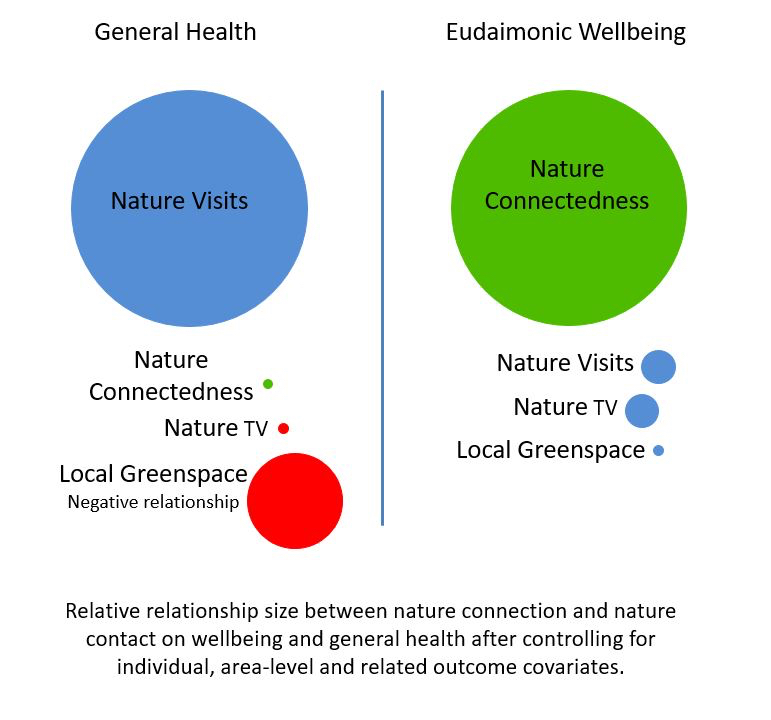
  • A positive relationship between nature connectedness and feeling one’s life has meaning and is worthwhile (eudaemonic wellbeing) – nearly 4 times larger than the increase associated with higher socio-economic status.
  • A positive relationship between nature connectedness and household pro-environmental behaviours (e.g. recycling, buying locally sourced food, eco-friendly products, walking or cycling).
  • A positive relationship between nature connectedness and pro-nature conservation behaviours (e.g. supporting nature conservation and volunteering).

A close relationship with nature is 4 times more important than purchasing power for feeling your life is worthwhile.

Psychological connectedness to nature was found to be important over and above getting out into nature for eudaemonic wellbeing, pro-environmental behaviours and pro-nature conservation behaviours.

Contact With Nature

For contact with nature we found:

  • Visiting nature once per week or more was associated with better household pro-environmental behaviours and general health (to a level substantially higher than socio-economic status) – but not directly to living a worthwhile life or pro-nature conservation behaviours.
  • Living in a greener neighbourhood was negatively related to general health and unrelated to any wellbeing or sustainability outcomes – highlighting the difference between presence of and use of greenspace.

These results suggest a need to encourage visits to local green spaces, but for the type of activities related to nature connectedness (e.g. pathways to nature connection) – more on this below.

Indirect contact with nature through watching nature programmes was also included in the analysis, there were some positive results with complex interactions. In brief, individuals who watched nature programmes reported more pro-nature conservation behaviours than those who did not, and this pattern became more marked as nature connectedness increased. This suggests further work around designing nature programming around the pathways to nature connection to intentionally increase nature connectedness could be worthwhile. However, for highly connected individuals watching nature programming was related to reduced life satisfaction, perhaps related to heightened concern about the decline of nature now increasingly referenced in nature programmes. This highlights the need for efforts to increase nature connectedness (for human and nature’s wellbeing) to be accompanied by positive news on the restoration of nature.

Visit nature for health. Connect for wellbeing.

Interaction effects

The analysis also considered how the main factors worked together.

Nature connectedness was found to be a key factor, not just in terms of a direct relationship with wellbeing and pro-nature behaviour, but also through interaction effects on indirect and intentional nature contact. For instance, living a worthwhile life, nature connectedness and frequency of visits to nature interacted. This suggests optimal visits may be those that activate nature connectedness – once again through the type of activities suggested by the pathways to nature connection.

For pro-nature behaviours and eudaimonic wellbeing think ‘what’ rather than ‘how long’ or ‘how often’.

Pro-nature Behaviours

The study also provided some interesting results on pro-nature behaviours.

Firstly, the analysis showed that pro-environmental behaviours and pro-nature conservation behaviours are distinct factors – that is they form two types of human behaviours that need to be thought of differently. However, although there are many validated scales of pro-environmental behaviours, there are none for pro-nature conservation behaviours (the good news is we’ve developed one at the University of Derby).

The study found that household pro-environmental behaviours, such as recycling, were far more frequent in our sample than pro-nature conservation behaviours (e.g. nature conservation volunteering) that are likely to require greater commitment and effort – and, as another paper from the project reports, are associated with higher levels of nature connectedness.

It is important to note that while the direct relationships between nature connectedness were stronger for household than conservation behaviours, the interaction effects were stronger for conservation than household behaviours. This suggests that efforts to improve nature connectedness may be particularly important for conservation behaviours that arguably require greater personal effort.

A close relationship with nature is important for pro-nature behaviours.

Implications

It is important to note that the link between nature connectedness and both living a more worthwhile life and pro-nature behaviours remained after accounting for various types of nature exposure and a comprehensive range of socio-demographics. Also, it should be noted that causality cannot be established form this type of research, however evidence of a causal relationship between nature connectedness and key outcomes has been found in other research, for example to improved pro-environmental behaviours and greater wellbeing.

The current study has though identified that the role of nature connectedness is important over and above getting out into nature for the two important outcomes of eudaimonic wellbeing and pro-nature behaviours. These effects are practically meaningful, given that they were greater in magnitude to benchmark socio-demographic factors.

Nature connectedness is a key target to foster a worthwhile and sustainable life.

Theory and research has largely overlooked the relevance of person specific factors in human-nature interactions and the results suggest that a more nuanced approach to human-nature interactions is necessary. This has implications for policies related to improving both human and planetary health.

The interaction effects show that nature connectedness influences the way in which people respond to contact with nature. This suggests that interventions are needed that increase both contact with, and connection to nature, in order to achieve human and nature’s wellbeing.

The results are particularly relevant to practitioners and policy makers because of the nationally representative nature of the sample and diverse types of nature contact respondents had. The concept of a worthwhile life also links through to the idea of a “good life”. A key transformative change stated in the IPBES assessment report on biodiversity and ecosystems (Section D3: Summary for policy makers) was to re-evaluate what we mean by the idea of a “good life” – improving nature connectedness provides a target to help establish a worthwhile life, a pro-nature life – a good life.

Conclusion

In sum, the psychological construct of nature connectedness, which describes the closeness of our emotional relationship with nature, was a key factor. Firstly, in terms of its direct relationship with having a worthwhile life, pro-environmental and pro-nature conservation behaviours. Secondly, through its moderating effect on nature contact – reporting a meaningful and worthwhile life (eudaimonic wellbeing), nature visit frequency and nature connectedness interacted, suggesting optimal visits may be those that activate the pathways to nature connectedness – which has implications for the types of activity encouraged in greenspaces.

The results support the value of collecting population levels of nature connectedness (as we did with the NCI) and encouraging interventions that increase it among the population. There is a clear need to move beyond facilitating access to nature to consider access for connection with nature. The pathways to nature connectedness (PDF pathways postcard) provide a design framework for interventions intended to facilitate the right type of nature engagement for connection.

Encouragingly we know nature connectedness can be increased through simple interventions such as noticing the good things in nature and campaigns such as 30 Days Wild. However, the warming climate and crisis of biodiversity loss show that the human relationship with the rest of nature is broken. The population data shows that levels of nature connectedness need to be significantly higher for the majority of the population to bring about the behaviours required for a sustainable future. A new, closer and sustainable relationship with nature will require systemic change at deep leverage points. We’re already working on ways to apply the pathways to nature connectedness at deep leverage points and will publish proposals in the coming months. For now, the research above provides an essential first step, identifying the key role of nature connectedness, highlighting a missing link in human and nature’s wellbeing.


Martin, L., White, M. P., Hunt, A., Richardson, M., Pahl, S., & Burt, J. (2020). Nature contact, nature connectedness and associations with health, wellbeing and pro-environmental behaviours. Journal of Environmental Psychology, 101389.


Posted in Uncategorized | 2 Comments