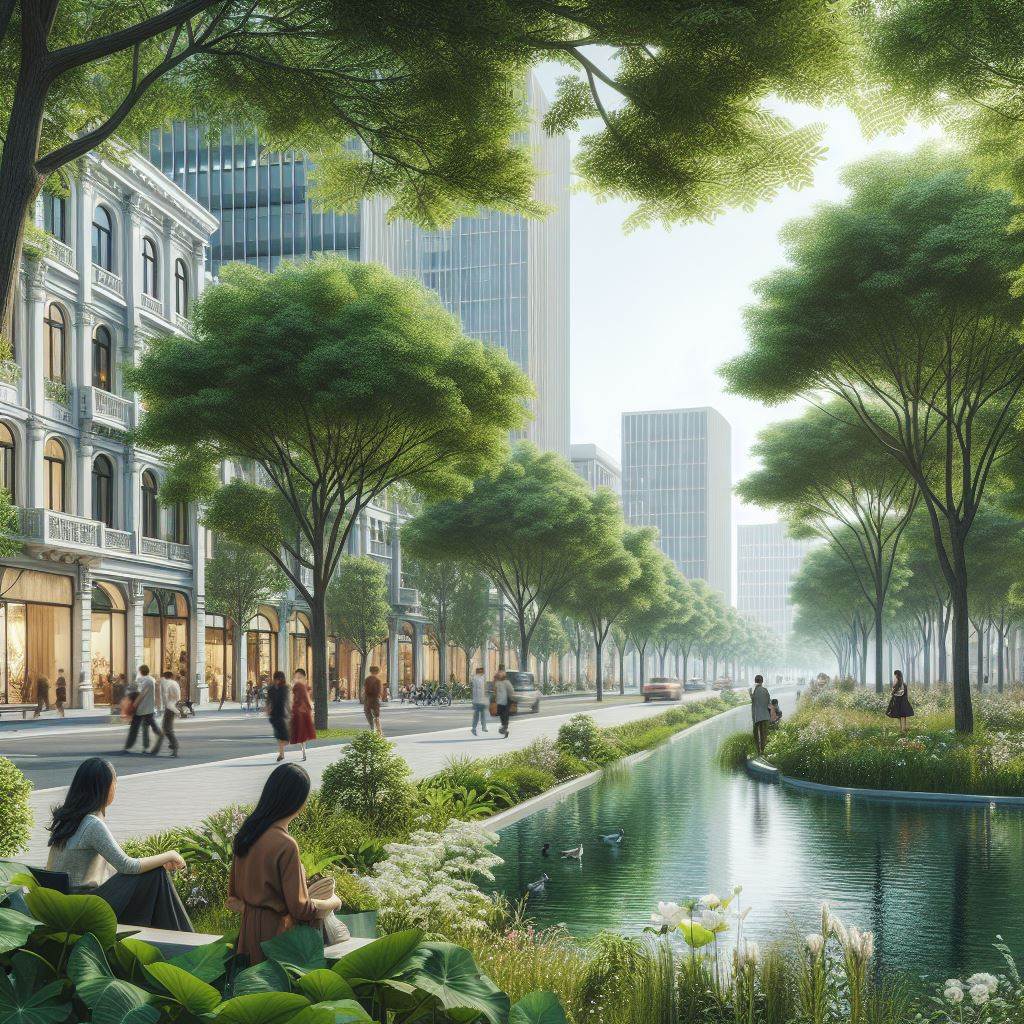
A horizon scan of issues affecting UK forest management within 50 years

Forests are currently in the spotlight, as they play a crucial role in addressing some of society’s most pressing challenges, including climate change and biodiversity loss. While forests are key to addressing these global issues, they, and the sector responsible for their management, are facing a complex set of intertwined threats and opportunities. Many of these challenges are well-documented, but solutions often remain elusive. Additionally, there are emerging trends that have yet to receive widespread attention.

Earlier this year I was involved in a horizon scan, aimed at identifying these upcoming issues that are likely to impact the field of forest management in the UK over the next half-century. These are challenges that, while currently under-recognized, have the potential to significantly influence the entire sector and extend their reach beyond it.

Considering that forest management operates on extended time scales, the importance of having a keen foresight is self-evident. So, the research, now available in the journal Forests, helps ensure the resilience and sustainability of our forests for the years to come.

The research employed a well-established horizon scanning methodology, engaging a diverse expert panel, to compile and prioritise a list of 180 proposed issues. After a rigorous process, we selected the top 15 most critical concerns for further examination.

The top-ranked issue, ‘Catastrophic forest ecosystem collapse,’ highlights the consensus on the potential for such a collapse and its far-reaching implications across the sector and society as a whole. The 15 issues encompass a wide range of themes, from environmental shocks to evolving political and socio-economic factors, underscoring the complexity of their interactions.

The 15 horizon scan issues identified were:

  1. Catastrophic forest ecosystem collapse
  2. Increased drought and flooding change the social costs and benefits of trees
  3. Forest management becomes more challenging due to changing seasonal working windows
  4. Protecting and enhancing soil microbial ecology becomes a higher priority
  5. Viruses and viroids emerge as pathogens of increasing importance for trees
  6. eDNA revolutionises our understanding of forest ecosystems
  7. Trees are at the heart of future urban planning
  8. The Taskforce on Nature-related Financial Disclosures (TNFD) drives transparency and investment in nature-positive management
  9. Natural capital funding streams are greatly upscaled
  10. New technologies facilitate widespread adoption of smart silviculture
  11. New technologies improve worker health and safety
  12. New wood product markets stimulate more active forest management
  13. UK commercial forest resources may not match future value chains
  14. Unpredictable supply and demand dynamics in global wood product markets
  15. International commitments will spotlight ecosystem integrity and drive monitoring efforts.

From my perspective, I was pleased that a human-nature relationship issue made it through from the 180 long list to the final 15 most critical issues – placing trees are at the heart of future urban planning. There weren’t many broadly social issues on the long list and a couple covered the potential for woodland management to foster human engagement with nature, for connection, wellbeing and one health. However, trees being at the centre of urban planning captures some of this thinking and was endorsed as a priority by the diverse expert panel.

It reflects the recent shift in environment science-policy thinking recognising that for a sustainable future there is a need for a fundamental change in the way that citizens, institutions and societies relate to and value nature (e.g. Stockholm+50: Unlocking a Better Future). Although accepted that woodland provides significant health benefits, UK urban centres tend to lack easy access to significant woodlands. There is a need for urban planning and planting principles to move beyond a focus on issues such as carbon storage and recreational access to the potential for wider benefits and societal impact. Given that the UK is one of the least nature-connected societies in Europe (White et al., 2021), integrating treescapes into and around urban areas will bring important opportunities to transform the ways society relates to and values nature and thereby protects biodiversity and responds to climate change (Richardson et al., 2020). These challenges and new objectives will have significant implications for both the forestry and arboricultural sectors, which will need to work closely together.


Posted in Uncategorized | Leave a comment

New forest species stripes with the WWF

Since 1970 there’s been a shocking 79% average decline in species – including gorillas, orangutans, hornbills, and so many more – that rely on forests for survival. The new Forest Stripes show the crisis facing our world’s forests in one striking image.

Forest Species Stripes

Forest Species Stripes

The Forest Stripes were created by environment charity WWF and based on the biodiversity stripes approach, which themselves were inspired by the Climate Stripes. The new image from WWF was made in collaboration with the University of Reading, ZSL and the University of Derby. They show the crisis facing our world’s forests:

  • There’s been a shocking 79% average decline in species that rely on forests.
  • We are failing forests and the species that rely on them for survival.
  • Since the global pledge to end deforestation by 2030 was made, an area of tropical rainforest twice the size of Wales has been lost.
  • We are now spending at least 100 times more public funding on environmentally harmful subsidies ($378 billion – $1trillion) than we are on finance for forests ($2.2bn).
  • Where tropical forests are under the stewardship of Indigenous Peoples and local communities, forests are better protected and deforestation and degradation are lower.

Despite every pledge to protect them, forest loss and degradation are still getting worse. We have to do to bring our forests back to life. WWF’s new major report, Forest Pathways, shows just how much we’re failing our forests and sets out exactly what needs to be done to bring them back to life. Find out more about forests here.

Global warming, biodiversity loss, and forest species loss 1970-2018

Global warming, biodiversity loss, and forest species loss 1970-2018

When combined, the trio of climate, biodiversity and forest stripes tells a devastating story of environmental crises and the scale of the challenge. As the planet warms biodiversity has been lost to a critical level. With forests crucial to help avoid the worse climate consequences and wider decline of biodiversity.

The root cause is the failing human-nature relationship. Once, forests provided food and shelter for many and were trusted to meet our needs as a giving parent. A worldview still found in Indigenous communities.  For example, trees of the forest have great importance for the Co Tu of Vietnam. They have souls and are personified as gods, creating a culture of protecting forests. Similarly, to the Nayaka, the animals of the forest (now represented by the forest stripes) were sentient beings, persons and co-dwellers.

From a modern perspective, such relational worldviews are often grossly misunderstood as a primitive worldview. Yet today, we’re failing nature and ‘relationally framing’ the technology we use – the objects of the concrete jungle, rather than the forest. Although we no longer see the forest as a giving parent, the forest still provides. Even in urban locations, the amount of forest near a person’s home relates to the structural integrity of the amygdala, a key centre for processing emotions within the brain. Forests also help manage our moods and keep us well. You can read more about such stories in Reconnection.

At the heart of efforts to protect forests is our relationship with the rest of nature. A deep emotional and meaningful bond with nature and a relational worldview are essential.  For example, people with a closer connection with nature are more willing to do more for conservation work in the forests. In the forest of life, the human tree casts much shade – but must also be a source of hope.


Posted in Uncategorized | Leave a comment

Launching the Nature Connected Organisations Handbook for sustainable futures and workplace wellbeing

A guest blog by Dr Carly Butler, Researcher in Nature Connectedness, University of Derby.  

The Nature Connectedness Research Group are delighted to announce the release of a new resource for businesses and other organisations: The Nature Connected Organisations Handbook: A guide for connecting organisations with nature for sustainable futures and workplace wellbeing.

Nature Connected Organisations Handbook

Nature connection is about how people think about, feel towards, and engage with nature. It is increasingly recognised as having a vital role to play in addressing the ecological and climate crises, as well as improving people’s psychological wellbeing. Those who have a strong sense of nature connectedness feel happier, function better, and help the environment more than those who are less connected.

Our previous Nature Connection Handbook was written to help organisations who aim to connect people with nature by providing a summary of nature connection research and evidence-based methods for helping people improve their sense of nature connectedness. We wanted to build on this to produce a second handbook to focus on internal organisational change, helping organisations grow nature connectedness amongst their own staff and management. So, we turned our attention to developing the idea of a nature-connected organisation, applying the science to develop a framework and guidance. This new handbook is the result – helping organisations of all types change how their people, infrastructures, and culture relate to nature.

The handbook offers a brief outline of the science of nature connection, explains why nature connection is important for organisations, and offers a framework and tips for bringing nature connection into an organisation. It identifies opportunities for connecting staff with nature, opportunities to develop spaces and processes that are nature connecting, and opportunities for going deeper and embedding nature connectedness into organisational culture. By closing the gaps between humans and the more-than-human world, nature-connected organisations support the mental wellbeing of their staff, make direct contributions to nature’s wellbeing, and champion transformational change to a more sustainable future for all.

Nature on the Board

Why do we need nature connected organisations?

Without global action to protect and restore nature and limit the effects of climate change, the world faces significant risks of environmental, societal, and economic breakdown and ultimately, of an unliveable planet. Organisations of all types have a key role to play in addressing these existential crises by adopting nature positive and net zero policies and practices. There is a growing wave of businesses recognising the risks and the opportunities of the climate and ecological crises and taking action to help nature and the environment. While there is a desperate need for all organisations to join this wave and for amplification and acceleration of the actions being taken, most climate and nature initiatives are missing an opportunity to address one of the root causes of the planetary emergencies – the breakdown of the human-nature relationship.

Over generations, people have become disconnected from the more-than-human world, becoming increasingly anthropocentric and nurturing a relationship with nature based on dominance and exploitation. Daily life often offers little opportunity for the kind of close engagement, appreciation and care for nature that can foster a closer relationship with nature. For individuals, having a close relationship with nature is essential for health and wellbeing, and on a broader level, a society that is connected with nature cares for it – protecting, regenerating and nurturing the environment. Changing how people think about, feel towards, and engage with nature is essential for addressing the loss of biodiversity and climate change that threatens our world.

Becoming a nature connected organisation can help businesses go beyond risk limitation, mitigation measures, the setting of targets, and surface-level changes to tick the boxes for climate and nature action, to effect meaningful change for staff, the organisation, nature, and society at large. Too often humans are absent from net zero and nature positive strategies, yet work to address people’s relationship with nature is fundamental to the kind of societal transformation that the crises requires. Organisations have an untapped potential to lead on this work, by becoming more nature connected and connecting.

Nature connected organisations are also essential for the wellbeing of staff. When people feel emotionally connected with nature they are happier and more satisfied with life. Organisations can help staff develop their sense of nature connectedness by embedding nature connection practices and principles into their day-to-day activities. Organisational spaces and infrastructure can be designed to help facilitate the development of closer emotional bonds with nature, while cultural shifts within an organisation can ensure a focus on nurturing nature and put a relationship with nature at the heart of its operations and visions. A focus on nature connection can also boost the financial and operational success of an organisation, with healthier and happier staff leading to greater productivity, reduced sick leave, and increased creativity and innovation.

The handbook offers practical guidance for organisations to bring nature connection into their workplace and culture. It sets out a pathway for uniting well-being and sustainability agendas and enacting corporate responsibility for delivering integrated social and environmental benefits for staff, society, nature – and the organisation itself. We have developed a ‘tree framework’ that organisations can use to audit their current practices and policies and to identify, design, and develop actions they can take towards becoming nature connected. The framework invites reflection and action across all levels of an organisational tree: the staff (the crown), the structures (the trunk), the culture (roots) and the community (soil).

It is designed to be useful to organisations across sectors – from small, medium to large businesses, charities and NGOs, public sector organisations, and community groups – and for people at all levels of an organisation, whether CEOs, trustees or directors, sustainability leaders, human resource managers, wellbeing champions, or employees wanting to initiate steps towards nature connection in their organisation. There are lots of ideas for actions – big and small – that organisations could do to boost nature connectedness. These range from use of five nature connection practices that organisations could use as part of a staff nature connection or wellbeing initiative, or ideas for ‘nature-hacking’ workspaces, through to suggestions for embedding nature connection principles in organisational culture by having nature connection as a KPI or putting ‘nature on the board’. Examples from SMEs, NGOs and public service organisations that already nurture nature connection are shared.


The handbook is free and available to download at bit.ly/ncohandbook. As with the original handbook, we are grateful to Minute Works and Catherine Chialton for the beautiful design and illustrations.


Posted in Uncategorized | 2 Comments

The Silk Mill Vision of a Nature Connected Society

Major institutions around the world are realising that a sustainable future requires a new relationship with nature. From the UN commissioned Stockholm+50 evidence review to the ‘Exiting the Anthropocene? Exploring fundamental change in our relationship with nature’ briefing from European Environment Agency, environmental science-policy thinking is pushing beyond what has gone before. This recognition and progress is driven by research, but the application of that research into policy solutions requires new thinking.

The Nature Connection in Policy and Practice event, hosted by University of Derby’s Nature Connectedness Research Group, aimed to share this research and its applications and provide a context for generating the kind of new thinking needed for transforming society’s relationship with nature. It was held at Derby’s Silk Mill – the site of the world’s first factory, a starting point of an industrial relationship with nature based on use and control, so a great place to start to forge a new relationship with nature based on care and reciprocity. The event set out to inform, inspire and imagine a vision of a nature connected society. The Silk Mill Vision report is available here.

The Silk Mill Vision: Inform, Inspire, Imagine

The Inform session set out to share the latest nature connectedness evidence, its benefits for human and environmental wellbeing and, importantly, how it can be improved. Full details are available in the report. The session ended with a Policy Network Activity which mapped out broad policy areas that can contribute to a nature connected future – the network maps can also be found in the report.

The Inspire session shared examples of transforming nature connection research into policy and practice across a range of sectors before the Imagine session where attendees took part in an exercise to imagine a future with nature connection at the heart of policy. Groups presented their visions and manifestos for nature connected societies and these were distilled into key themes and a narrative summary. Once again details of the Inspire and Imagine sessions are presented in the full report.

The 5 themes were:

  1. Community Participation and Governance – Nature, communities and future generations are given a voice in decision-making processes to help shift norms to value actions that benefit nature.
  2. Sustainable Economy and Natural Credits – integration of nature into the financial system and rewarding actions that benefit nature, through a circular biodiversity and well-being economy, with a biodiversity pegged currency linking nature’s recovery to the prosperity of all.
  3. Infrastructure and Land Use – nature based regeneration to repurpose outdated infrastructure to engage people with a vibrant natural environment. Development and common spaces for growing food and nature to help people have a closer connection to their food, both in terms of food miles and natural ingredients.
  4. Nature Integration into Daily Life and Education – keeping nature present in everyday life, for example, through utilising technology for feedback on local nature. Implementing sustainability as an educational goal with a nature-based curriculum to foster caring relationships with the natural world.
  5. Social Values and Corporate Responsibility – collective celebrations of nature, and celebrations of culturally diverse nature connections. Corporations act as stewards of the environment, moving from punishment for harm done to restoration and repair. Nature represented on the board. Prioritise the protection, restoration, and repair of nature through legislation and legal duties.

The Silk Mill Vision

These themes are illustrated in the vision above, 1- Trees, river and birds with a voice; 2 – the nature bank with biodiversity pegged currency floating out; 3 – homes with space for food and nature; 4 – adults and children enjoying nature with feedback from the wi-fi enabled tree on a big screen; 5 – a parade of people celebrating nature.

Summary

A vision is the first step towards transformational change, to be followed by opportunities for communities to take action, become engaged and updated on their progress. The essential conclusion from the Silk Mill day is that visions and opportunities for a new relationship with nature can be targeted and made. It is possible to move beyond treating the symptoms of the failing relationship with plans for nature and plans for people, to target and restore the human-nature relationship. The Silk Mill vision is one vision distilled from the imaginings of one group, for vision-driven policy, other groups and communities can and should be enabled to share their visions of a new relationship with nature.

It was a positive experience, and personally, it was a great day hearing how a new relationship with nature is of relevance across sectors. It also gave me the opportunity to go on about ideas for a biodiversity pegged currency, an advertising levy (half a penny in the pound for nature) and keeping nature present in everyday life through utilising technology. I also found the movement to give nature rights to be very powerful. Overall, in contrast to the stories of what we need to give up to meet net zero, this was a day of imagining a future with, rather than without – an approach to be recommended.


Live scribe and vision images by James Huyton, Burograph.


Posted in Uncategorized | 1 Comment

Beyond Access: Uniting Human and Nature’s Wellbeing

A sustainable future requires more pro-environmental and pro-nature conservation action. Increasingly it is being recognised that fixing the human-nature relationship is an important factor in motivating positive behaviours towards the natural world. As we’ve shown in our recent paper, relationships and behaviour are linked. Nature connectedness captures the human-nature relationship, and it is known through systematic reviews that closer nature connection is linked to more sustainable behaviours. However, often nature connection is conflated with visits and access to nature. With the nature connection evidence sometimes used to suggest increased nature visits and access will lead to pro-nature action and a more sustainable future. Sadly, it’s not that simple.

Firstly, nature exposure doesn’t necessarily lead to increased nature connection as is seen in this study comparing planned nature connection activities to a walk in nature control. While nature visits have led to short-term increases in nature connection, sustained increases are rarely tested and when they are tend to be observed after regular nature activities and nature-noticing practices, or regular mindfulness and meditation practices. Also, nature connection aside, while visits and time in nature have been linked to pro-environmental behaviours, as we will see below, when connection is added to the mix it tends to matter more.

Clearly, equitable access to nature is hugely important. Even passive exposure to nature with little engagement is good for human health. All the better if that nature is rich in wildlife. That is a straightforward argument but approaches to access and visits need to be based on wider evidence. Increasing opportunity to access nature doesn’t necessarily increase orientation to engage with nature. Indeed, research has shown that nature orientation is the most significant factor in the use of green space, ahead of perceived accessibility.

Availability and ease of access to green space has tended to be the focus on the basis that greater opportunities will lead to increased use. However, when both opportunity and orientation are considered in tandem, orientation has been found to be a stronger factor in use, even when green spaces are as close as 250 meters. Once again nature orientation is the primary effect with researchers concludingthat measures to increase people’s connection to nature could be more important than measures to increase urban green space availability if we want to encourage park visitation’ – so to increase visits there is a need to consider connection.

Returning to the environmental crises, ultimately human wellbeing is dependent upon nature’s wellbeing. There is a need to ensure greater pro-nature behaviour and pursue the most effective ways to do that. Similarly, to wellbeing, previous research has tended to look at the links between nature access/visits and pro-environmental behaviour. Access, visits and time are relatively straightforward measures that are seen to be objective, but ‘describing things by certain characteristics rather than others merely because those characteristics are countable is a profoundly subjective decision’. Measures of access and visits will likely capture aspects of opportunity, orientation and connection, but recommendations tend to follow the metric and, therefore, focus on visits and access.

So, let’s look at the links between nature visits, connection, local access and pro-environmental behaviours. When measures related to orientation and connection are included results start to vary. For example, Alcock and colleagues found that an increase in nature visits led to an increase in general environmental behaviour, but about 2.5 times less than that predicted by nature appreciation.

When nature connectedness is introduced, things change again – plus an important distinction between pro-environmental (broadly carbon/resource use) and pro-nature conservation (broadly habitat related) behaviours emerges. Martin and colleagues found that nature visits were related to pro-environmental, but not pro-nature conservation behaviours. With the explanation of pro-environmental behaviours being almost twice as strong for nature connectedness. With nature connectedness also explaining pro-nature conservation behaviours, whereas visits did not. Local greenspace was unrelated to either behaviour. This work also found a strong relationship between nature connectedness and feeling one’s life is worthwhile (eudaemonic wellbeing), whereas nature visits were linked to general health.

Similarly, when focussing on pro-nature conservation behaviours, we found that it was nature connectedness and actively tuning into and noticing nature that best explained behaviour. With time in nature, knowledge/study of nature and value/concern for nature being non-significant. However, in real life factors tend not to work in isolation. We then find nature access and connection work together, meaning ‘access to do what?’ should always be considered.

In some recent and on-going work, we’ve been considering such factors again, namely how local greenspace, visits, connection and noticing explain pro-nature, pro-environmental behaviours and wellbeing. The complex statistical analysis is on-going, but in simple scrutiny of our data we’re finding that local green space (within 1km of a person’s home) has a very weak relationship to wellbeing (0.05), pro-environmental (0.05) and pro-nature behaviours (0.07). Nature visits have a weak relationship to eudemonic aspects of wellbeing (0.16), pro-environmental (0.13) and pro-nature behaviours (0.23). Nature connection has a moderate to strong relationship to wellbeing (0.30), pro-environmental (0.59) and pro-nature behaviours (0.64). With everyday noticing of nature having a similar relationship to wellbeing (0.24), pro-environmental (0.41) and pro-nature behaviours (0.56). Nature connection has a 2.5 to 4 times stronger relationship than visits on the pro-nature and pro-environmental behaviours. There’s much more work to be done on the direct and in-direct effects, but that is the start of the story.

Broadly, visits and time in nature (which are driven by orientation more than opportunity) are good for health and aspects of wellbeing, but less of a route to pro-environmental behaviours. Noticing and a close connection with nature are more strongly associated with different aspects of wellbeing, but also pro-nature and environmental behaviours – thereby doing more to unite both human and nature’s wellbeing for a sustainable future.

The indicative chart below attempts to capture this story. At present access to local greenspace and visits varies between communities more than it should, represented by the spread of blue dots. Efforts are underway to give more people access and tighten and raise that distribution, represented by the blue arrow below. This will contribute a certain amount to health and wellbeing of people. However, at a time of environmental crises there is also a need to deliver greater pro-nature behaviours through increased connection – the green & blue arrow. More access, visits and a closer connection with nature for wellbeing and pro-nature action represents a new relationship with nature. It’s worth considering whether nature engagement initiatives are heading down the blue or the blue & green arrow.

When such evidence is considered, it’s likely that a singular focus on access and visits will deliver more for people than it does for nature – and not as much for people as it could. For a sustainable future there is a need to consider both people and nature together. More broadly, thinking of the calls for a new relationship with nature, there’s a need to be careful that efforts, although very well intentioned, are not expanding our current failing relationship with nature – more of the same isn’t a new relationship. The chart above is closer to the reality in suggesting that most, perhaps all of us as a society, need to change – to move from blue to green.

The second indicative chart tells a similar story. It is informed by a multinational survey published in Scientific Reports that included human wellbeing and wider biodiversity data (nature’s wellbeing). The survey showed that the UK was amongst the lowest nations for wellbeing (17th of 18), but also for nature connectedness (16th of 18) and nature visits (17th of 18). Separate data shows the UK is amongst the lowest for biodiversity, both of the 18, and globally. So, in the chart below it’s fair to place the UK in the bottom left quadrant – relatively low wellbeing for both humans and nature. As considered above, and the Scientific Reports paper concludes, the “Results also offer support for initiatives … aimed at increasing levels of psychological connectedness to the natural world, irrespective of direct exposure, for mental health as well as ecological reasons”. Once again, it’s important to ask if initiatives are heading down the blue arrow or the green & blue arrow towards a new relationship that unites both human and nature’s wellbeing.

Living in one of the most nature depleted countries on the planet and with a one of the weakest relationships with nature in Europe there’s a need to realise that our failing relationship with nature is deeply embedded. Looking back a few generations offers few solutions. When thinking about this, it is interesting to reflect on how older generations had a greater ‘home range’ – across generations children have had decreasing experiences of outdoor spaces (that have also become less biodiverse). Yet those older generations who played outside in more biodiverse times have witnessed and overseen the decline in biodiversity. It doesn’t offer a relationship to return to.

Within a modern, technological society a new relationship with nature is just that, new – we have not lived in harmony with nature for a very long time. So, a new relationship with nature for a sustainable future is about opportunity, orientation, engagement and embeddedness in nature – which itself is about a mindset shaped by macro-factors such as land use, consumerism, education, biodiversity and technology. It is these systemic issues affecting the human-nature relationship that must be addressed.

Too often we focus on the individual level rather than on the system the individual exists within. Too often we focus on changing standards and policies within the system, rather than the deeper leverage points such as goals, institutions, and structures. And too often we focus on one side, be it people or nature, rather than the relationship between the two – and acting on the basis that they are one and the same. Through nurturing this worldview and realising our place within nature, it is possible to unite both human and the rest of nature’s wellbeing.


Posted in Uncategorized | Leave a comment