Urban greenspace use: Insights from mobile phone GPS data

A major challenge to understanding how to harness urban greenspace as a tool for improving health and well-being is the lack of data available on how people actually use greenspace. Four years ago I wrote about the launch of a smartphone app to study how green and built spaces affect our wellbeing. Previous papers have revealed the benefits when people are prompted to engage with greenspace, the good things in urban nature and the impact of more biodiverse greenspaces. The app also tracked the user’s time and use of green spaces identified by 945 ‘geofences’ in Sheffield.  The GPS tracking data collected by the app has been analysed to illustrate how city residents use their urban greenspace. A research paper on how to handle such complex data and providing basic data on the trips has been published in Plos One.

To our knowledge, this is the first paper using GPS data to specifically investigate adults’ greenspace-visiting behaviour. So, the paper provides basic information that we’ve had little insight into before. Aspects such as: (1) how long users spend in greenspaces; (2) how far they travel within them; (3) how far from home they travel to visit them; (4) average speeds of users; and (5) types of greenspaces visited. This objective data is also compared to self-report MENE data.

The geofences of green spaces

The app recorded 29,669 trips from 656,000 GPS data points on 888 smartphones. The process of extracting trip-level data from the raw GPS data points was complex and comprised several stages. From dividing GPS points into trips, to interpolation to obtain polylines with vertices corresponding to regular time intervals. The final stages of post-processing involved cropping the starts and ends of journeys to greenspaces, and checking the validity of trips as representations of single, non-vehicular visits to greenspace. Full details are given in the paper.

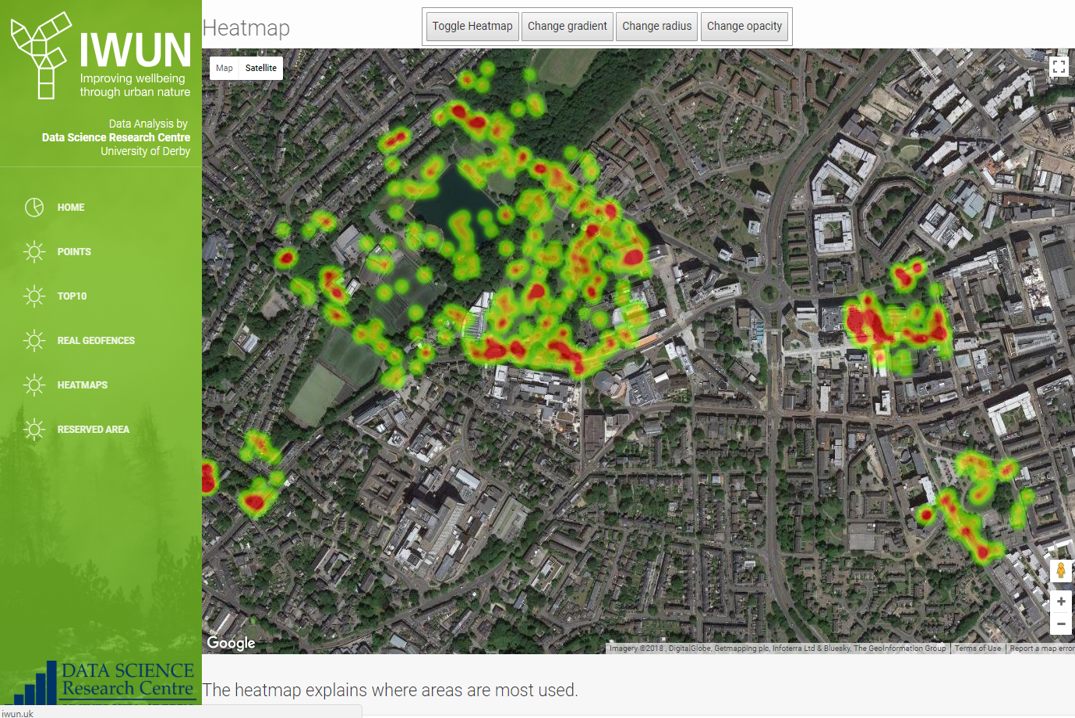
Heat map of most visited places

Lots of details of the trips are included in the paper, but the key findings were that the median trip length was 190 meters with a median duration of 4 minutes 36 seconds. This reveals the reality of urban engagement with nature for many. On average the user of the app made just over one trip per day to a greenspace, with a weekly total duration of nearly an hour and total distance of around 2.5 km.

These trip statistics were influenced by demographic factors including age (older participants spent more time and covered more distance in greenspaces) and gender (women make more frequent trips to greenspace). Importantly, ethnicity and deprivation also play a role, with ethnic minorities and people from more deprived areas making shorter visits to greenspaces. It should be noted that the difference was 3 minutes to 4.5 minutes. There is a need for equality of access, however there’s a fundamental problem of very little time being spent in greenspaces. When the most common trip to urban greenspace is around 0.004% of a typical day, it changes the conversation around access to nature, it needs to be more equal and higher for all. Recent research shows that people in the UK visit nature less than other countries.

Finally on demographics, time spent outside as a child seemed to positively influence the frequency of trips made as an adult, suggesting that behaviours learnt as a child continue into adult life. Time spent outside in the past year was also significant, with people who have spent more time outside having a 25% faster walking speed!

Four minutes in urban nature

The GPS results were compared to results from the face-to-face MENE survey. For types of green spaces, the MENE category “park in a town or city” comprises 53% of visits to greenspaces within towns and cities. This was very similar to the 50% of trips from the app data. Parks, both local and large, were found to be particularly popular destinations for greenspace visits given that only 15% of the geofenced greenspaces that were parks. However, 3% of MENE trips were to “woodland or forest”, compared to 13% from the app, showing how self-report can underestimate some everyday exposure to nature.

Our results suggest that most day-to-day greenspace trips are brief and incidental, i.e. travelling through rather than to greenspace. This reveals an important reality of people’s everyday engagement with nature. The results also confirm the importance of including social and cultural factors when investigating who uses and who benefits from urban greenspace. Of course, regular readers of this blog, will know a key theme is engagement with nature, moving beyond visits and thinking about ‘moments not minutes’.

In a recent study people asked to “tap into their sense of wonder” on a 15 minute walk in nature found greater benefit than those that just walked in nature. Also, we’ve found that a person’s relationship with nature explains the benefits of greenspace over and above visits and time. However, there’s an interaction between the two, connection is built on moments  and time in greenspaces. So, while the data on trips matters, the engagement during the visit is key. As is the reality of everyday time in nature revealed in this latest research. There’s a need to consider how to turn brief incidental trips to and through urban greenspaces into everyday moments of wonder. Imaginative design and awareness of the role of nature in keeping well can do this – and those wonderful places would attract longer visits too.


Mears, M., Brindley, P., Barrows, P., Richardson, M., & Maheswaran, R. (2021). Mapping urban greenspace use from mobile phone GPS data. PloS one16(7), e0248622.


Posted in Uncategorized | 1 Comment

The Dasgupta Review and Nature Connectedness

Professor Sir Partha Dasgupta led the review on the economics of biodiversity that was announced by the Chancellor of the Exchequer in March 2019. The review set out to assess the economic benefits of biodiversity and the costs and risks of biodiversity loss before identifying actions that can enhance biodiversity and economic prosperity. The review was published early in 2021, but at 610 pages it’s taken me a while to compile my thoughts. This blog considers the aspects most relevant to human-nature connectedness – of which there are many.

The Dasgupta Review recognises the essence of nature connectedness and it runs as a theme through relevant chapters. The review acknowledges the adoption of anthropocentric viewpoint – the value that nature provides to human wellbeing. This is discussed with reference to sacredness and the different systems of belief and thought that go beyond an anthropocentric perspective (section 1.8). Sacredness is discussed further, how it can include a sense of awe and wonder that we know contributes to nature connectedness and human wellbeing.

The Dasgupta Review goes beyond the essence of nature connectedness, to discussing it directly. The review notes the ‘admirable’ 2015 review of the wellbeing benefits of nature connectedness by Capaldi and colleagues (we published a review more recently). The Dasgupta Review accepts the distinction between contact with nature and connectedness with nature. When discussing contact and connection, it’s interesting that the review notes that:

“Psychologists would appear to be on firmer ground when reporting the role contact with Nature plays in our sense of well-being. The influence on our well-being of connectedness with Nature is less assured empirically, at least as of now. The reason may be that connectedness is more difficult to achieve than making contact with the natural world. So, most studies have looked for the influence of contact on hedonic well-being.”

The ‘firmer ground’ of contact goes well beyond psychologists to policy where the focus is often physical access, rather than emotional or meaningful access to nature. As discussed later, for the much needed new relationship with nature, perhaps there’s a need for a new language of connection and access. The science of nature connectedness is more recent than the large body of research into contact with nature, but as I’ve noted previously, contact is easier to measure and to maximise benefits we must ensure research based on metrics that are more straightforward to measure do not dominate policy recommendations. The data to support the important role of nature connectedness in wellbeing is building though. In addition to the specific nature connectedness and wellbeing reviews above, three recent population surveys (1, 2 & 3) directly compare contact and connection with nature. This shows that for mental wellbeing outcomes, nature connection can matter more than time in nature, with empirical work showing the causal link.

It is also interesting that the review discusses comparisons of wellbeing (such as life satisfaction and eudemonic wellbeing), ‘affect balance’ (a topic that is often overlooked and I discuss here) and relationship to income. Similar there’s been nature connectedness research in these areas, from the benefits to both feeling good and functioning well, to how nature connectedness is a strong predictor of eudemonic wellbeing – four times greater than socio economic status.

When presenting options for change, the review again distinguishes between contact with nature and connectedness with nature – the need to take something away from nature contact and internalise it – from a pathways to nature connectedness perspective, to find meaning. The review also states that “contact with the natural world is a means to furthering personal well-being, connectedness with Nature is an aspect of well-being itself” – which mirrors our call earlier in 2021 for nature connectedness to be adopted as a metric for wellbeing. Here there is progress with nature connectedness being trialled in the Gallup World Poll, which is also discussed in the review.

In the section on transforming our institutions and systems, the review continues, “Access to green spaces (they are local public goods) can also reduce socio-economic inequalities in health. Interventions to increase people’s contact and connectedness with Nature would not only improve our health and well-being, there is a growing body of evidence to suggest that those interventions would also motivate us to make informed choices and demand change” – thereby capturing the essential reciprocal relationship needed for a sustainable future and indirectly referencing the work on the causal link between nature connectedness and both pro-environmental and pro-nature conservation behaviours.

Glimmers of hope for such an approach are identified, in small initiatives for the renewal of urban nature – it is true that examples of programmes to increase both access and nature connectedness are relatively new and recent, but examples can be found, for example 30 Days Wild by The Wildlife Trusts and 50 Things by the National Trust are both informed by the pathways to nature connectedness. More on this work can be found in our recent booklet, Nature & Me. More widely, projects applying the pathways to nature connectedness include the RSPB Scotland nature prescription pilot, the Oak Project, Generation Green and WWT’s Generation Wild. Finally, the connecting people with nature theme of the Government’s Green Recovery Challenge Fund engages applicants with the pathways to nature connectedness, so many more projects are on their way – but is easy to slip back into an anthropocentric approach where access green space is simply provided as a ‘dose of nature’.

Good progress, but the wish in the Dasgupta Review is grand, for a future where citizens can live in peace with nature. The University of Derby’s Nature Connectedness Research Group also has grand visions for a new relationship with nature and proposals for moving from small initiatives to those that increase nature connectedness through transforming institutions and systems – see our recent paper in Ecosystems and People.

Education is a further, and final, option for change that considers nature connectedness with reference to our emotional attachment to nature and appreciation of our place in nature. While the focus on introducing the awe and wonder of nature to children is present, there is reference to teaching knowledge when the research evidence suggests that this isn’t the best route to nature connectedness or ecological behaviour. There is a need to remember that the loss of biodiversity has been overseen by a generation that likely spent more time in nature and had greater knowledge of it. Rather than looking backwards, there is a need for a new relationship with nature where traditional assumptions are challenged and the latest research evidence applied.

Citing the ‘teenage dip’ in nature connectedness, the review states that ‘Connecting with Nature needs to be woven throughout our lives’ and there is need to create an environment in which, from an early age, we are able to connect with Nature’. It is notable that the final section on Transforming our Institutions and Systems is often a manifesto for connecting people with nature and the final paragraph includes the line, ‘Each of these senses is enriched when we recognise that we are embedded in Nature’.

Although the abridged version of the report retains aspects around nature connectedness, the key distinction between contact and connection and the need for connection with nature to be woven throughout our lives, the language of connectedness falls away in the Headline Messages document. There is mention of interventions to enable people to connect with nature for both human and nature’s wellbeing, but education policy is reduced down to environmental education programmes that unless careful designed are known to play a small part in ecological behaviours. Those engaging with the five pages of text in the headline messages will come away with a different feel than when engaging with the much longer abridged version and full report.

From a human-nature connectedness perspective the full Dasgupta Review is very encouraging document. It’s quite up to date and shares much of our thinking around the need for a new relationship with nature. It’s great that a review led by an economist captures this perspective so well.

It’s interesting to consider the Dasgupta Review alongside May’s WHO publication, ‘Nature, biodiversity and health: an overview of interconnections’. It includes a quote from the final paragraph of Dasgupta Review, but that perspective doesn’t run through the overview:

“Biodiversity does not only have instrumental value, it also has existence value – even an intrinsic worth. These senses are enriched when we recognise that we are embedded in Nature. To detach Nature from economics is to imply that we consider ourselves to be external to Her. The fault is not in economics; it lies in the way we have chosen to practise it.”

The WHO publication is much shorter, even than the abridged Dasgupta Review. Although the title includes interconnections between nature, biodiversity and health, the summary states that the report ‘provides an overview of the impacts of the natural environment on human health. It presents the ways nature and ecosystems can support and protect health and well-being’. It takes the anthropocentric viewpoint noted in the Dasgupta Review and focuses on the benefits of nature to humans, rather than the interconnections. In contrast to the Dasgupta Review, there is no distinction between contact and connection, with little language around the importance of close human-nature relationships (beyond the quote from the Dasgupta Review). There is mention of non-materials benefits such as spiritual meaning and aesthetic value within a linear figure on Cultural Services, but again the focus is what nature provides for people, rather than a sense of interconnected relationships between people and the rest of nature. The circular interaction between capitals is captured simply in the Dasgupta Review (figure 1.1).

Figure 1.1 Interaction Between the Capitals from Dasgupta, P. (2021), The Economics of Biodiversity: The Dasgupta Review. (London: HM Treasury)

When considering access to nature, unlike the Dasgupta Review quote on access above, in the WHO report there’s little on interconnectedness and the opportunity to build access and connection to move beyond the one-way benefits nature provides to human health, towards building a reciprocal human-nature relationship for a sustainable future. Access to nature should provide an opportunity for people to form a close relationship with nature and care for nature – an opportunity to unite human and nature’s wellbeing.

The section on access to nature is short, but to mind access for connection, or facilitating both physical and psychology access to nature is an essential and simple point when considering the interconnections between nature, biodiversity and health. The conclusions of the WHO report focus on the clear need to protect and restore nature, but there is mention of ‘sustainable behaviours that benefit nature and health’, ‘simultaneously providing human well-being and biodiversity benefits’ and ‘promoting benefits for both human health and the natural environment’ – it’s a shame that’s not a stronger theme throughout.

Previously, I’ve written about the National Parks Landscape Review (Glover Review) and Michael Gove’s speech on a Green Brexit. The Landscape Review included a focus on learning, Michael Gove inferred a distinction between themes such as emotional attachment with nature and science – as policy is rooted in science. Yet there is a science of emotion and connection. The Dasgupta Review embraces the emotional and soulful relationships with nature and recognises the accompanying science. The challenge, as found in the brief Headline Messages document, is retaining and reflecting those essential elements in policy recommendations.

In sum, the WHO report on the interconnections between nature, biodiversity and health sets out the importance of nature for health and thereby the need to protect it. Although a review of the economics of biodiversity, the Dasgupta Review sets out and understands the relationship between people and the rest of nature and how that is key for human and nature’s wellbeing. However, there is still a need for wider acceptance of that message, or a need to find a language of nature connectedness compatible with policy proposals.


Posted in Uncategorized | Leave a comment

Did Lockdown Spring Bring a Lasting Connection to Nature?

A blog with Dr Carly Butler.

Many of us found a friend in nature during the first lockdown in Spring 2020 but new data suggests this was just a short-term relationship for some. The latest data from Natural England’s People and Nature Survey shows that levels of nature connectedness fell by 25% between April 2020 and April 2021, meaning fewer people reported feeling a part of nature. This matters as higher levels of nature connectedness bring better mental health and more pro-nature behaviours.

It’s not that people have stopped visiting nature, as the proportion of people accessing green and natural spaces grew during lockdown and has stayed higher. As lockdowns eased, it’s likely that people took the opportunity to meet with others and engage in outdoor activities. But it seems that the boost to ‘noticing nature’ in the quiet times of April and May 2020 has diminished. The data shows a 13% drop in the percentage of people reporting they are taking time to notice and engage with nature, such as listening to birdsong or noticing butterflies. This is important as our previous analysis showed that noticing, rather than recent visits, explained higher levels of wellbeing.

Nature connectedness, noticing and visiting nature 2020 to 2021

While it makes sense that attention may have shifted away from nature to people and other activities after being kept apart for so long, the chart shows we must not neglect our relationship with nature. Even though visits to green spaces have remained high, noticing and deeper connection to nature have faded – a visit to nature does not guarantee connection. Research has shown that taking time to notice nature is vital for nature connection, and simply noticing nature leads to greater mental wellbeing for humans – and nature too. It’s important to pause and find moments to tune into the sounds, sights, smells and beauty of nature to foster our relationship with it.

The drops in nature noticing and connection are notable. Although 25% between April 2020 and April 2021, this fell to 16% between May 2020 and May 2021 – interventions that can boost nature connectedness by 16% would be a great success! We need to wait for release of the full dataset to see if these falls are statistically significant and understand them more fully. We will also be exploring the relationships between nature connection and other behaviours and wellbeing measures. The PANS data now covers a full year which gives a good seasonal overview of shifts in our relationship with nature. For example, the dip in nature connection, noticing nature and visits in September 2020 seems to be linked. Visits and noticing nature started to increase again in Spring 2021, but nature connection levels remained low. It will be interesting to see what the annual data looks like in future years without lockdowns. To address the loss of wildlife and recent strains on mental wellbeing, we need to find a way of developing a new relationship with nature that lasts.


Posted in Uncategorized | Leave a comment

Nature Connectedness and Biophilic Design

Biophilic design is a building design concept used to increase occupant connectivity to the natural environment. Stephen Kellert was one of the pioneers of biophilic design and with Elizabeth Calabrese published The Practice of Biophilic Design. Kellert also identified the nine values of biophilia, five of which formed the basis for our 2017 pathways to nature connectedness. Since 2015 there has been a rapid growth in research into nature connectedness, both the benefits to human and nature’s wellbeing, and how to improve it. This has led to the pathways to nature connectedness being widely used. So, I’ve been thinking about how the pathways to nature connectedness integrate into Biophilic Design to maximise the benefits it can bring.

Why consider nature connectedness?

‘Nature connectedness’ refers to the way we relate to and experience nature. A strong connection with nature means feeling a close relationship or an emotional attachment to our natural surroundings. It is grounded in scientific study and measurable which allows research to establish the benefits and the design of interventions to improve it. Greater nature connectedness delivers better mental health and is key for both carbon cutting pro-environmental behaviours and wildlife friendly pro-nature conservation behaviours – more so than passive exposure to nature. Some interpretations and applications of Biophilic Design can focus on built elements and exposure alone. However, incorporating the pathways to nature connectedness brings the original Biophilic Design principles of meaningful and emotional engagement with nature back to the fore. Finally, incorporating recent research findings from nature connectedness increases the evidence base and justification for Biophilic Design.

Biophilic Design Principles

In The Practice of Biophilic Design, Kellert and Calabrese state five basic principles essential for the successful application of biophilic design. Three of these are highly related to nature connectedness:

  • Biophilic design requires repeated and sustained engagement with nature.
  • Biophilic design encourages an emotional attachment to particular settings and places.
  • Biophilic design promotes positive interactions between people and nature that encourage an expanded sense of relationship and responsibility for the human and natural communities.

These principles are of great relevance to nature connectedness and overlap with some of the pathways to nature connectedness, which are based on Kellert’s values of Biophilia. They are more behavioural elements of the eventual users of a biophilic design.

The Application of Biophilic Design

In The Practice of Biophilic Design, the categories of the biophilic design framework are described as:

  • Direct experience of nature – actual contact with environmental features such as natural light, air, plants, animals, water, landscapes, fire and ecosystems.
  • Indirect experience of nature – contact with images of nature, natural materials, colours, shapes and forms that evoke and mimic nature
  • Experience of space and place – providing spatial features characteristic of nature that have advanced human health and wellbeing. Such as open views and places for retreat and refuge within organised diversity, clear pathways with natural waypoints and cultural and ecological elements that help develop attachment to place.

Considered alone and apart from the basic principles, the dimensions can be seen as material and physical elements for inclusion. If this becomes the focus, the need to foster engagement, emotional attachment and positive interactions to build a relationship with nature can be lost.

Research Evidence and Biophilic Design

Review articles (e.g. Gillis & Gatersleban, 2015; Hung & Chang, 2021) into biophilic design have presented evidence of the wellbeing benefits of individual elements of Biophilic Design, such as the use of plants, water, wood. However, these reviews have focussed on the three categories of application (direct, indirect, space and place) rather than the principles of biophilic design. Understandably, they also compile evidence on studies that have empirically tested an individual natural element, not necessarily within a biophilic design. There is less research on the impacts of the benefits of actual applications of biophilic design.

When considering empirical work on individual elements the context should be noted. For example, in the research showing the benefits of touching, or viewing images of, nature (for managing our emotions), people had to attend to the image or touch the material for a period of time, e.g. for several minutes. To gain the benefits the natural engagement must be engaged with – remember the principle above ‘Biophilic design requires repeated and sustained engagement with nature’.

The biophilic design principles are an essential element. When considering the principles, nature connectedness research provides further general evidence, although as above, to support their inclusion and use, rather than from actual biophilic designed buildings.

Recent nature connectedness research highlights the importance of the biophilic design principles, with findings showing that:

  • People’s nature connectedness (emotional attachment), rather than contact with nature, best predicts wellbeing.
  • When measured alongside nature connection and noticing nature, time in nature uniquely explained just 1% of happiness, a worthwhile life, and higher wellbeing.
  • Simply noticing ‘the good things in nature’ (positive interactions) brings sustained benefits to mental wellbeing, with clinically significant improvements for people with common mental health problems.
  • People’s nature connectedness, rather than contact with nature, predicts pro-environmental and pro-nature conservation behaviours.

The Importance of Direct Engagement

Further, the nature connectedness research shows which of the three categories of biophilic design are likely to contribute most to the benefits of biophilic design. In research on the relationship between nature connectedness, time in nature, direct and indirect engagement with nature, nature connectedness and direct engagement with nature consistently emerged as being the significant and prominent factors in explaining mental health and wellbeing. Time in nature and indirect engagement were not significant.

Direct engagement involved simple activities, noticing and engaging with nature. Or engaging with the natural features supplied by following the direct experience of nature biophilic design category. As we’ve seen above indirect images of nature can also bring benefits, but they need to be noticed and engaged with. When a natural element is provided (directly or indirect) there is a need to consider how will it be engaged with? Why will it be engaged with? How can the design prompt that engagement?

The need to, and power of, prompting people to engage and notice nature can be seen through our noticing the good things in nature research. In this study people’s smartphones were used to alert them when they were in a green space and asked them to record a ‘good thing in nature’. Doing so and prompting emotional responses led to significant increases in nature connectedness and wellbeing.

Direct engagement with nature is also needed for beneficial outcomes for nature. Research shows that it is simple direct engagement through actively tuning into nature that best explains pro-nature behaviours.

In sum, the three categories of biophilic design (direct, indirect, space and place) provide opportunities for contact, but recent nature connectedness research shows direct engagement and the principles of biophilic design are essential. Thankfully, the pathways to nature connectedness provide a framework for direct engagement and embedding the biophilic design principles.

Integrating the Pathways to Nature Connectedness into Biophilic Design

The pathways to nature connectedness can be combined with the three categories of biophilic design application to create an extended biophilic design framework. The pathways to nature connectedness focus on active engagement and have provided a new approach to nature engagement design. For example, in national programmes such as 30 Days Wild from The Wildlife Trusts and 50 things to do before you’re 11¾ from the National Trust.

Rather than design elements such as plants, wildlife and water, the pathways to nature connectedness outline the types of activity to prompt with those natural elements. They provide a framework with great flexibility of application. The pathways are:

  • Senses: Provide opportunities and prompts to notice and actively engaging with nature through the senses. Simply listening to birdsong, smelling wildflowers, or watching the breeze in the trees.
  • Emotion: Provide opportunities and prompts to engage emotionally with nature. Spaces to notice and reflect on the good things in nature, to experience the joy and calm nature can bring. Provide opportunities to express and share feelings about nature with others.
  • Beauty: Provide opportunities and prompts to find beauty in the natural world. Create spaces and moments to appreciate beauty in nature and to engage with it through art, music or in words.
  • Meaning: Provide places to use and explore how nature brings meaning to life. How nature appears in songs and stories, poems and art. Provide spaces to celebrate nature.
  • Compassion: Provide opportunities and prompts to care for nature. Spaces to take action for nature, such as creating homes for nature or planting insect friendly plants.

The matrix below shows how the pathways and biophilic design categories can be combined to ensure interactions of different types across the three categories of application. For example, the direct experience of water provides an excellent opportunity for calm and a place of refuge. Further, pathways and design categories will interact and combine, a place to care for nature can facilitate direct and sensory experience through creating more nature. All the pathways do not need to be activated at every point, the matrix provides a prompt to design in the opportunity for interaction when the opportunity arises without becoming contrived.

Biophilic Design & Nature Connectedness Framework

From Design to Use: The Need to Prompt Engagement

The research evidence, pathways and principles show that biophilic design cannot be passive. The space and features must be used and engaged with. Sadly, evidence shows that most people do not notice nature. Therefore, there is a need make the natural elements salient, and to prompt and provoke people to notice. To use design to demand attention and the power of affordances to encourage interaction.

Affordance theory highlights the many possibilities that a space or an object can offer – a tree can be a climbing frame or a place to rest. Affordances are possibilities for action suggested by the environment. Affordances don’t involve thinking as they are direct perception-action processes; all of the information is available within the environment so no instruction is needed. That said, at times people might need inviting into activities in order to realise potential affordances the environment offers. The more diverse the environment the more diverse the affordances and potential experiences. Biophilic design for nature connection could afford reflection – a space to pause and notice – close to features that engage the senses, a place of beauty that evokes emotions. A place that becomes meaningful with experiences one might wish to share.

Moving from the design of a physical space and features within it, to the behaviour of people occupying that space is a difficult process, especially when the principles require emotions to be fostered. So, although good design can influence behaviours, guidance on how users might enjoy and use a biophilic building should be considered. Especially as research evidence can challenge assumptions, such as nature connection comes from knowledge and identification or simply spending time in nature.

A biophilic workplace may need guidance on break taking (e.g. 30 Days Wild) and wellbeing programmes that facilitate sustained engagement with nature. A biophilic school may need guidance on opportunities for extra curricula activities (e.g. 50 Things), or even a biophilic curriculum. Otherwise a biophilic space could soon become more of a background for work or learning rather than a place of positive interactions between people and nature. The interactions that encourage a close relationship and emotional attachment that can help deliver wellbeing and a sustainable future.

Three Key Points

  1. Use the pathways to enact the biophilic design principles
  2. Prompt direct experience of natural elements rather than passive exposure
  3. Provide guidance and ideas for those using biophilic designs.


Lumber, R., Richardson, M., & Albertsen, J. A. (2018). Hfe in biophilic design: Human connections with nature. In Ergonomics and Human Factors for a Sustainable Future (pp. 161-190). Palgrave Macmillan, Singapore.

Hung, S. H., & Chang, C. Y. (2021). Health benefits of evidence-based biophilic-designed environments: A review. Journal of People, Plants, and Environment24(1), 1-16.

Gillis, K., & Gatersleben, B. (2015). A review of psychological literature on the health and wellbeing benefits of biophilic design. Buildings5(3), 948-963.


Posted in Uncategorized | Leave a comment

Nature Connectedness for Recovery from Substance Use Disorder

The pathways to nature connectedness have been applied widely to the development of activities to develop a closer relationship with nature for wellbeing. They’ve also provided a design framework for physical spaces. We’ll soon publish a paper on a pathways informed audio meditation that improves mental health. Last week saw the publication of a paper describing how the pathways to nature connectedness can be used to aid recovery from Substance Use Disorder (SUD). The work was completed by colleagues at the University of Derby and I was involved in the initial conception and made a small contribution to the paper, now published in the International Journal of Mental Health and Addiction. It’s exciting to see the power of working with nature for wellbeing, and the utility of the pathways to inform such work.

Substance use disorder (SUD) affects millions of people. Various approaches to treatment are used including medication and counselling. Twelve step programmes (TSPs) have been found to deliver outcomes for the maintenance of abstinence from alcohol and other drugs. TSPs promote ‘restructured cognitions’ to help move away from thinking that perpetuates addiction. Accepting ‘powerlessness’ at Step 1 indicates the need for a “higher power” (Steps 2–3). With the impact on others (Steps 4–9) leading to a determination to move beyond self-centredness (Step 10) and seek a deeper, more spiritual, meaning in life (Step 11). Finally, there’s a shift from a focus on self to a focus on active service and altruism (Step 12). Previous research has found that a strong sense of spirituality was linked to reduced relapse rates. This suggests the effectiveness of TSPs lies in the creation of a spiritual connection.

Spiritual health is associated with psychosocial well-being which brings meaning and purpose. Spirituality is a key component of TSPs where participants seek a ‘higher power’, or “a god of our own understanding”. So, a goal of the TSP is the formation of a spiritual connection as fundamental as the idea of God (Alcoholics Anonymous, 1976). For flexibility around the higher power, TSPs are described as spiritual rather than religious. However, terms such as “spirituality” can present significant challenges for some, and atheists and agnostics have lower levels of TSP engagement. Therefore, alternatives to traditional deities are required.

One such alternative is nature and the human-nature relationship. Connecting with non-human life offers an opportunity to form a relationship with a higher power. Nature connectedness describes an individual’s relationship with the wider natural world and is linked to spirituality and is part of a meaningful life that facilitates a spiritual connection. The five pathways to nature connectedness provide a framework for developing nature connectedness. So, in the pilot it was proposed that they’d help individuals to use nature as a source of connection – to a power greater than themselves. Thereby providing an alternative to traditional deities within a TSP.

Nature as a Higher Power

A positive relationship with nature, where nature is offered as a higher power provides an alternative focus for people engaging in a TSP. The purpose of the pilot study was to see if using a pathways informed approach and higher power of nature worked for individuals in early recovery from SUD. Twelve volunteers from an aftercare programme of an inpatient drug and alcohol treatment centre in the UK took part. Each group engaged in four weekly one-hour sessions.

The nature sessions were designed to activate the pathways to nature connectedness (senses, emotion, beauty, meaning and compassion). For example in one session, the group were invited to consider the beauty of birds: their colour, form, and flight patterns. Paintings and photographs were displayed, and bird feathers made available to touch. Birdsong was played quietly. These sensory experiences were used as catalysts for discussion about any emotions associated with birds. The group were invited to share any meaning they found in the experience. For compassion, endangered and extinct bird species were introduced.

The control group followed an open 12 Step meeting format with a reading from Narcotics Anonymous (NA) text. The readings focused on themes such as “higher power”, “spiritual connection”, and “spiritual awakening”. The group then discussed their response to the readings.

Various measures were taken before and after the programme and, although a small pilot, significant improvements in nature connectedness, well-being, quality of life, and spirituality were found in the nature group. In contrast, no significant differences were found when a traditional deity was selected as the higher power in the control group. Of note was a five-point increase in the ReQoL 10 measure, indicating a clinical level of improvement in quality of life for the nature group.

In qualitative analysis, participants referred to pathway’s elements (e.g. beauty, senses meanings) showing pathway activation during the sessions. The approach and ability to form a connection with non-human life also led to a greater sense of social connectedness. The study provided further support for the effectiveness of the pathways approach to reconnect people with nature and improve wellbeing, but more importantly showed the effectiveness of the pathways within a therapeutic setting.

The approach also seemed to help those involved find renewed meaning in life with those taking part referring to removing negative energy, finding peace and stillness which then helped them connect with the higher power of nature.

While promising, the results are from a small pilot to support proof of concept. However, the results suggest that nature, and a reconnected relationship with it through the pathways approach, can be used as an alternative to traditional deities and could well be a highly effective approach for those recovering from substance use disorder. More widely, the study provides further support for the fundamental importance of a close relationship with nature.


Rhodes, C., Lumber, R. (2021). Using the Five Pathways to Nature to Make a Spiritual Connection in Early Recovery from SUD: a Pilot Study. Int J Ment Health Addiction. https://doi.org/10.1007/s11469-021-00565-4


Posted in Uncategorized | Leave a comment