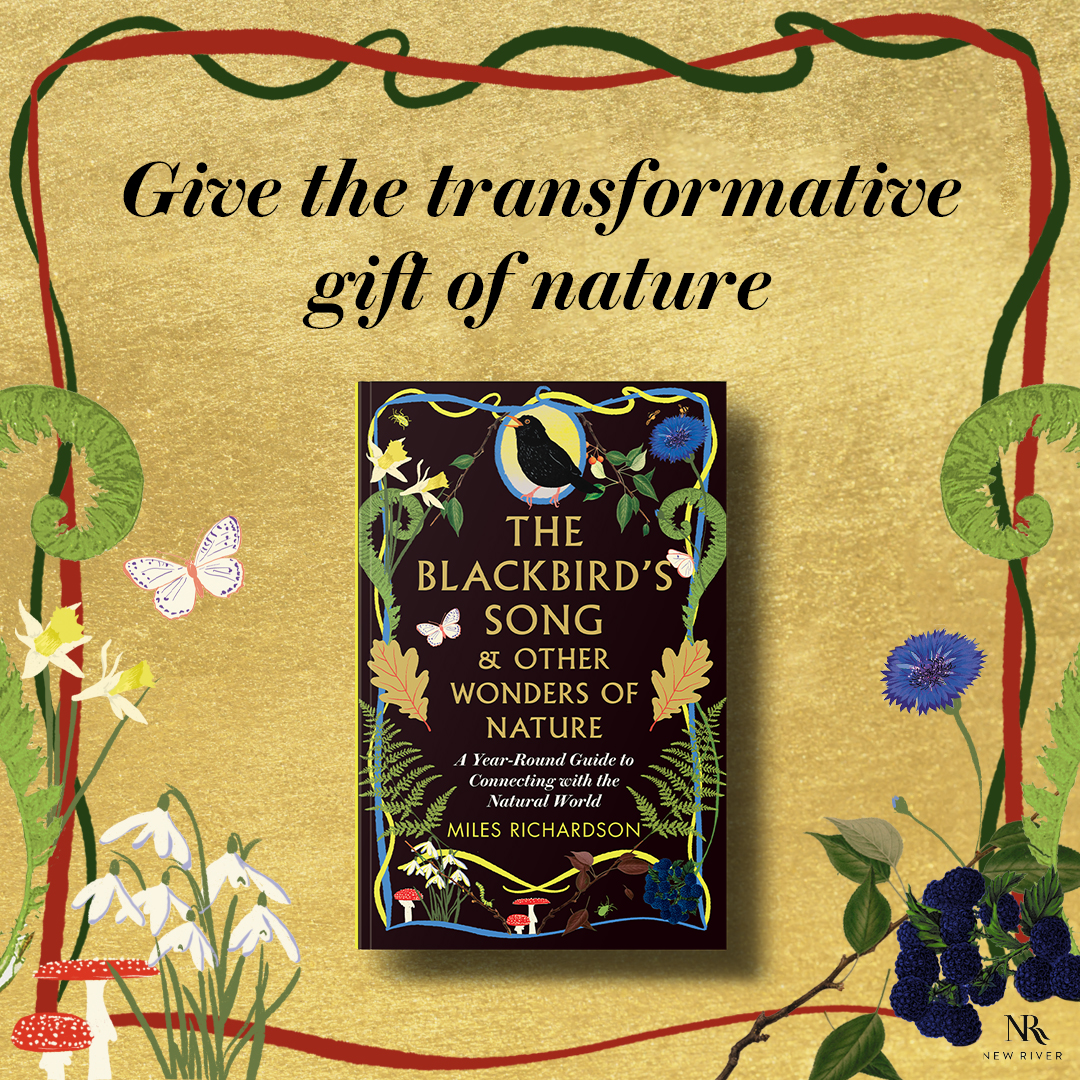
The Blackbird’s Song: Nature Connection Guide

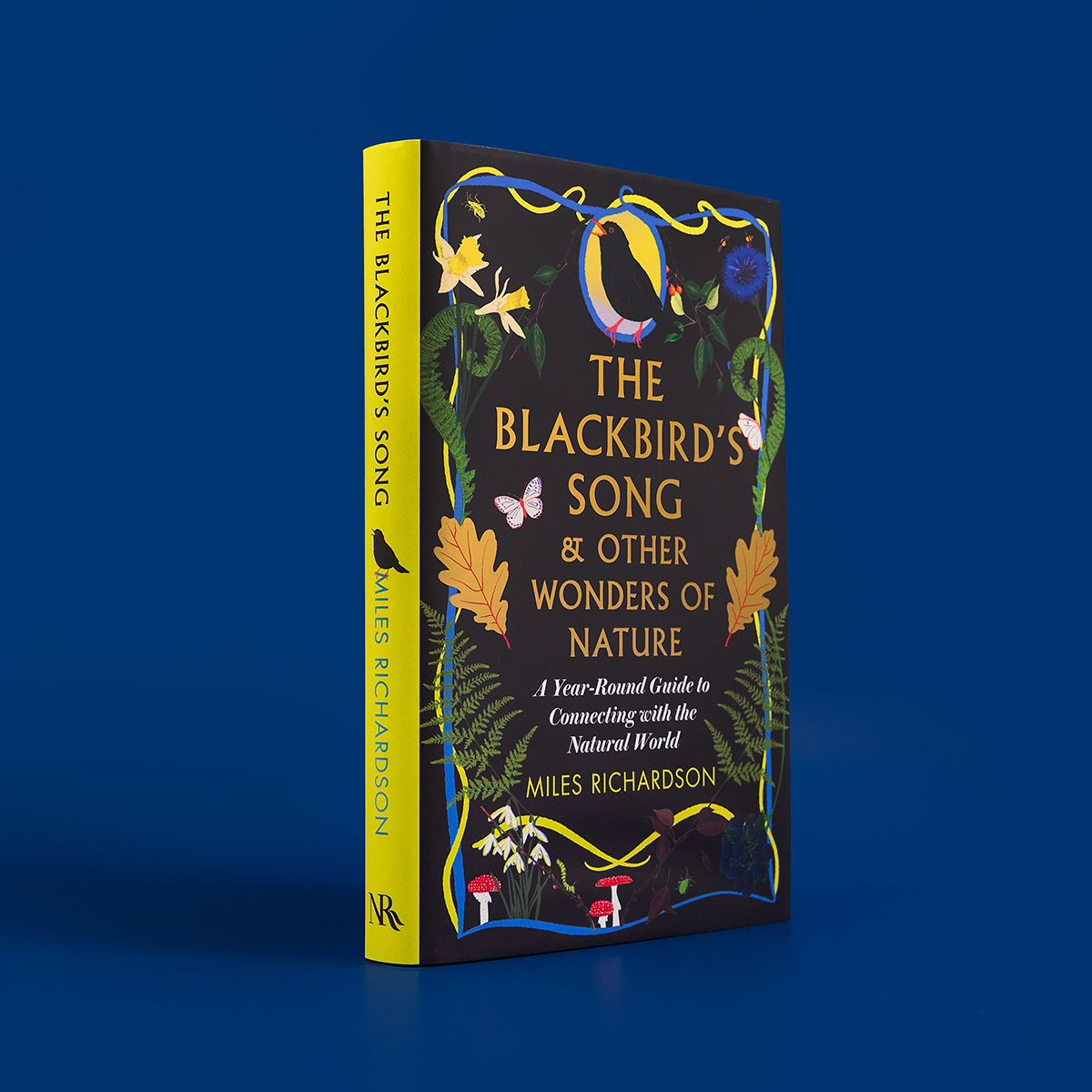
Writing The Blackbird’s Song & Other Wonders of Nature was a special time, and the book was published 24th October, less than a year after I typed the first words. Finished in July this year it is current. A practical guide to connecting with nature, based on years of research and a writing process that generated new ideas. Special though because it reminded me of the need to keep on finding everyday wonders of nature, bombarded, as we are, with other demands on our attention.

I’m writing this blog as I sit beneath an ash tree. The ground becoming more leaf than earth, as a dunnock hops about quietly searching for food just a few feet away from me. It is these simple shared moments that are special, and it sometimes feels like they have to be carved out of a day busy with other things. The Blackbird’s Song is a guide to help others find and enjoy their own moments, to cast off the demands of busy lives and focus on the joy and calm of nature that can be found close to home.

Month by month, The Blackbird’s Song introduces nature connection science and stories that provide the foundations for activities, from simply breathing and noticing to travelling in time. Each month ends with an activity for nature, to give back. The Blackbird’s Song is not a pill to pop, it’s a guide to developing a reciprocal relationship within nature.

My dunnock friend is now perched, its gaze taking in all that surrounds. A great tit and blue tit perch close by momentarily then leave. The dunnock drops down and returns to its search of the golden leaves.

Each month The Blackbird’s Song highlights these everyday birds, ‘angels’ as they are messengers from an extinction many millions of years ago. Although the book provides simplicity for the individual, it touches on the deeper meaning that surround our connections with nature, from deep time and the need for good ancestors to our worldview.

The science of nature connection is a wonder of its own, from hidden, yet vital, microbes that keep us well, to how the soft fascination of a single flower can help manage our moods. There’s science in the power of tapping into the awe and wonder of nature and reflecting upon the moments we enjoy. Different ways of knowing are introduced and how scientific and spiritual mysteries might combine as we seek the essence of nature. All this informs suggestions of how to reconnect with the natural world.

Science gives us a better understanding of our connections with the rest of nature and through art those connections can be understood further still. Understandings that can be discovered and shared through stories, maps and song. The Blackbird’s Song seeks connections with nature through head, heart and hands.

The dunnock has now left, to be found as an angel in March and a hedgerow near you, soon after the blackbird’s return to song. Below are some comments from others that have read The Blackbird’s Song & Other Wonders of Nature.

________

A wonderful “rough guide” to the planet we live on… Read it and pass it on as a gift of love from you to those around you so they can learn to feel comfortable in their own skins and ultimately, be happy. ― Sir Tim Smit, The Eden Project

Inspiring and rooted in research, The Blackbird’s Song will surely transform lives. ― Melissa Harrison, author and nature writer.

A treasury of practical ways to reconnect with nature and feed your soul. ― Mary-Ann Ochota, author and broadcaster.


Posted in Uncategorized | 2 Comments

Tune Into Nature Music Prize 2025

The Tune into Nature Music Prize is back from hibernation and receiving entries. With a first prize of £500, the prize aims to encourage submissions of original music from young musicians aged 18 to 30 that celebrate the human-nature relationship and showcase the inclusion of sounds of the natural world. Organisers hope the tunes will highlight the need for a new, stronger relationship with nature whilst providing vital support for young creative talent.

You can find out all you need to know about the prize, new partners, opportunities for winners and judges on the new website: https://www.tuneintonaturemusicprize.info/

The winner will have the option of their track being released on NATURE’s profile across major streaming platforms as part of the Sounds Right initiative, benefiting from significant promotion and marketing, and featured on a special playlist to raise funds for nature restoration and protection. Winners may also get the chance of air play on BBC Radio.

Judges for the prize include musicians and artists including Cosmo Sheldrake, Madame Gandhi, Andrew Fearn (Sleaford Mods), Jason Singh, Jinny Lyon, Melissa Harrison and Sam Lee, and BBC presenters Sian Eleri and Elizabeth Alker.

Nature connection dips during teenage years and takes more than a decade to recover. Research also shows that references to nature in contemporary music have decreased consistently since the 1950s. This research provides a basis for the prize. Plus, a close connection with nature is good for personal wellbeing and motivates greater care for the natural world.

From Louis Armstrong to Louis VI, a Tune into Nature play list on Spotify provides inspiration, with lyrics and sounds that celebrate the natural world. The playlist also include previous winners Ceitidh Mac, Girl Next Door  and Caslean.

Finally, the Tune Into Nature Music Prize  is a collaboration, we’re on the look out for organisations who can help amplify the message. If you can help, get in touch.


Posted in Uncategorized | Leave a comment

Stripes of Grey: Visualising the Crisis of Biodiversity Loss

The latest Living Planet Report paints a stark picture of our planet’s health, revealing that wildlife populations have plummeted by 73% since 1970. This alarming statistic is now visually represented by two darker grey stripes added to the biodiversity stripes, a tool designed to raise awareness and engagement about biodiversity loss. While climate change often dominates headlines, the decline in biodiversity is equally critical, underscoring a failing relationship between humans and nature. This blog delves into the complexities of biodiversity data, the significance of the Living Planet Index, and the urgent need to address both climate change and biodiversity loss to ensure a stable future for generations to come.

The biodiversity stripes have been used widely, from a football kit to adoption by the global Nature Positive campaign that put nature and the stripes at the heart of the world’s biggest environmental conventions, including COP27, COP28, and COP15. This biodiversity stripes themed campaign won the Best Environmental Cause Campaign at the Purpose Awards in June 2023. Such exposure should now be easier with the new stripes released as Creative Commons CC BY-SA 4.0, thereby allowing others to share and adapt the stripes, with appropriate credit and sharing.

Biodiversity data is massively difficult and complex, and the Living Planet Index is just one approach that focusses on wildlife populations. The global data includes over 30,000 populations of over 5000 species and tells us that the population of mammals, birds, fish, amphibians and reptiles has seen an average drop of 73% globally since 1970.

The biodiversity stripes though are an awareness and engagement tool to highlight the issue. Climate change has been found to get up to eight times more coverage than biodiversity loss. Yet only by addressing both the warming climate and loss of wildlife do we stand a chance of passing on a stable planet for future generations. This imbalance is odd as many of us claim to love nature and wildlife. And while we may talk about the weather, few of us love the climate. The decline of nature provides a sure sign that our relationship with nature is failing.

It is biodiversity, the variety of life on Earth, that supports life. It is fundamental in providing the air we breathe and food we eat. Humans evolved within a vibrant, biodiverse, natural world. It is inherently good and vital for our wellbeing. Yet through a disconnected relationship dominated by use and control of nature we have done great damage to the natural world. A spiralling breakdown as when biodiversity decreases so does our relationship with nature. A failing relationship that the UN recognise as the root cause of the environmental crises.

In addition to the global stripes, there are stripes for several continental areas, such as Latin America, a region where the creative use of the stripes is illustrated with the toucan, showing the 95% decline in Latin American wildlife populations since 1970.

And Africa with 76% decline.

The larger the decline, the darker the grey, so you may wonder why the Europe and Central Asia stripes below are comparatively green? The living planet index starts at 1970 and the decline calculated from a standard maximum level of ‘1’. Therefore, any loss of wildlife before 1970 doesn’t feature, every region starts as a vibrant green, even though some have less nature to lose.

The biomass of wild mammals has declined by 85% since the rise of humans. Tens of thousands of years ago several million humans hundreds of mammals were wiped out in a megafauna extinction. Then, the Industrial Revolution centred in Europe saw the industrial exploitation of nature, together with changing agriculture, this saw the UK becoming one of most nature depleted countries on the planet.

Biomass of mammals

So, to illustrate, using another biodiversity index, the NBI, the mean level of biodiversity across the European nations of UK, Poland, France, Germany and Spain is 0.39, compared to mean in selected Latin American nations of Brazil, Columbia, Ecuador, Uruguay and Venezuela of 0.80. Latin America is around twice as biodiverse as Europe, yet has the greyest stripes based on the decline since 1970. Whereas Europe and Central Asia has stayed relatively green. The pair of stripes below provide a rough visualisation of this. The biodiversity stripes represent decline, rather than levels.

There is an urgent need to protect and restore what remains. But, like climate change, biodiversity loss is a symptom of a failing relationship between people and the rest of nature. Addressing biodiversity loss requires more than just conservation efforts; it demands a fundamental shift in our relationship with nature. ‘Nature connectedness’ captures this relationship and research shows it can be targeted to inspire pro-environmental behaviours and enhance human well-being.  The biodiversity stripes serve as a powerful reminder of the urgent need to protect and restore our planet’s wildlife. By fostering a deeper connection with the natural world, we can. As we confront the intertwined crises of climate change and biodiversity loss, we must strive to rebuild our bond with nature, ensuring a vibrant and biodiverse world where both people and nature thrive.

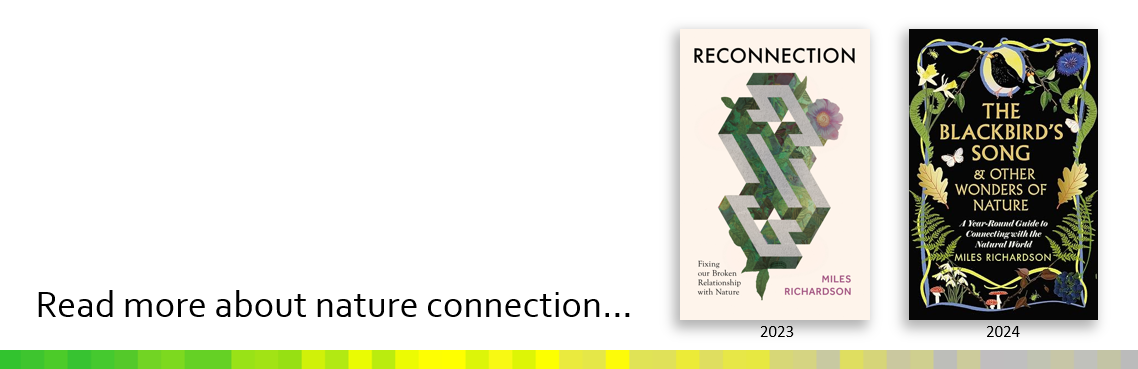
Find out more about the human relationship with the rest of nature and how to improve it take a look at Reconnection: Fixing our broken relationship with nature and The Blackbird’s Song & Other Wonders of Nature.


Posted in Uncategorized | Leave a comment

Beyond the Moment: How the Past can Shape Nature Connection

Walking through the entrance of an ancient hill fort recently returned my thoughts to time. Nature connection is often seen as about being ‘in the moment’. Reviews conclude mindfulness is the essential step to connection. Time and reflecting on the past or future isn’t a common theme, which is odd as reflection can explain nature connection better than mindful attention. This is a topic I explore in my next book, The Blackbird’s Song, a month-by-month guide to connecting with nature, which is published 24th October.

Bury Ditches Hill Fort

The hill fort dates from 500BC, I expect some of their descendants still live locally. An unbroken thread of life, from parent to child across over a hundred generations. The same thread runs through the local wildlife, but across many more generations, with far more failures as populations dwindled. This means that over recent centuries, many of our forebears have not been good ancestors for nature. Intentionally and unwittingly reducing and polluting habitats. The need for a new relationship with the rest of nature is now readily apparent.

That new relationship is a major challenge, the options need to extend beyond noticing nature in the moment. This ‘nature connection space’ is something I explore in The Blackbird’s Song using the diagram below. The mayfly represents the fleetingness of the present and mindful attention which can be the foundation for a deeper state of reflection and wisdom as represented by an owl. Reflecting on our connection with nature can involve thinking about the future, inspiring new ideas and understanding the importance of being a good ancestor. This represented by the beaver now being successfully reintroduced to the UK. Equally reflection can take us back into the past, our thoughts exploring the environment like the wolf that used to roam the UK.

The Nature Connection Space

Looking back and a sentimental desire for a former time is called nostalgia, which can be mocked somewhat in modern society. Yet, nostalgia is an emotion found across cultures that makes life more meaningful and provides a bridge between the past and present. Like nature connection, nostalgia is a positive emotion and helps us feel part of something beyond the here and now.

Looking further back in time to our ancestors brings continuity, connects us with place and shapes our personal identity. That link to the past can be used to encourage us to look forward and think about becoming good ancestors ourselves, by restoring the natural world and our relationship with it.

On the theme of time, unlike the distant past, our days are driven by ‘mechanical time’. This detaches us from natural rhythms and changes how we value time and how it flows between past, present and future. Time in nature feels longer and the clocks and schedules of urban living put us under pressure. This matters, as the perceived availability of time affects our behaviours.

Reconnecting with nature requires us to embrace a relational view that includes past, present, and future. By reflecting on our ancestral ties and the natural rhythms that once guided their lives, we can foster a deeper, more meaningful connection with the natural world. This journey inspires us to become better stewards of the natural world, ensuring that we leave a positive legacy for future generations.

This reflection on nature connection and time is a small part of The Blackbird’s Song. Month by month, the book explains the benefits nature can bring and suggests how to bring nature into everyday living in tangible and practical ways, creating a closer relationship with the natural world.


Posted in Uncategorized | Leave a comment

The Science of Love: Comparing Human Affection and Nature Connection

Last year we published a paper comparing the human nature relationship to inter-personal relationships, put simply love between people, or love for nature. Love is a profound human experience, it influences relationships, motivates behaviour and the love of nature is among the most frequently felt types of love. Our experience of love is shaped by both biological and cultural factors, rooted in fundamental neurobiological mechanisms of attachment.

Sometimes, people refer to the UK as a nation of nature lovers, although it’s not. A nation of pet lovers maybe? Love doesn’t have to be between people, but are these types of love different neurologically? Is a love of nature the same as love of a child?

To explore this, a recent research paper examines brain areas involved in love for six different objects: romantic partners, one’s own children, friends, strangers (varieties of interpersonal love), nonhuman pets (interspecies love), and nature (non-social love). The researchers used functional magnetic resonance imaging (fMRI) to measure brain activity while inducing feelings of love through short stories.

The stories about love for nature depicted beautiful natural surroundings, immersing the subject in nature, for example: You are in the archipelago at the seaside. The blue waves ripple over the coastal stones, a crooked pine rises next to you, and there are white fluffy clouds here and there in the sky. You love nature.

Researchers systematically evaluated the differences between categories of love, using contrasts of the six types of love with each other in a pairwise manner. These contrasts highlighted clear differences between close interpersonal relationships, particularly romantic and parental love, and love towards nature.

Romantic and parental love activated social cognition, long-term personal memories and self-processing activations significantly more than love for nature. Those associated with sensory perception, were absent for interpersonal love.

Love for nature activated some brain regions more strongly than love for humans or pets, such as sensory integration, emotional memories, emotion related behaviours, modulation of visceral reactions, temporal memory, imagery, viewing of landscapes autonomic nervous system regulation and joy! While, as one might expect, self-processing activations were missing.

The activation of sensory, emotional and meaningful memories have parallels with the pathways to nature connectedness. Which also include beauty, of landscapes, for example and compassion – which returns us to care and behaviours driven by love. It is fair to talk of nature connection as a relationship.

So, while love for nature and interpersonal love share some neural mechanisms, they also involve distinct brain regions. That said, human and nature love both produced significant activation in the region associated with neurobiological frameworks of human affiliation. This commonality together with the differences, suggest a ‘fuzzy continuum’ where love between people is the original ‘prototype’ case, and compassionate love for categories, such as pets and nature love resemble the prototypes in varying degrees dependent on biological, cultural, and subjective psychological factors.

Of course there’s another prototype, the brain architecture of human love can also be seen as emerging from and building on fundamental biological attachment systems shared with other mammals, showing our innate connection with the rest of the natural world.


Pärttyli Rinne, Juha M Lahnakoski, Heini Saarimäki, Mikke Tavast, Mikko Sams, Linda Henriksson, Six types of loves differentially recruit reward and social cognition brain areas, Cerebral Cortex, Volume 34, Issue 8, August 2024, bhae331, https://doi.org/10.1093/cercor/bhae331

Rinne, P., Tavast, M., Glerean, E., & Sams, M. (2023). Body maps of loves. Philosophical Psychology, 1–23. https://doi.org/10.1080/09515089.2023.2252464

Posted in Uncategorized | 1 Comment